

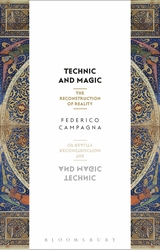
 Technic and Magic: The Reconstruction of Reality (Bloomsbury, 2018), Federico Campagna
Reviewed by James Edward Draney
Publisher’s website: https://www.bloomsbury.com/us/technic-and-magic-9781350044036/
The trouble with the concept of technology, as an old mentor once told me, is that ‘tends to suck everything into itself.’ Take the writings of Martin Heidegger, whose concept of technology has proved influential in a variety of fields, from philosophy to media and literary studies. For Heidegger, the mysterious Gestell, ‘the essence of technology’, had a disastrous effect on human society: it strong-armed all possible phenomena into becoming a stockpile of ‘standing reserve’ (1977: 17). Beyond technology as mere collection instruments or machines, Heidegger’s conceptual sketch was designed to cover a whole totality. Indeed, according to the German philosopher, the stakes of such totalized strong-arming were high. Truth itself—aletheia, as a mode of revealing—was supposedly in danger of being obliterated. But why name this totality and its dangers as specifically technological? When everything—from material devices, to ideas, to organizational methods—can be collected under the broad banner of ‘technology’, don’t we risk evacuating this concept of any usefulness? Does this totalizing concept of technology—referring to the kind of pervasive rationality described by Heidegger, Adorno and Horkheimer, and Jacques Ellul—still have any purchase today, in the twenty first-century?
Moreover, what happens when we try to distinguish so-called technological rationality from its opposite? It should go without saying that the concept of technology can never exist in isolation; the very act of naming it requires one to distinguish it from that enigmatic something else to which it is opposed, be it the ever-problematic and highly ideological categories of the ‘natural’ or the ‘organic’. Such is one of the toxic features of the concept of technology: far from confronting us with something new, it forces us to think in pre-determined categories. Or, as Bernard Stiegler puts it, ‘…a certain understanding of technics dominates all the fields of discourse…that are articulated by categories—ends and means, subjects and objects, nature and culture—which only function and make sense in oppositional pairs’ (1994: 91).
In his fascinating new book, Technic and Magic: The Reconstruction of Reality (2018), Federico Campagna fleshes out a new oppositional term. For Campagna, the opposition to what he calls ‘Technic’ is not to be found in either politics or collective action, but in a strange new sphere that he calls Magic. In searching for an outside to Technic’s regime Campagna has turned away from conventional political action. His goal is not social organization, but spiritual awareness: Technic and Magic outlines a whole new ‘cosmology’ that will help shift us from our current (and altogether brutal) ‘reality-setting’ to another, more wholesome conception of the world. For Campagna, the answer to our troubles lies not in the realm of appearances but in a hidden cosmological logic that binds the technological world together.
To begin, Campagna’s idea of Technic is by no means new. It is the latest in a long line of theories of the technological society. Indeed, to a select few writers in the twentieth century, the emerging landscape of high modernity presented itself not as an immense collection of commodities but an immense collection of technologies. The new machinery of the factory elicited a whole host of theories, from Oswald Spengler’s Man and Technics (1931) and Lewis Mumford’s Technics and Civilization (1934) all the way through Heidegger’s influential writings on technology and beyond to the writings of Ellul, Herbert Marcuse, and even Hannah Arendt. It should come as no surprise that this conception of the technological society (generally associated with the older model of industrial machinery) has made a comeback in our own period of cybernetic and information technology. The recent flood of books on the topic, both popular and academic, attests to this. But Campagna’s book distinguishes itself by offering an alternative system to the one that we live with today. Rather than merely understand the world, Campagna wants to change it.
Campagna’s charm as a politically engaged writer has always been his emphasis on the need for lyrical abstraction and a certain kind of poetic thought. For instance, in his previous book The Last Night: Anti-Work, Atheism, Adventure (2013), Campagna blended autobiography with philosophy and in order to argue for a new radical-atheism based on the idea of adventure. The result was a life-affirming and positive manifesto for a co-operative, anti-work politics that echoed and drew from the anarchist tradition. Yet, in Technic and Magic, Campagna (ostensibly a writer on the left) has chosen to elevate his poetic aesthetic into an all-out embrace of the mystical. By ‘mystical’ I mean to say that Campagna has chosen to abandon any reference to concrete material phenomena. He foregoes the economic in favor of the esoteric. Technic and Magic does not locate the cause of our present crisis in anything human, social, material, or even political. The book is not so much an investigation into the material conditions of society as it is an autopsy of society’s massive superstructure (what Campagna calls the ‘reality-settings’ of a culture). Finally, it has the immodest ambition of hastening the demise of Technic’s mystical hegemony. Does it hold up to its promises? Do we want it to?
* * *
Technic and Magic is divided into two sections, split down the middle through a brief intermezzo. The book forms a mirror image of itself, where the first reality-setting described (our hegemonic episteme of Technic) is reflected in its opposite, the more wholesome cosmology that Campagna calls Magic. It is important to underscore that Technic does not describe technology—the objects and devices that make up the infrastructure of world—as an isolated concept per se, but, following Heidegger, names a sort of totality. Technic is, as Campagna sees it, the logic of our current system. This technical totality manifests itself in the degradations of lived experience in the advanced capitalist countries. The accumulation of such degradations (such as the rise of homo economicus, the objectification of subjectivity, the triumph of the quantitative over the qualitative, and so on) has resulted in a ‘crisis of imagination’. But for Campagna this is something like a spiritual crisis, one whose solution cannot be found with a mere political fix (both socialism and capitalism are beholden to the logic of Technic, according to Campagna) but requires a more subtle, interior shift within the subjects and citizens of Technic’s world.
Both Technic and Magic find their origins in what Campagna calls a ‘cosmogony’. Technic’s interior structure consists of five different but interrelated hypostases, which Campagna lists as 1) absolute language, 2) measure, 3) unit, 4) abstract general entity, and 5) life as vulnerability. We can quickly summarize the content of these hypostases by saying that they add up to the utter knowability and graspability of the world, the conversion of all natural resources into what Heidegger famously called ‘standing reserve’ (the stockpiling of energy for mass appropriation). Thus, ‘absolute language’ comes to stand in for irrefutable fact and rationalization; ‘measure’ represents the dominance of calculation; ‘unit’ and ‘abstract general entity’ refer to discretization, atomization, and universal equivalence through money; and ‘life as vulnerability’ as the urge to overcome biological finitude. It is important to underscore that Campagna sees this ‘set of fundamental axioms’ as only ‘superficially social/economic/etc.’ (2018: 5). Technic’s dehumanizing cosmogony structures our historical age, to be sure, but not from any recognizably human perspective. This is not a question of men making their own history. Rather, Technic is a non-human concept, something imposed on us. In a world where ‘Technic is God’ (2018: 64), Campagna urges us to leave the noisy sphere of politics and enter the hidden abode of theology.
Theology is not just a critical apparatus for understanding the world, but it also happens to be the answer to our technical difficulties. Magic, as we’ve noted, is the alternative reality-system that Campagna poses to the supposed hegemony of Technic. Campagna wants us to understand Magic, first and foremost, as a shadow world. Drawing on the tradition of what he calls ‘true magic’—a blend of theosophy and Islamic theology spanning from antiquity to the Renaissance—Campagna distinguishes this mode from a more vulgar conception of Magic as a dark art. But the most important aspect of Magic is that it should be ‘considered a form of therapy to Technic’s brutal regime’ (2018: 115).
What is Magic, you ask? In a word: the ineffable, or what we may want to translate as whatever has yet-to-be-reified or instrumentalized in human experience. ‘Magic’s cosmogonic process originates precisely from that dimension of existence which can never be reduced to any linguistic classification,’ writes Campagna (118). It is here that we find an ‘outside’ to Technic’s totality, precisely in that incalculable area of experience, the unformed aspects of our species-being, that place humans in a unique relationship with the world. I take Campagna to mean something like what Heidegger, in his later thought, called humanity’s ‘openness to the mystery’ (1966: 55). Magic and its hypostases (which Campagna lists as the ineffable as life; person; symbol; meaning; and paradox) can be thought of as that enigmatic thing called ‘poetry’, a different mode of dwelling in the world, that Heidegger famously opposed to technology.[1]
There is obviously a crisis of widespread unhappiness in the advanced capitalist countries, a crisis that Campagna registers as a negative and unproductive form of opposition to Technic. Depression and anhedonia, forms of ‘stoic suicide’ (88), should be channeled into a more positive form of resistance in the form of Magic, the cultivation of the ineffable, which cannot be captured by Technic’s all-consuming apparatuses. Here I take Campagna to mean something like what Michel Foucault described as counter-conduct (2007: 201). The two are similar in that they are not forms of organized revolt, dissidence, or resistance in any recognizable sense, but more individual acts of inner disobedience, which, when accumulated and undertaken by a large population, can add up to a significant amount of power.
Campagna draws on a fascinating and wide-ranging variety of sources in order to outline the structure of Magic’s cosmology. But, as a reader without any knowledge or familiarity with ancient Islamic thought, I should note that I am unable to accurately assess the quality of Campagna’s scholarship in this section of the book.[2] However, I feel confident enough in questioning the usefulness of his turn away from the economic and social. In the end, Magic turns out to be a form of quietism (another urge that Campagna seems to share with Heidegger). It is specifically not a ‘superficial revolution at the level of the immediate political system’ (2018: 192). Its answer to our current crisis seems to be, more or less, to avoid it. While I have much sympathy for Campagna’s description of our current world order, there is little to love in his answers to the questions he raises. In an age in which our most serious crisis is not spiritual but environmental, Campagna’s form of magical thinking falls short of its world-changing objectives.
References
Campagna, F. (2013) The Last Night: Anti-Work, Atheism, Adventure. London: Zero Books.
Foucault, M. (2007) Security, Territory, Population: Lectures at the College de France, 1977-1978. Trans. Graham Burchell. New York: Picador Books.
Heidegger, M. (1966) Discourse on Thinking (A Translation of Gelassenheit). Trans. John M. Anderson and E. Hans Freund. New York: Harper Torchbooks.
Heidegger, M. (1977) The Question Concerning Technology and Other Essays. Trans. William Lovitt. New York: Garland Publishing.
Stiegler, B. (1994) Technics and Time, 1: The Fault of Epimetheus. Trans. Richard Beardsworth and George Collins. Stanford: Stanford University Press.
Ventura, A. (2018) ‘Technica e Magia nell’opera di Federico Campagna’ in L’Intelletuale Dissidente: https://www.lintellettualedissidente.it/filosofia/tecnica-magia-federico-campagna/
[1] ‘To paraphrase Heidegger, if we can understand Technic as the essence of technology, so we can understand Magic as the essence of poetry’ (2018: 152).
[2] For an in-depth review of the book that assess the merits of Campagna’s use of Islamic thought see Ventura, A. (2018) ‘Technica e Magia nell’opera di Federico Campagna’ in L’Intelletuale Dissidente: https://www.lintellettualedissidente.it/filosofia/tecnica-magia-federico-campagna/
 James Edward Draney is a PhD student in English at Duke University. His essays and reviews have been featured in Los Angeles Review of Books, Public Books, Review31, Apollo Magazine and 3:AM Magazine. He usually writes about contemporary literature and digital culture.
Email: james.draney@duke.edu
Leave a Reply