

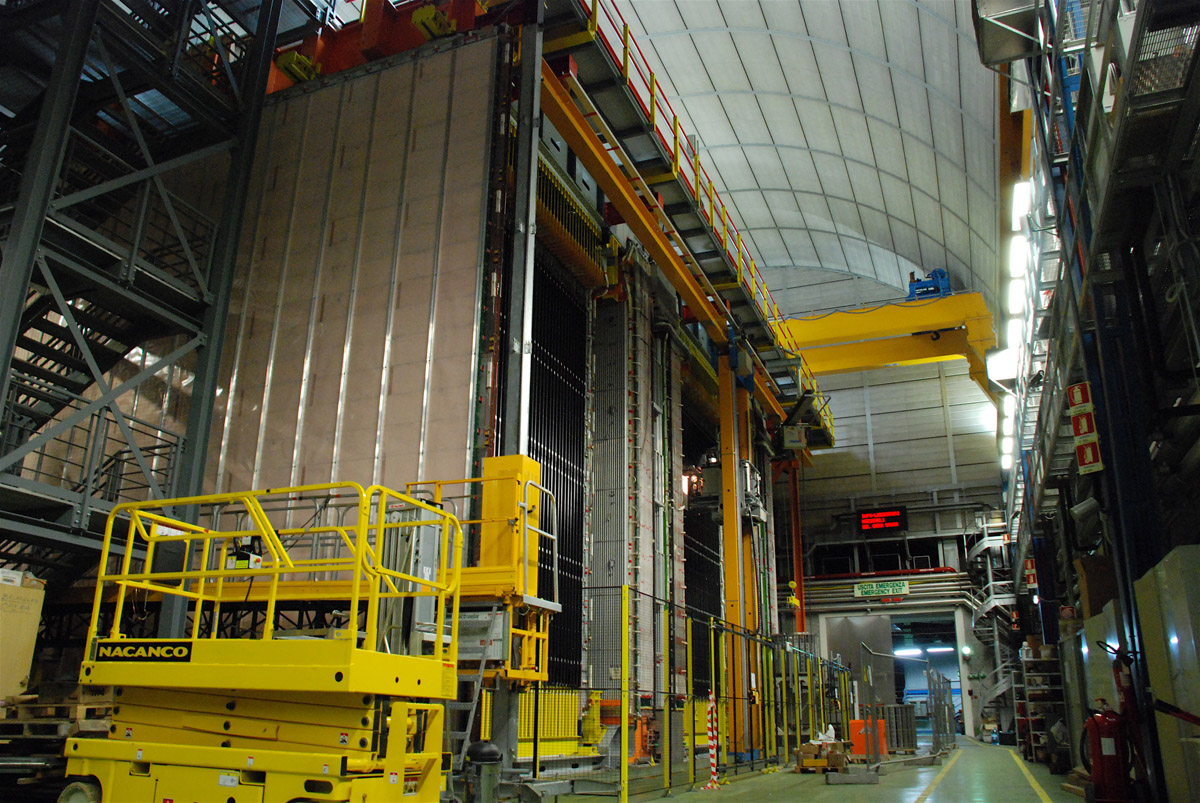
From our forthcoming special issue, Geospatial Memory (Media Theory 2/1), Jamie Allen considers the distinction between “pure” and “applied” science, focusing on geology and astronomy as equivalent practices of extraction.
The Overgrounds and Undergrounds of Pure and Applied Science: Cosmic Collisions and Industrial Collusion
JAMIE ALLEN
Critical Media Lab, Basel, Switzerland
& Institute of Departments and Organisations, NSCAD, Canada
Abstract
Archeology and geology are presumed to be “pure” knowledge practices, curiosity-driven investigations of the material histories of humankind and the Earth. Underwritten by Enlightenment techniques and tropes like clarity, organisation, cleanliness and illumination, there is in all the sciences a similar drive and imaginary toward a valuation of purity, against application, in all the sciences. These practices of observation, sampling, inscribing, analyzing and publishing are, of course, much more untidy than we sometimes imagine. What other sciences might be possible, were we more sensitive to the complicity of specific material practices as collusive affairs, amalgams of the pure and the applied, the clean and the messy, the ecological and the infrastructural, of light and shadow, of overground and underground?
Keywords
Applied, infrastructure, knowledge, science, pure.
Introduction: The Cause of Some Recent Changes
The Earth’s procession sways with us. It moves by way of a chant. It steps in the way of the base, in the way of the dancing tao. It bows to the sisters of the good foot, carrying flowers from Caliban’s tenderless gardens. The Earth is on the move. You can’t join from the outside. You come up from under, and you fall back into its surf.
This is the base without foundation, its dusty, watery disorchestration on the march, bent, on the run. Down where it’s greeny, where it’s salty, the Earth moves against the world under the undercover of blackness, its postcognitive, incognitive worker’s inquest and last played radio (Harney and Moten, 2017).
Here thoughtless men, seized with the newness of such objects, become thoughtful, and willingly contemplate the incessant changes of this Earth’s surface. They see, as in one instant, the revolutions of past ages, the fleeting forms of things, and the decay even of this our globe; whose youth and first formation they consider, whilst the apparent spoil and irreparable breaches of the wasted mountain show them the world itself only as a noble ruin, and make them think of its approaching period (Shaftesbury, 1709, in Klein, 1999).
We begin, as ever, impelled by the soft suggestions of the Earth. By tectonic whispers, from below.
Mildred is a discontented art student, someone who feels that both she and her community of fellow artists in the painting department have lost their way: “I’m sick of wasting time. We start work at ten and tire after half an hour…we aren’t enjoying ourselves but what else can we do? I’m tired of it. I want to do something vigorous and constructive.” She is a student at a modern art school, probably in Glasgow, a city supposed as a seedbed of inspired, creative industry. And yet, poor Mildred finds herself confiding in a classmate her frustration at the tedium of institutional studio art studies. Her confidant gives immediate advice, as improbable as it is practical:
“Dig a tunnel,” he recommends, earnestly.
It is counsel from the pages of a short story, “The Cause of Some Recent Changes,” by the Scottish pedestrian, independence activist, Glasgow Art School alumni and writer, Alasdair Gray (1997). It comes as some surprise that Mildred and her cohort wind up passionately taking up this advice, as given. She and her classmates set immediately, continuously and vigorously to the work of boring a hole in the sub-basement of the institution.
They return, throughout the ensuing semester, to their advisor to show off milestones of their earthward labour. At first, we visit upon a large hole, then we witness involvement by students from industrial design and more technical departments, a manhole cover, an organising committee, an elevator shaft. The project proves a huge success at motivating even the most jaded students. The tunnel reaches staggering depths just as interdisciplinary, communal spirits at the institution reach new heights.
The vertical shaft, eventually and unexpectedly, opens out into a pre-existing hollowed out cavity deep in the Earth – a vast infrastructure, an architected technopolis which no one expected to find. White lab-coated engineers whizz by on bicycles, ignoring their new visitors-from-above (“It’s like all big organizations. The staff are so numerous that you can go where you like if you look confident enough”, Mildred explains). Attentions are drawn to a buzzing, whirring, central mechanical engine that seems to be driving the whole affair. Standing on a mezzanine that overlooks the elaborate subterranean clockwork, Mildred says: “The industrial design boys are quite certain it’s a steam engine of the most primitive sort imaginable.” The steam engine, we find out, is responsible for Earth’s gravity and other supposed constant cosmological effects. The more zealous amongst the student group convince themselves that they are able to re-engineer the contraption, that they understand it, and can make it run “better”…Mildred is unable to heed the cautions of the project’s initiator, her trusted advisor, who describes what happens next:
That night I was wakened by an explosion and my bed falling heavily to the ceiling. The sun, which had just set, came up again. The city was inundated by the sea, and we survivors crouched a long time amongst ruins threatened by earthquakes, avalanches and whirlwinds… It is clear that the planet has broken into several bits. Our bit is not revolving (Gray, 1997).

Alasdair Gray’s story calls to mind a recurrent, imagined fantasy of engines, mechanisms, laboratories, factories, metropolises and architectures, energies and agencies, kept secret and deep in the Earth, that somehow power, articulate or control cosmic and telluric processes. As Rosalind Williams points to in both of her wonderful books, The Triumph of Human Empire: Verne, Morris, and Stevenson at the End of the World (2013), and Notes on the Underground (2008), the development of enlightened, technoscientific and industrial lives and futures has always been driven and paralleled by geological and archaeological realities and imaginaries. Industries of extraction, and in-earth resources – mined, pumped or dredged from the deep – are arche- and fossil- fuels which feed the many engines of modernity: labour, industrial technics and technologies, scientific “progress” and acceleration.

Arthur Conan Doyle’s “When the World Screamed” is the story of Professor Challenger, a “wild genius of a violent and intolerant disposition” (Doyle, 1928) and his colleagues, whose perfunctory ambition it is to make man’s first direct contact with the “world upon which we live…[the] living organism, endowed…with a circulation, a respiration, and a nervous system of its own.” Mother Earth is “quite unaware of this fungus growth of vegetation and evolution of tiny animalcules which has collected upon it during its travels round the sun as barnacles gather upon the ancient vessel,” and it is this condition that Challenger seeks to undo; he wants her maternal recognition (Doyle, 1928). The story follows Challenger’s commissioning of two other men, Peerless Jones and one Edward Malone, who help with the drilling of ever deeper shafts into the Earth, culminating in a “vigorous stimulation” of the planet’s “sensory cortex,” at great depths beneath the mantle (Doyle, 1928). Challenger describes, just before a public exposition and experimental performance of this operation, that an “exposed and sensitive substance will be pricked, and how it will react is a matter for conjecture” (Doyle, 1928).
The result of a direct electrical impulse applied to the Earth’s sensory cortex is a violent discharge of petroleum-like fluids and a rapid healing of the drilled wound, a fleshy organic life form. Challenger’s experiment justifies a kind of sexual assault on the Earth, proof that the Earth is a living organism, and the mantle its living tissue (Parikka in Hörl & Burton, 2017). An audience of researchers and lay-people, press and industry representatives, all hail “Challenger the super scientist, Challenger the arch-pioneer, Challenger the first man of all men whom Mother Earth had been compelled to recognise” (Doyle, 1928). Doyle’s Professor Challenger, like Jules Verne’s Professor Lidenbrock of “Journey to the Center of the Earth” (1864, 1992) creates the imaginary of a type of earthly recognition that would seem to evolve toward the R&D labs of both the Eldorado Mining and Refining Limited and Elon Musk’s “Boring Company,” dedicated to eradicating “soul destroying traffic” and fixing “congestion in any city, no matter how large it grew (just keep adding levels)” (Boring Company website). Gray’s, Doyle’s and Verne’s fictional protagonists always lead to the brink of a kind of destructive, lusty knowledge-madness, as actual extractive science and industries likewise constantly shock in their overreaching attempts to understand Earth as an archeological object, ripe for interpretation, and hence interventionist probing and violation. These mobilised, fictional, hubristic archeologists of recognition and progress are reflections of and precursors to our real, engineered desire (machines), which, more and more hurriedly, have sought to tame the secrets of nature and capture ever deeper corners of the globe. Isabelle Stengers’ comments on the fast science of chemistry hold equally well for the applied, colonial sciences of geology and astronomy, through to today’s physics and applied mathematics (computation):
[T]he sciences that became synonymous of progress in the nineteenth century – and which were what I would call “fast sciences” already then – are extractive sciences. Chemists, for instance, used to be artisans, craftsmen…But the extractive, purified objects of chemistry – which nineteenth century industry produced, and which could enter into protocols which everybody could follow – produced a fast science that had nothing to say any longer to the old craftsmen. It was contemporary with big industry, not small industry. And I would say that this isolation, this new kind of environment for the now academic chemists, is as important as epistemology! (Latour, Stengers and Tsing, 2018)
Can we make clear, or simple, separations between actuality and fiction, in tracing the causes of more recent changes? Rationalism, realism, demythologization, the scientific method, objectivity – a whole battery of terms – attempt to describe stances and positions that might occupy a space outside superstition and history, narrative, tradition, myth. Knowledge practices, nonetheless, remain forever linked to genealogical and archaeological myth and fiction. Science and enchantment mix and co-mingle, an amalgam that can be opportunistically re-deployed, containerised or re-pre-packaged in the service of sanctioning the ways in which industrial free enterprise puts the squeeze on the Earth, its beings and its resources. The magic of “capitalist sorcery” gives way to exchange-based environmental management, which is full of metaphors, beliefs and spirits that we think we have destroyed, but discover we have just lost all appropriate means of responding to (Pignarre and Stengers, 2011). Deep mythologies of application and extraction sanction the contradictory, and supposed inexorable, belief that a finite planet could somehow be the basis for infinitely increasing value:
The mobilised scientist stridently defends the position of science as the “goose that lays the golden eggs” and his fearless certainties (outside the laboratory, at least) result in what Alfred North Whitehead, an early critic of the twentieth-century professionalisation and specialisation of knowledge, would call “dogmatic denial”: an enormous difficulty in dealing with what is external to science except in the derealising terms of “beliefs,” “mere opinion” or “illusions” (Pignarre and Stengers, 2011).
Meanwhile, in Chile for example, Indigenous practices and archaic, sacred uses of metals are twisted by companies like Codelco (the largest refined-copper producer in the world, nationalised in a country where one-third of the Gross Domestic Product is copper-derived) into a justificatory national(ist) patrimony, or a kind of extractivist birthright. “Chileans have always mined copper, it is what makes the country strong, and its people pure” – this is the implicit message of Codelco-sponsored exhibitions and tours, featuring archeological goodies like copper facemasks and amulets found during excavation:
Copper has been one of the pillars of our economic and cultural development since before we were a nation. The Indigenous cultures that lived in the Andean region, such as the Incas and Tiahuanacos, Aymaras and Atacameños (Chuquicamata derives from Chukos people), incorporated the red metal to make tools, utensils, and even alloys with other metals which they used as a means of exchange with other neighbouring peoples, and in their various ornamental and artistic expressions, creating part of the symbolic and material universe of these cultures (Codelco website, 2017).
In Canada, also for example, Aboriginal peoples’ relations to land and territory is likewise aberrantly refashioned into rationales that produce an opportunistic remodelling of deep and sacred relations and genealogies of belief. Indigenous peoples’ relationships to flora and fauna, so the exploitative retelling goes, have always been overtly managerial (Notzke, 1994); extractive relationships have existed between all peoples and their lands throughout time. The land, so the story goes, has forever been a natural source of power and riches for Canadians, native or settler, and we can simply “obey the laws of nature so as to make nature obey” (Pignarre and Stengers, 2011). Contemporary industries of hydro-electric energy generation, fossil fuel and mineral extraction preserve and perpetuate traditions of extractivism – is what is suggested by such expedient retellings. Thomas King, the Cherokee, German, and Greek novelist, points to a well-known historical event — the Boston Tea Party — as historical precedent for the repurposing of aboriginal ideals and aesthetics in the service of colonial exchange and economics: “Whites, disgusted by the tax that the crown had placed on tea and determined to show their displeasure by dressing up like Indians and dumping the tea into the bay” (King, 2003). The recasting of ancient and artisanal uses, cohabitation and care for localised material resources through the lens of modern managerialism and value production is as perverse as it is inaccurate as a legitimisation of contemporary industrial expansion.
Revisionist and less-progressivist European and Western colonial-scientific knowledge practices benefit from recognition of the linked tensions between what is real and what is imagined in them, what hauntings and mythologies prevail and authorise, and what other science(s) might be possible. There is no shortage of menacing stories of unforgiving, natural gods that use the Earth and its beasts against us, rendering the Earth as a resistant and puzzling object, or even an enemy, at least a problem to be solved. “As subjects, we face a universe of objects, of problems, which are somehow hurled against us” (Flusser, 1986). Against these elements, we find ourselves in a curious position – residents of a mysterious home we come from, out of, but having already exited it in order to presume it knowable, colonisable, and controllable (often in that order). A more modern and popular terminology for the spectrum of observational, reflective and activated knowledge practices — “pure” and “applied” sciences — drives ambiguous ambitions and conjoined pursuits and conceptions in archaeology, geology, mining, infrastructure in downward, inward directions. A taut and substantial tension exists between infrastructures of knowledge, industrial infrastructures, and the extraction of material, as well as the likewise ambiguous pursuits of much more “modern” sciences that hasten in the opposite orientation — upward, outward, onward.
Pure Masters, Applied Slaves
From this point of view, science – the real game in town – is rhetoric, a series of efforts to persuade relevant social actors that one’s manufactured knowledge is a route to a desired form of very objective power (Haraway, 1988).
“Science” remains the sign under which we imagine pursuits of knowledge per se, somehow different from and tainted by knowledge for practical use. The intermixed, confused and parallel values that saturate these two orientations, or directions, of Western science are trans-historic; they pervade eras, thoughts and actions with claims of either uselessness or usefulness. “Pure” and “Applied,” imagined as the poles of a globe where ideal ideas and practical utilities reside, are in fact amalgams of techniques and opinion that permit and motivate the knowledge work of thinking, notating, writing and speaking (“theory”) just as much as sampling, arranging, instrumenting, analysing and re-presenting (“practice”) and building, making and bricolage. Yet the binary rubric of high-minded purity versus dirty, vulgar practice that has installed itself in our Western thinking seems to know no bounds. Other, related imagined polarities that we moderns hold dear include, “high” and “low” culture, the “poetic” and the “pragmatic,” “art” and “design,” “idealisation” and “implementation,” “politics” and “policy.” As Keller Easterling points out through the work of Gregory Bateson in her essay “Histories of Things That Don’t Happen and Shouldn’t Always Work,” these “binary” stances are entirely too common categorical errors: “People even set up binary oppositions over things that are ‘not dual in nature—youth versus age, labor versus capital, mind versus matter’” (Bateson cited in Easterling, 2016). There are always thin and permeable threads that join imagined bifurcations, as differentiation supposes relation. Even as the disciplines reiterate pure thought and pure idea as dissociated from applied action and implemented function, where different interrelations between art and technology are obsessively re-performed, and endless attempts are made to break open, recombine and pervert supposed, nonexistent boundaries between practice and theory. These are the contradictory, idealised pursuits of thinking about thinking, which is, of course, doing something. That is, “thinking is a practice” (Rancière & Sloterdijk, 2008).
The dissociations between practice and theory are imbued with a level of moral culpability as they relate to (de)couplings between work and management, and the plight of slaves controlled by masters. That we owe ourselves and our thinking in these ways to a history of subjugation, control and command, is evidenced by denotations in contemporary telecommunications systems, in which “receivers” of clock synchronisations and “peripheral” systems are “slaved to the master.” The archeology of this communicational messenger-slave relation has been analysed by Markus Krajewski (2013) in his essay “The Power of Small Gestures: On the Cultural Technique of Service” and as the “fusion of bodily techniques and technical media.” Its echo is also felt in the name we give to computers or computer programs that manage accesses in a communications network: “server.” The work of communications transfer and storage is done through diminished and dejected labouring subjects, but also of hardworking, exothermic objects. Replaceable relations, in a race to the bottom, resulting in the concomitant erosion of moral-material and ethical-ecological responsibilities. Slavery is both a technique and a technology. Technology, in a way, is an enslavement of the physical properties of matter. Matter is one of the “some/thing[s] logistics is always after” (Krajewski, 2013). When our “hardware devices are imported as needed… programs are now service providers on loan; they are treated like guest workers or leased labourers” (Zielinski, 2013).
Our “debt that cannot be repaid, the debt at a distance, the debt without creditor, the black debt, the queer debt, the criminal debt” (Harney and Moten, 2013) to the slave produces never-efficient-enough machines of desire, material and information extraction, and capital accumulation without limit. The indentured technological-bondship of millions of server computers all over the world invokes the co-subjugation of human and electronic labour. Human counterparts, contracted to companies like TaskUs (www.taskus.com), are custodians to content, servers, networks and psyches, providing for and staving off Internet users’ more depraved tendencies (see Wired Magazine’s article “The laborers who keep dick pics and beheadings out of your Facebook feed,” Chen, 2014). Earnings analyses for server-based labour for Amazon’s Mechanical Turk crowd-labour service show that human workers earn slavishly low median hourly wages well below minimum wage in the U.S., in the region of $2 USD (Hara, et. al 2018).
Said another way, as Pierre-Maxime Schuhl did in 1947 (echoing Gilbert Simondon and translated through Henning Schmidgen), historic developments of certain proliferative technologies can be seen to have been slowed or stalled due to the reprehensible, forced-abundance of living human labour:
If one did not make recourse to machines on a large scale, it was because there was no need to reduce manual labor, given the fact that one had (inexpensive and numerous) living machines ready at hand who were as distanced from the free man as animals, i.e., slaves (Schuhl in Schmidgen, 2012).
Tim Ingold retells the Platonic dialogue between Socrates and Alcibiades, in which a discussion of shoemaking and their shoemakers serves to convince Alcibiades of the existence of the human soul. Socrates argues to convince Alcibiades that the shoe-maker is a divided being, a deferential and perhaps slightly tortured body and an unencumbered, soulful “mind.” The soul’s separateness from menial practice grounds a Socratic ethics that justifies the slavery of Classical Greece:
In one of his dialogues, Plato has Socrates debate with a character called Alcibiades on precisely this question. “What are we to say of the shoemaker?,” asks Socrates, “Does he cut with his tools only, or with his hands as well?” Alcibiades is forced to concede that he does indeed cut with his hands, and moreover that he uses not just his hands but his eyes – and by extension his whole body to accomplish the work. Yet he had already agreed, with Socrates, that there is a fundamental difference between the user and the things he uses. So who is this user? If it be man, counters Socrates, it cannot be his body, which is used. Only one possibility remains, it must be the soul. “So”, he concludes, “do you require some yet clearer proof that the soul is man?” Alcibiades is convinced.
There is no reason, however, why we should have to follow suit. “It would be wrong to assume,” as Roger Coleman caustically remarks, “that because Plato was a Greek he knew what he was talking about.” He was no craftsman, and had no practical experience whatever of shoemaking or any other trade. Plato’s objective, in forcing a division between the controlling mind and subservient body, was to establish the supremacy of abstract, contemplative reason over menial work, or of theoretical knowledge over practical application, and thereby to justify the institution of slavery” (Ingold, 2000).
For Leo Marx, culture and technology stand in for a “stock distinction between the useful and the fine arts [which] had served to ratify an analogous – often invidious –lineup of distinction between things and ideas, the physical and the mental, the mundane and the ideal, body and soul, making and thinking, the work of slaves and of free people” (Marx, 2010). There are ambiguous and multiple meanings we can read into terms like “anthropotechnics,” some of which call attention to the technosphere (Haff, 2013), and some of which call attention to the ways in which people are employed as technics (Wiener, 1967).
The middle-aged, internet-addicted, obsessive emailer and insomniac from Chris Petit’s film, Content, links the industrial subconscious of contemporary life with indentured labour and incarceration:
All those secret torture zones, or rooms – where the U.S. has been rendering its non-people prisons, are not so different from all the servers in the world – those underground sites where your email is rooted, sustained. Lines and lines of shiny servers…like prison corridors (Petit, 2010).
“Pure” and “Applied” Science mark a difference that somewhat softens this scenography and history of master-slave roles, but it is still a nomenclature that signals various levels of opportunity, acquisition, subjugation and control. The pure and the applied, somewhat insidiously, distribute and evaluate standing reserves of information, value, labour and resources across human/mental and material/ecological scopes and scapes. The Applied Sciences at once evoke strategic and systematic studies that fulfil particular purposes or operations, but also seem to suggest a sort of coating, an application or appliqué that lathers all the stuff of the world with the goopy, synthetic ooze of science. Like the image of the Sherwin-Williams Company logo, or the actuality of Monsanto’s, Ciba’s and Montrose’s swathing of whole continents with dichlorodiphenyltrichloroethane…we apply science all over the place.


Blossoming between the wars and through the Cold War era as practice-based research that conceptually elevates craft and technique to the status of ways of knowing, Applied Science all the while provided the precursory and perfunctory framing for need- and application-driven research that resulted in things like Agent Orange, and the sticky, flammable anti-personnel liquid innovation “Napalm B,” both products of the Dow Chemical Company. Lab scientists, field scientists, engineers (Applied Scientists) enact age old divisions between the known and the known-for – between the abstract poetry of cosmological understanding, and those things that are still seen by some as the opportunistic or violently crass labours of pragmatic productivity.

It is first through a set of concepts introduced in Samuel Taylor Coleridge’s 1817 “General Introduction to the Encyclopædia Metropolitana; Or, a Preliminary Treatise on Method” (Coleridge, 1849) that we find explicit mention of the term “Applied Science” in English (Bud, 2012). Later, the phrase appears in the “Encyclopaedia Metropolitana; or, Universal dictionary of knowledge…comprising the twofold advantage of a philosophical and an alphabetical arrangement,” edited by other authors but begun by Coleridge’s prospectus and based on Kantian categories which wholly separated practiced knowledges in the natural world from impractical understandings of that same world. Resonances continue between German idealist categories like angewandte Wissenschaft (Applied Science or Knowledge) and the English idea of a “practical science” introduced into science classrooms at the beginning of the 19th century (Gee and Clackson, 1992). A similar French concept of “arts appliqués” is differentiated from a more industrial conception, “arts et metiers” by none other than René Descartes. This latter term was all but invented by Descartes to bridge a gap he understood to have been opened up too wide by Aristotle between episteme and tekhne in knowledge practices.
The main orientation of the American 20th century seems to be its leanings toward pragmatist technical study and research, birthed into the U.S. educational establishment largely through the efforts of a 35-year-old educational reformer and American exceptionalist named Charles William Eliot (1834-1926). Eliot expressed what reads now as somewhat contradictory views in his inaugural address as president of Harvard College. He spoke in the same speech of a “truth and right [that] are above utility in all realms of thought and action,” but at the same of his desire to “have science taught in a rational way, objects and instruments in hand – not from books merely, not through the memory chiefly, but by the seeing eye and the informing fingers” (Eliot, 1869a). Eliot’s vision for “The New Education” (also the title of an essay he wrote, published in Atlantic Monthly) would transform teaching throughout the U.S. and set the stage for the ways in which the presence of practicality, practicability, economy, industry and corporate liaison are still negotiated in U.S. Universities, especially in the natural and physical sciences. “We are fighting a wilderness, physical and moral,” said Eliot (1869b) the youngest president in Harvard’s history. From the highest pulpit of America’s oldest university, Eliot boomed forth his plans for orienting not just one American school, but the project of new American universities and education, designed to combat natural enemies and for global dominance. “For this fight we must be trained and armed” (Eliot, 1869b).
Nexuses of power-knowledge have been pointed out and picked apart, (un)productively de-constructed by lots of people; Denis Diderot and Jean le Rond d’Alembert, Michel Foucault (“Knowledge is not for knowing: knowledge is for cutting,” Foucault, 1984), Paul Feyerabend (“The idea that truth is concealed and even perverted by the processes that are meant to establish it makes excellent sense,” Feyerabend, 1993), and Donna Haraway (see, for example, the citation at the start of this essay). Applied Science, for humanities, philosophy of technology and critical studies of science has become a kind of requisite evil villain – the engineer, since Robert Oppenheimer perhaps, ever the figure of the unreflective, amoral technical-zombie, carrying a pickaxe in one hand, and an atom bomb in the other. We must attend to practices, say such critiques, as the humanities have become disenfranchised from their origins in cultural techniques of human expression, including, sometimes, language itself. We raise a radical challenge wherever and whenever an unambiguous motivational or moral certainty is asserted, and in so doing hobble the hubristic presumptions of modern men.
Applied Science disrupts the lofty presumptions and disengaged politics of un-applied knowledge labours in multiple ways, first and foremost by pointing at the fact that there is, after all, no theoretical world. We all wind up complicit, as there are no “pure” knowledges, only techniques, only knowledge practices. Pure Sciences, as the Humanities are sometimes conceived, are always much dirtier than their naming implies, in part as they rely, increasingly, on engineered technologies and instrumentations, scripting and scratching implements, media devices and substrates of representation – each with an industrial genealogy and origin in material resources, complicit with divisions of class and labour that these have always precipitated. Permitting and arming forces of planetary scale engineering and the basest interests of the economy and everyday people, the purest of sciences come down to purpose as engines of progress and productivity, and are given near exclusive purchase on hopes for innovation, change and economic salvation. The specialisations of Applied Science and Engineering re-expose the true colours and colourful subsidies of supposed-pure sciences like Chemistry, Geology and Biology – knowledge practices and “fast sciences” as Isabelle Stengers puts it – that regularly reconfigure planetary systems and life, so far mostly in the service of petrochemistry, pharmaceuticals, extraction and agriculture, amongst other anthropogenic pursuits.

Plumbed Depths
All science is either physics or stamp collecting (Sir Ernest Rutherford in Birks, 1963).
I owe the best of myself to geology, but everything it has taught me tends to turn me away from dead things (Pierre Teilhard de Chardin, 1969).
Rosalind Williams writes of a great “eruption from below” that “paleotechnic industries” unleashed in the pre-Industrial Revolution 18th century (Williams, 1990). Ambiguously dark, subconscious, hellish-yet-necessary and productive impressions of industry and labour are, for Williams, birthed with underground industries of extraction, along with modern Geology. Williams writes of the rise and preeminence of The Freiburg Academy as a center for the Applied Science of Mining derived predominantly from the teachings and research of Abraham Gottlob Werner (1750-1817). The Werners were an old industrial mining and metallurgy family from Silesia, a background which gave Abraham some authority as a “Neptunist,” promoting a theory that the features of the crust of the Earth arose out of a receding, vast ocean. This and the other more popular, opposing theory (that would wind up more in line with today’s earth science), Vulcanism, which pre-supposed that the cooling of magma resulted in rock masses and large-scale land formations, were amongst the first European hypotheses of earth formation. The Neptunism/Vulcanist debate was a popular one, and the more organised, proof-enabling and ambitious popular speculation it fomented, constituted a genesis of modern Geology. In Abraham Werner’s day, opinions and positions, either Neptunist or Plutonist, were socio-scientific litmus tests, indicating and determining the “kind of person” you were, which “side” of contemporaneity you were on. Discussing the history of the Earth was not merely a matter of scientific veracity, but a learned skill and concern, closely connected to one’s all-embracing Weltanschauung, or worldview. Geology was at the time a scientific politics (or a political science of a different sort) comparable to the creationist/evolutionist debates in North America, or conflicts over climate change. Understanding the evolution of the Earth’s origins, features, and changes partially interpolates our political worldview, personal ethics and the quality of our relations, human and otherwise.

It is a longstanding public secret, and a fairly benign joke, that Geology is not a “real” science (for an odd yet interesting personal reflection on this issue, see Larry Davis’ contribution to The Compass: Earth Science Journal of Sigma Gamma Epsilon, “Is Geology a Real Science?” Davis, 2012). The implication and questioning we bring in through the adjective “real” is, of course, intended as a diminution. It is a diminution usually backed up, if at all, via claims of methodological insubstantiality (rock collections evolving somewhat arbitrarily or through overly personal interest derived aesthetical or geographical contingencies) or the very, very longitudinal nature of geologic investigation (requiring observational experiments that last longer than the average human observer’s lifetime). This second factor prevents the causal cycles of experience and observation some would require of the Scientific Method, with its requirement of recursive intervention and iterative data production. Geology, first allied to a set of rich historical archives and resources from medieval mining industries, and then reborn in the Romantic age of Goethe’s rock collections, seems forever and somewhat understandably maligned. Goethe had a passion for the gathering of mineral specimens, and for Mikhail Bakhtin it was an avocation which spoke to Johann’s insightful ability to make necessary, material connections between the past and the living present:
All we have said reveals the exceedingly chronotopic nature of Goethe’s mode of visualisation and thought in all areas and spheres of his multifaceted activity. He saw everything sub specie aeternitatis [from the point of view of eternity] as his teacher Spinoza did but in time, and in the power of time. Everything – from an abstract idea to a piece of rock on the bank of a stream – bears the stamp of time, and is saturated with time, and assumes its form and meaning in time (Bakhtin in Aronowitz, 2010).
The “higher” modern sciences – physics, astrophysics, biophysics, and the like – give off an air of ratiometric aesthetics and an ascetic rationality, through appeals to mathematics, modelling and digital data. Sharp-ended instruments, vibration-isolated environments and Underwriters’ Laboratories, these are the scenes of post-industrial Pure Science, which descends into the practical matter of empirical proof and dirty workbenches only when absolutely necessary to the verification of theoretical constructs or in the translation of such constructs into practical applications. The image of modelled and data-driven science is one of clean, infrastructural purity – of telescopic arrays high atop a rainless mountain, or a robotically managed twenty-four-hour industrial clean room. These are not your grandfather’s rock collections; this is not your grandmother’s science.
There remain pundits of the geological imperative and sciences today; geoscientists like Leila Gonzales and Christopher Keane ask questions like, “Who will fill the geoscience workforce supply gap?” in the Journal of Environmental Science and Technology, arguing that their chosen discipline is central, if not indispensable, to contemporary societies “inextricably linked to the resources and natural processes that exist and occur on our planet,” for which “dependence on resources and the impact from processes is becoming increasingly apparent” (Gonzales and Keane, 2010). Their fundamental concern? We are not training enough geologists. Chemistry is more lucrative, and Physics more and more where one accrues academic status, popular accolades, larger research grants and more numerous funding sources.


If there is one thing the hubbub about “The Anthropocene” has done for Geologists, it is to re-up the centrality of the Earth Sciences. It may yet re-popularise and re-resource that science of rock collection that has for a long while found itself with lessened public, private and institutional interest. If it was Einstein who cast his long shadow over much of 20th century planetary-scale research and discovery, geologists and geoscientists are back in the news, guiding and explicating fluctuations in the price of oil, gas, precious and rare earth metals, and the sand, gravel and stone we need to “modernise” the remaining two-thirds of the planet. Geologists and geoscientists predict and explain the increasing frequency of devastating earthquakes, floods, and volcanic eruptions. With the Anthropocene, knowledge practices of the Earth return as lenses through which we view and orient human activities and knowledge. The Applied Science of Geology precipitates and projects a future that only Geology can save us from.
Ups and Downs

Astronomer (Gaspar Galaz): We manipulate the past. We are used to living behind the times. That’s how it is.
Interviewer (Patricio Guzmán): Like an archaeologist who also studies the past.
Astronomer (Gaspar Galaz): Exactly. A not-so-distant past, but it’s the same (Guzmán, 2010).
Typically the island inverted the geologists’ maxim, “The key to the past lies in the present.” Here, the key to the present lay in the future. This island was a fossil of time future (Ballard, 1964).
Just as it is for the geologist, the past is the astronomer’s main field of research, as futuristic as cosmic sciences seem to be. Disciplinary squabbles and hierarchies manifest some irony, as the principles and practices of geoscience, mining and underground engineering have eventually been pressed into service in the proving out of Einsteinian particle physics and astrophysical theory. It would be difficult to over-emphasise the role that mines, caves and tunnels, mine and mountain-moving engineering has played and will continue to play in the experimental proving out of the existence and behavior of post-Newtonian particles. A poetic kinship links the work of the geologist and the archeologist to that of the physicist and astrophysicist, as all have a common concern in extra-human temporalities and in arche-fossils, dug up and brought into the present. This link is more than figurative, however, as the use of the Earth as a filter for cosmic noise makes literal Tycho-Brahe’s incantation:
Despiciendo suspicio
Suspiciendo despicio
(“By looking up I see downward
By looking down I see upward”)
(Tycho-Brahe (1546-1601), inscription at Castle Uraniborg, Øresund, quoted in Howell, 1998)

It is through the construction and use of deep underground laboratories that today’s physicists are able to reach the low radioactive background levels required to attempt the detection and characterisation of cosmic particles. Avowing the study of the fundamental laws of physics, including those that guide proton stability and particle-antiparticle neutrino properties, “rare event physics” is seemingly the purest of sciences. Yet, it is only by going deep into the dirt that particle physicists can probe the interiority of the Sun, or model and experiment with the nature of dark matter.
These reconstructions of past states of matter and the universe allowed for by underground industries also enable the archeological promise of reassembling microcosms of human history. Ancient mining practices are a large area of archaeological study for this reason, as underground caverns, sealed or caved-in, present conditions that preserve the activities and implements of ancient peoples. Consequential archeological finds also regularly result from the field investigations, imaging and extraction operations of mineral and petroleum engineers and workers. One such find was of second century gold coins, linked to the great mines of the Roman Empire at Riotinto, a river tinted red from five thousand years of mining. Riotinto is an area that often pits archeological and metallurgical interests against one another, and it has been rendered largely impossible to study by present-day archeologists due to continued large-scale open-cast mining in the area (“Rio Tinto Group” is also now the name of an Australian-British multinational, one of the world’s largest metals and mining corporations).
The cleansing effect that reconstructive, “pure” knowledge pursuits like astrophysics and archeology have in sanctioning further and future extraction is easily seen in the ways that industries reframe what are, for them, production delays, or what we might call cultural-resource curses. Rio Tinto mining company Atalaya’s Second Quarter 2017 Operations Update declares their applied pursuits, purified through archeology-as-CSR: “As part of the Company’s Corporate Social Responsibility (CSR) initiatives a significant archaeological programme was launched in June 2017 to study a number of archaeological sites including Cortalago, a Roman mining settlement of relevance” (Atalaya, 2017). The rewards of contemporary extractive industries are never just mineral or petrochemical, but they involve complex collusions of knowledge practices – at once geological and mineralogical, archeological and metallurgical, Applied and Pure. It is only by going deep underground that we can look into the deep history of the universe and its humans, and it is only by extracting material at those depths that conditions are created for many of these histories to be revealed.
The Deepest and Most Rewarding Holes Ever Drilled[1]
The National Institute for Nuclear Physics (NINP), which is under the supervision of the Ministry of Education, Universities and Research of Italy, operates four national laboratories. One is in the ancient Sicilian port city of Catania at the foot of Mount Etna; another in the suburban commune of Frascati within Rome’s metropolitan area; a third is in Legnaro near Padua. The fourth, the most elaborate and well-funded of the facilities of the NINP is the Laboratori Nazionali del Gran Sasso (LNGS), an extensive underground research facility extending from and next to the longest two-tube, two-lane tunnelled roadway in Europe, Traforo del Gran Sasso. LNGS is the largest underground science laboratory in the world, located a thousand meters above sea level, in the highest part of the Italian Alps. The laboratory comprises three massive, brightly lit experiment galleries, each one measuring one hundred meters in length, and about twenty meters in diameter, all sheltered beneath 1,400 meters of limestone and dolomite rock – “conditions of ‘cosmic silence’ are guaranteed by the protection of the rock” (INFI, 2018). Such conditions are needed for the minimisation of cosmic and human-made “noise,” which enhances the probability and quality of detections of cosmic particles of known and unknown kinds.

LNGS is situated within and extends disused service and access tunnels for a major highway and a freshwater aqueduct. It is where it is because, in 1984, Italy decided to bore a ten-kilometer two-lane highway tunnel carrying the A24 autostrade through the Gran Sasso Massif. The site has been publicly controversial, and opposition to the project helped to galvanise the environmental movement in Italy, somewhat. In 2002, over fifty liters of trimethylbenzene, a chemical used to increase the light emitted from water when struck by neutrino particles, was spilled and released underground, flowing into an overground stream, its gasoline-like smell noticed by locals. LNGS is a quintessential example of a scientific infrastructure that was forged through, and symbiotically benefits from, collusion with transport, mining and industry needs.

The European network of Deep Underground laboratories includes the LNGS, as well as Laboratoire Souterrain de Modane (the deepest laboratory in Europe at 4,800 meters) in France, at the midpoint of the Fréjus Road Tunnel, and Laboratorio subterráneo de Canfranc in the disused railway tunnel of Somport under Monte Tobazo, in the Spanish Pyrenees.

The Boulby Underground Laboratory in the UK is the fourth member of the European coordinating group of Deep Underground observatories, called the Integrated Large Infrastructures for Astroparticle Science, or ILIAS. Boulby’s laboratory facilities are housed in an old mine within an active and busy mining site that produces half of the United Kingdom’s agricultural potash. The mine is owned and operated by Israel Chemicals’ subsidiary Cleveland Potash Limited. The Boulby Underground Laboratory is 1,100 meters below Earth’s surface.

In the U.S., an international mega-science project, to which the UK alone has committed $88 million, will result in something called the Long-Baseline Neutrino Facility (LBNF) and something else called the Deep Underground Neutrino Experiment (DUNE). The LBNF will support DUNE activities toward new discoveries in neutrino and proton science, requiring a neutrino “gun” fired by the U.S. Department of Energy’s Fermilab near Chicago, and a receiving detector deep in the earth at the The Sanford Underground Research Facility (SURF). This second facility is housed in the repurposed Homestake Gold Mine in South Dakota, at depths reaching to 2,440 meters underground. Homestake mine was a deposit discovered in April 1876, and so was part of and precipitated the Black Hills Gold Rush in Dakota territory at the time.

Outside of Europe, and currently under expansion, the China Jinping Underground Laboratory (CJPL) is situated in the Jinping Mountains of Sichuan, China. It was placed where it is because the construction of the Jinping-II Dam hydroelectric power project required excavation of an extensive tunnel system beneath the Jinping Mountains. CJPL sits at 2,400 meters below the Earth’s surface.

The Sudbury Neutrino Observatory, or SNOLAB, in Canada, resides in the former site of the Creighton nickel mine, still owned and operated by the Vale Brazilian multinational metals and mining company. It is the deepest nickel mine in Canada and SNOLAB was for a moment the world’s deepest Deep Underground observatory, until CJPL opened in 2010. It is now the world’s second-deepest underground research facility, at 2,070 meters.

Mining for Knowledge
There is no copper or nickel mine without its correlative constitution of a field of knowledge, no astro or particle physics that does not presuppose and constitute at the same time power relations, domination and exploitation (to paraphrase Michel Foucault). These are the strange knowledge-practices, always at once pure and applied, that subtend civilization, modernity. It is a modernity in which we wind up inhabiting weirdly contradictory real and imaginary places. To look up, we must go down, into the quiet deep, away from the noise and clamour of industries we have so elaborated that they blind us to the stars. To detect the faintest of signals, we descend into the remains of extraction, extraction that also powers (tele)communicative desire machines. Government agendas and workforces move away from manual and physical labour and toward cultural, informational and research economies that are knowledge and/or data-driven, as we accelerate all knowledge-practices into “fast science” (Latour et al., 2018).
Are these dirty, concealed shafts (wissen-schafts?) ever truly repurposed and reclaimed – their votive character, cleaned up yet still haunted by industry and contamination; their histories re-written, their applied science purified? Can new economies of knowledge extraction ever cleave or entirely remove themselves from long shadows of the mineral-material, the industrial, from base desire? Perhaps, noting and witnessing these vertical oscillations, these transapplications (not transformations), should give us pause, could suggest other decelerative paths and uses. Might we ask ourselves what other knowledge practices, what new kinds of science, could be made possible in the deep alcoves of our mines, and minds?
References
Aronowitz, S. (2013) Dead Artists, Live Theories, and Other Cultural Problems, London: Routledge.
Atalaya Mining (2017) “Second Quarter 2017 Operations Update,” http://atalayamining.com/blog/secondquarter2017operationsupdate/ [Accessed 10 April. 2018].
Ballard, J. G. (1964) The Terminal Beach, New York: Berkley.
Barrack, R. (2011) “You Asked, and Rick Answers: A Revamp of the Sherwin Williams Logo”. Available at: https://www.fastcodesign.com [Accessed 10 May 2018].
Birks, J. B. (Ed.) (1963) Rutherford at Manchester, London: Heywood.
Boring Company website FAQ (2018) Available at: https://www.boringcompany.com/faq/ [Accessed 10 April. 2018].
Bud, R. (2012) “Applied Science”: A Phrase in Search of a Meaning. Isis, Vol. 103, No. 3: 537-545.
Chen, A. (2014) “The Laborers Who Keep Dick Pics and Beheadings Out of Your Facebook Feed”. Wired, October, No. 23.
Codelco Annual Report (2011) Available at: https://www.codelco.com/flipbook/memorias/memoria2011/en/history.html [Accessed 10 April. 2018].
Coleridge, S. T. (1849) General Introduction to the Encyclopædia Metropolitana; Or, a Preliminary Treatise on Method, London: JJ Griffin.
Davis, L. E. (2012) “Is Geology a Real Science?” The Compass: Earth Science Journal of Sigma Gamma Epsilon, Vol. 84, No. 3.
De Chardin, P. T. (1969) Letters to Léontine Zanta. Available at https://archive.org/details/LettersToLeontineZanta. [Accessed 10 April. 2018].
Doyle, A. C. (1928) When the World Screamed. Strand Magazine.
Easterling, K. (2016) “Histories of Things That Don’t Happen and Shouldn’t Always Work,” Social Research: An International Quarterly, Vol. 83, No. 3: 625-644.
Eliot, C. W. (1869) Addresses at the Inauguration of Charles William Eliot as President of Harvard College, Tuesday, October 19, 1869. Sever and Francis.
Eliot, C. W. (1869) “The New Education”, Atlantic Monthly, No. 23: 203-220.
Feyerabend, P. (1993) Against Method, New York: Verso.
Flusser, V. (1986) “The Photograph as Postindustrial Object: An Essay on the Ontological Standing of Photographs,” Leonard, Vol. 19, No. 4: 329-332.
Foucault, M. (1984) The Foucault Reader (Ed. Paul Rabinow) City: Pantheon.
Gee, B., & Clackson, S. G. (1992) “The Origin of Practical Work in the English School Science Curriculum,” School Science Review, Vol. 73, No. 265: 79-83.
Gonzales and Keane (2010) “Who Will Fill the Geoscience Workforce Supply Gap?” Environ. Sci. Technol, No. 44: 550-555.
Gray, A. (1997) Unlikely stories, mostly. Canongate US.
Guzmán, P. (2010) Nostalgia for the Light. Icarus Films.
Haff, P.K. (2013) “Technology as a geological phenomenon: implications for human well-being”, Geological Society, London, Special Publications, 395, pp.SP395-4.
Haraway, D. (1988) “Situated Knowledges: The Science Question in Feminism and the Privilege of Partial Perspective,” Feminist Studies, Vol. 14, No. 3: 575-599.
Harney, S. and Moten, F (2017) “Base Faith,” EFlux Journal, No. 17. Available at: http://ink.library.smu.edu.sg/lkcsb_research/5415
Howell, K. J. (1998) “The Role of Biblical Interpretation in the Cosmology of Tycho Brahe,” Studies in History and Philosophy of Science Part A, Vol. 29, No. 4: 515-537.
INFN, The National Institute for Nuclear Physics. 2018. Available at: http://home.infn.it/en/theinstitute/missionandorigins [Accessed 10 May 2018].
Ingold, T. (2000) The Perception of the Environment: Essays on Livelihood, Dwelling and Skill, London: Routledge.
King, T. (2003) The Truth About Stories. CBC Massey lectures series. Toronto: House of Anansi Press.
Klein, L. E. (Ed.). (1999) Shaftesbury: Characteristics of Men, Manners, Opinions, Times. Cambridge University Press.
Klemetti, E (2016) “Dear College Students: You Should Take Geology,” Wired.com. Available at https://www.wired.com/2016/08/dearcollegestudentstakegeology/ [Accessed 10 April. 2018].
Krajewski, M. (2013) “The Power of Small Gestures: On the Cultural Technique of Service,” Theory, Culture & Society, Vol. 30, No. 6: 94–109.
Latour, B., Stengers, I., Tsing, A., & Bubandt, N. (2018) “Anthropologists Are Talking – About Capitalism, Ecology, and Apocalypse,” Ethnos, 83(3), pp.587-606.
Martin-Nielsen, J. (2013) “‘The deepest and most rewarding hole ever drilled’: Ice cores and the Cold War in Greenland”, Annals of Science 70(1), pp. 47-70.
Marx, L. (2010) “Technology: The Emergence of a Hazardous Concept,” Technology and Culture, Vol. 51, No. 3: 561-577.
Morales, J., Beltrán, B., Carmona, J. M., Cebrián, S., García, E., Irastorza, I. G., de Solórzano, A. O. (2005) “The Canfranc Underground Laboratory. Present and Future,” In (Eds. Neil J. C. Spooner and Vitaly Kudryavtsev) The Identification of Dark Matter: Proceedings of the Third International Workshop, York, U.K., 18-22 September 2000, Singapore: World Scientific, 447-452.
Moten, F., & Harney, S. (2013) The Undercommons: Fugitive Planning and Black Study, Wivenhoe and New York: Minor Compositions.
Parikka, J. (2017) “Deep Times and Media Mines: A Descent into Ecological Materiality of Technology,” In Hörl, E., & Burton, J. E. (Eds.), General Ecology: The New Ecological Paradigm, London: Bloomsbury Publishing.
Petit, C. (2010) “Content” [film] 1h17m. Screenplay: Chris Petit, Ian Penman. Produced by ARTE, Illuminations Films, More4.
Pignarre, P. and Stengers, I. (2011) Capitalist Sorcery: Breaking the Spell, Andrew Goffey (Ed., Trans.), New York: Palgrave MacMillan, 2011.
Rancière, J. and Sloterdijk, P. (2008) Jacques Rancière and Peter Sloterdijk Debate Aesthetics and Modernity [mp3]. Available at: http://bufvc.ac.uk/dvdfind/index.php/title/ [Accessed 12 September 2015].
Reynolds, D. L. (1947) “The Granite Controversy,” Geological Magazine, Vol. 84, No. 4: 209-223.
Schmidgen, H. (2012) “Inside the Black Box: Simondon’s Politics of Technology,” SubStance, Vol. 41, No. 3: 16-31.
Shepherd, J. (2008) “It’s official: geology rocks.” The Guardian Online. Available at https://www.theguardian.com/education/2008/sep/11/geology.students [Accessed 10 April. 2018].
Sherwin Williams (2018.) “Sherwin Williams”. Available at: https://www.sherwinwilliams.com/ [Accessed 10 May 2018].
Smedley, E. (1845) “Encyclopaedia Metropolitana; Or, Universal Dictionary of Knowledge, on an Original Plan: Comprising the Twofold Advantage of a Philosophical and an Alphabetical Arrangement, with Appropriate Engravings”, in Smedley, E., Rose, H. John and Rose, H. James, (Eds.) Encyclopædia metropolitana. Text: voll. XXVI. Plates: voll. III. Index (Vol.1). London: B. Fellowes, Rivington, Ducan, Malcolm, Suttaby, Hodgson.
Verne, J. (1992) Journey to the Center of the Earth, Basingstoke: Macmillan.
Waters, C.N., Zalasiewicz, J.A., Williams, M., Ellis, M.A. and Snelling, A.M. (2014) A Stratigraphical Basis for the Anthropocene? London: Geological Society. Special Publications, 395, pp.SP395-18.
Wiener, N. (1967). The human use of human beings: Cybernetics and society. New York: Avon Books.
Williams, R. (1990) Notes on the Underground: An Essay on Technology, Society, and the Imagination, Cambridge, Massachusetts: MIT Press.
Williams, R. (2013) The Triumph of Human Empire: Verne, Morris, and Stevenson at the End of the World, Chicago: University of Chicago Press.
Zielinski, S. (2013) [… After the Media]: News from the Slow-Fading Twentieth Century. Trans. Gloria Custance. Minnesota: University of Minnesota Press, Univocal Publishing.
Notes
[1] This subsection title comes from the superbly titled paper by Janet Martin-Nielsen, “‘The deepest and most rewarding hole ever drilled’: Ice cores and the Cold War in Greenland” (Martin-Nielsen, 2013), which traces the transition that Greenland makes from an infrastructure of U.S. military to one of importance for climate and atmospheric sciences.
Acknowledgment
This essay is part of work emerging from the Shift Register project, supported by the Swiss National Science Foundation and taking place through the Critical Media Lab Basel at the The Institute of Experimental Design and Media Cultures (IXDM).
Jamie Allen is a Canadian-born artist and scholar who investigates what technologies teach us about who we are as individuals, cultures and societies. He has been an electronics engineer, a polymer chemist and an exhibition designer with the American Museum of Natural History. Allen works, learns and teaches all over the world, with NYU’s Interactive Telecommunications Program, the Pratt Institute of Art and Design, Hanyang University in Seoul, and the Royal College of Art in London, amongst others. He likes to make things with his head and hands – experiments into the material systems of media, electricity, and information as artworks, designs, events, and writing. He attempts to recompose the institutions he works with in ways that assert the importance of generosity, friendship, passion and love in knowledge practices like art and research. Allen is Senior Researcher at the Critical Media Lab in Basel, Switzerland and Canada Research Chair in Infrastructure, Media & Communications. His PhD, under the supervision of Siegfried Zielinski and Avital Ronell, was awarded in 2015 (summa cum laude) by the European Graduate School. He is co-founder of the media, art and philosophy journal continentcontinent.cc. At NSCAD, he is developing the Institute of Departments and Organisations, seeking to reroute artistic research, collaborative energies and conceptual, extra-disciplinary knowledge practices.
Email: ja@jamieallen.com

The ‘version of record’ of this article is available as part of the special issue on Geospatial Memory (Media Theory 2/1) here: http://journalcontent.mediatheoryjournal.org/index.php/mt/article/view/51
The full issue on Geospatial Memory (MT 2/1), edited by Joshua Synenko, is available here: http://journalcontent.mediatheoryjournal.org/index.php/mt/issue/view/2
Leave a Reply