


Abstract
Drawing on Deleuze and Guattari’s (1994) methodology developed in their swansong, What is Philosophy?, this article deploys its own conceptual persona: the Neosomnambulist or new sleepwalker. Not to be mistaken for an actual living person, the Neosomnambulist is utilized so as to bring concepts to life. In this case, what the sleepwalker gives life to are spatiotemporal zones of indistinction that pervade the digital now.
Keywords
Space, Temporality, Indistinction, Sleepwalk, Social Media
Spatiotemporal Zones of Neosomnambulism
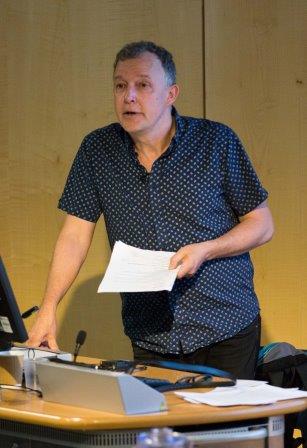
TONY D SAMPSON
University of East London, UK
Introduction
Drawing on Deleuze and Guattari’s (1994) methodology developed in their swansong, What is Philosophy?, this article deploys its own conceptual persona: the Neosomnambulist or new sleepwalker. Not to be mistaken for an actual living person, the Neosomnambulist is utilized so as to bring concepts to life.[1] In this case, what the sleepwalker gives life to are spatiotemporal zones of indistinction that pervade the digital now. We begin with erstwhile somnambulist personae, borrowed from the old contagion theorist, Gabriel Tarde. Tarde’s social sleepwalkers were continuously composed in the collective mimicries of the newly animated urban crowds of nineteenth century industrial life. Importantly, they were posited as somewhat absurd subjects-in-the-making. Their openness to the imitation-suggestibility of the urban crowd occurred somewhere in between sleep, mechanical habit and awakened cognitive volition (Sampson, 2012). What the sleepwalkers mistook to be their own sense of self was, in actuality, a composite of collective mimicry and self-other similarity.
What initially defines the Neosomnambulist is a similarly poised imitative and porous social subjectivity. Yet, we must not confuse the sleepwalker’s porosity for stupidity, or indeed, wisdom. We need to smooth out some of the cruder binary aspects of crowd theory and its theoretical legacy in popular psychology. In the work of Gustave Le Bon ([1895] 2002), for example, where rational individuals become absorbed by the crowd, there is an almost magical emergence of an irrational horde, intent on revolution. Inversely, in more contemporary crowd theories, it is argued that the many are often smarter than the few (Surowiecki, 2004). In short, in both cases, the crowd miraculously supervenes the individual, yielding cognitive excesses, collective intelligence or mob mentality. The Neosomnambulists are most definitely not polarized figures of this kind. Their experience of the digital now is not located on either side of a macro/micro spectrum of rational individuality, collective irrationality or indeed the smart mob alternative. On the contrary, the novelty of new somnambulistic experience is found in the breaching of thresholds that are supposed to separate individuals from collectives. Moreover, the nonconscious associations of the sleepwalker also breach the divide between sleep and the cognitive and habitual demands of digital workloads and excessive consumption. To begin with, then, the Neosomnambulists provide a conceptual probe that enters into contemporary zones of indistinction; slipping between the spatiotemporality of nonconscious mechanical habit and conscious user experiences.
The Neosomnambulist is further developed in this article in order to grasp a recent coincidence between a mode of digital capitalism, focused on conforming user experiences, on one hand, and a trajectory toward racialized collective mimicries, on the other. In summary, this is a concurrence between the spread of far-right race hate and monetized social media virality, both of which perform political and economic expropriations of the user experience.[2] In other words, Neosomnambulism can be grasped in two intersecting ways. First, it is a ramping up of the intensity, velocity, spreadability and similarity of user experiences in the digital economy. Second, it is implicated in a seemingly docile sleepwalk toward far-right populist contagions. Subsequently, this article develops on a methodological approach to indistinction, intended to resolve (and challenge) certain distinctions apparent in this coincidental regime, which paradoxically stirs up contagions of collective mimicry, and consequent identity loss, while also forcing immunological, racialized divisions.
Moreover, in addition to raising questions concerning the disturbance of spatial identity through mimetic processes, the article also considers how autoimmunity affects temporality in these zones of indistinction. Finally, then, an alternate account of collective mimicry is forwarded, which although collapsing notions of self-identity into indistinct and impersonal experiences, also opens up to the potential of a speculative communal mimesis. Evidently, such a collapse of the spatiotemporality of identity increases social anxieties concerning the loss of personal distinctiveness, but if these apprehensions can be overcome, then, a new concept of indistinction might provide an alternative to current immunological divisions. This is a concept that not only challenges the spatial predicating of self experiencing nonself. It also points toward an affirmative failure of immune systems, resulting in the possibility of what Margrit Shildrick (2019: 11) calls a ‘fundamental disordering of linear temporality,’ which in turn, provides a potential and radical reconceptualization of community, without the ‘conventional bookends of life and death.’
Ultimately, the article makes an important political point. It argues that previous revolutionary moments of social media, like the ostensible nascent prodemocracy movements of the Arab Spring, are currently being usurped by this perilous dark refrain of far-right politics. Nonetheless, in spite of a widespread foreboding rhetoric, concerned with populations sleepwalking into a political abyss, the Neosomnambulist is positioned here as a more affirmative account of how we can comprehend the peril. Along these lines, the proposal herein is less about the idea of waking up individuals so that they are able to think and act against a collective impulse toward the dark refrain. On the contrary, the Neosomnambulist is posed so as to better understand how digital platforms help to spread nonconscious affective flows of micro-imitation through shared user experiences. Again, the somnambulists are neither awake nor asleep. Their viral flows exceed the celebratory distinction made, on one hand, between an awakened emergent cognition, typified in collective intelligence and global brain discourses, and on the other, the docile subjects of crowd theory. Better to probe the indistinction than continue with this well-worn distinction.
The Sleepwalker Returns
A fairly recent study published in the Journal of American College Health looked at incidences of students in Pennsylvania reading and responding to texts while asleep (Dowdell and Clayton, 2017). The authors claim that what it calls ‘sleeptexting’ is an ‘abnormal’ sleep behaviour, similar to sleepwalking, and linked to mobile phone dependency. These cases of sleeptexting share some similarities with French philosopher, Frédéric Neyrat’s (2018) contention that the digital present has little to do with sleep. Instead of that dulled sense of reverie one experiences when struggling to wake up – those zones when we can’t make out the difference between woken surroundings and a lingering dream – Neyrat points to protracted periods of wakefulness. Digital work is certainly not limited to daytime hours. Check email, notifications, updates, posts, tweets… Sleeping isn’t easy in these excesses of light, data overload, infinite linking, and myriad of other attentional demands. Neyrat supposes that digital work requires, as such, vigorous cognitive engagements. Nevertheless, perhaps the sleeptexting experience is a little fuzzier than this somewhat forced distinction between sleep and wakefulness suggests. Which is to say, such a distinction seems to miss the aspirations of corporate social media enterprises to manage user experiences in between conscious and nonconscious states. The Pennsylvanian sleeptexters may well seem like extreme cases, but the compulsion to take smartphones to bed is evidently a more commonplace experience that crosses generations. Arguably, the experience designers of these daytime/bedtime devices produce an array of neurologically intuitive comfort zones, dependent on users that are neither entirely somnolent nor ambulant.
A closer reading of the digital now suggests that workers and consumers may indeed be at a somnambulate threshold; which is to say, their ‘user’ experiences of the digital now are in between these two distinct states. Theoretically speaking, there is clearly a connection to be made here between such thresholds and a Deleuzoguattarian interest in The Middle (Genosko, 1998: 91-96). Instead of erecting a barrier between somnolent and wakeful zones, thresholds are like those infamous, deterritorialized weeds that appear in between the cracks. Yet again, perhaps this notion of an in between (a kind of middle of nowhere) is in itself continuing to force a distinction? Yes, user comfort zones are designed to be intuitively felt and tacitly grasped. They also vary the frequency of experiences registered in the brain, since relaxed states are considered to be creative states. Yet, these zones induce concrete actions too; habits, compulsions, new work velocities and collective impulses. In the intensities of experience and the subsequent clicking or swiping actions, there are blurry zones of indistinction, whereby the nonphenomenological world of somnolent experience slips into habitual ambulant user engagements. In this light, user experiences are neither asleep nor wide awake, or indeed, in between, but rather they are, at once, absurdly somnambulistic.
This brings our discussion to the main point; which is to once again resuscitate Tarde’s old somnambulistic social subjects as a way to probe the digital now. Why bring back these old conceptual personae from nineteenth century crowd theory? Well, Tarde’s sleepwalkers were always situated as absurd conceptual personae. They would not rest easily on either side of a barrier erected between dreamy or uninterrupted sleep, on one hand, or the prolonged interruptions and wakefulness of Neyrat’s digital culture, on the other. Unlike such sharp distinctions, Tarde’s somnambulist brings us a little closer to what Jonathan Crary (2013: 30) calls the ‘monotonous indistinction of 24/7’. For Crary, digital culture has similarly become a ‘zone of insensibility’ and ‘memory loss,’ which ‘defeats…the possibility of experience’ (ibid.: 17). In a similar way, the Neosomnambulists mess with the spatiotemporality of worktime founded on a distinction made between daytime and bedtime. Certainly, Tarde would not be at all surprised to learn about the 24/7 sleeptexting students in Pennsylvania!
Nonetheless, by bringing back Tarde’s somnambulist we need to carefully approach the idea that there are possibilities of experience to choose from. This is because currently there is an ambiguous struggle going on for the so-called user experience in terms of sleep and wakefulness. Zones of indistinction cannot simply be restricted to the industrial capitalist erosion of daytime and bedtime or indeed worktime and leisure time alone. On the contrary, what I will call experience capitalism has already breached these boundaries. Much of what is produced, consumed and discarded in the experience economy is no longer carried out on either side of this bipolar spectrum, but rather occurs on much thicker spectra of spatiotemporal experiences.
We need a Neosomnambulist who can probe the viscosity of spectra and grasp the user experience in the insensible and inseparable degrees between vigilance and sleep. A Neosomnambulist needs to probe the varying velocities of experience capitalism, which can no longer simply be expressed in terms of high frequency brainwaves at work or low frequency brainwaves at sleep. Crary’s 24/7 ultimately opens up the user experience to a loss of a distinction between beta and alpha waves. Along these lines, then, to understand the digital now, the sleepwalker concept must probe the neuro-management of collective user experiences. This is, it would seem, the principal method of experience capitalism, whereby psychological corporations, with their teams of experience designers, behavioural marketers, data miners and consumer researchers, develop on a longstanding fascination in the spreadability of social influence (Simonite, 2012), on one hand, and nonconscious processing of user experience (Norman, 2007), on the other. Along these latter lines, then, experience capitalism can be grasped as a departure from older models of consumption, based on a theatrical subconscious or dream factory; now moving toward a neurochemically constituted nonconscious mode of social influence. Indeed, the user is said to now primarily process experience on a visceral register (located in neurochemical body–brain relations), before behavioural habits, moments of inward reflection or emotional expressions surface in cognition (ibid). Neurologically modelled in this way, Neosomnambulists are not thinking machines that feel; they are feeling machines that think.
Of course, the exact determinacy of the various components of experience capitalism will require further empirical research. However, the rise of experiential methods of persuasion, suggestibility and control, based on a neurological turn to feelings, emotions and affect, alongside the experience economy model, has demonstrably entered into the cultural circuitry of capitalism (Sampson, 2016). The rise of experience capitalism has occurred via ubiquitous marketing strategies that move increasingly to the centre of most private and public organisations, including banking and universities, where the consumption of commodities has been transformed by data evidenced experiential journeys and a dubious happiness agenda (Davies, 2016). This transformation also crops up in the utterances of influential TED Talks, business bestsellers and experiential design guru seminars. Even if some of these methods do not work directly on a population, they have become part of the everyday rehearsal of marketing led management regimes across sectors.
The Revolutionary Politics of Neosomnambulism
Another reason for bringing in a Neosomnambulist is to explore how a corresponding visceral register of felt experience can be mapped to a recent dramatic slide into a political abyss. This is a shadowy refrain that has become entangled with contemporary user experiences with viral platform architectures. Herein, the revolutionary moment of social media no longer belongs to prodemocracy protesters, but has been captured by a far-right tendency supercharged by social media. This tendency is, in part, reified by social media because it collapses the immunopolitics of the far-right (Esposito, 2008) and the virality of platform architectures into the same dark refrain. So, on one hand, the failure of social media immunity systems to weed out race hate, for example, plays to the refrain of the Neo-Nazis. Like this, paradoxically, social media immunity failures help to reinforce the far-right desire for racial immunity. On the other hand, the virality of these platforms helps to bolster and spread the sentiments of race hate far and wide (Sampson, 2020: 114-150).
What can we learn about this current dilemma from the indistinctions of Tarde’s conceptual personae? Well, in his day, sleepwalker contagions of the revolutionary kind had both spatial and temporal modes. Firstly, revolutionary contagion spread from the industrial clusters of the urban crowd to infect an entire nation. Secondly, and judging by the anxieties of the French upper-classes, including those expressed by figures like Le Bon, revolutionary modes of nineteenth century collective mimesis were also perceived to spread at a dangerous, breakneck speed. Considered as an extension of the contagions of the urban crowd, Tarde’s newly mediated, imitative, and contagious impulses swept through the countryside via word of mouth, newsprint and telegraph wire. These contaminations made crowds feared entities because they shared radical political experiences that threatened the existing order of things. Early popular crowd psychologies, like those forwarded by Le Bon, were, in effect, providing a prototype of the dynamics of mob contagion; offering new political strategies for crowd control and modes of manipulation of the populace, later to be exploited by 1930s fascists (Koon, 1985: 4-5).[3]
There are additional historical continuities and discontinuities to pick up on here. In the mass media climate of the 1960s, R.D. Laing (1983: 80) profoundly contended that by inducing similar user experiences, it is possible to more effectively steer a population towards more aligned and conformed behaviours and decisions. A population that feels the same experiences is, Laing argues, a population whose behaviours will become de facto more controllable (ibid). The link between shared felt experiences and contagion may seem continuous, but the potency (and ownership) of the revolutionary moment it inspires seems to be less certain. Indeed, well in advance of the recent social media-fuelled surge in the racist populisms of strongmen, like Trump or Bolsonaro, Laing understood how inducing the feelings of a population and encouraging them to share the same feelings – to ‘want the same thing, hate the same things, feel the same threat’ – would ensure that ‘their behaviour is already captive’ (ibid).
In spite of these continuities, the medium through which shared experiences spread has been radically transformed. In the digital now there are new political modes of experience, stirred into action, and given impetus, through contemporary user engagements with viral social media platform architectures. The sharing of felt experiences has, arguably, become ever more entrained. As Laing put it, once the alignment of experience is achieved in this way, then, ‘you have acquired your consumers [and] your cannon fodder’ (ibid: 80). The difference now is, it would seem, what used to spread through time and space at breakneck speed has become an almost instantaneous contamination of experience. There is, indeed, a potential immediacy in the spreading of collective mimesis that defies the capacity of resistant forces to play catch-up.
There are Many Sleepwalkers
Step right up. Now showing for the first time: Cesare, the somnambulist
(Wiene, 1920).
Sleepwalkers occupy zones of indistinction in which they are continually made and remade as they move in-between conscious and nonconscious experiences with media technology and politics. Indeed, the somnambulist is a ubiquitous conceptual persona in the histories of media theory, particularly in early automatic experiences with cinematic technologies, which Deleuze and others have noted coincided with fascism (Crary, 2001: 358). There is, indeed, a more explicit link made between media technology, fascism and the somnambulist in the aesthetic figure of Dr Caligari’s hypnotized sleepwalker. Such a comparison between Cesare and the sleepwalkers in the title of this article may well give the impression that current user experiences of media technology are acquiescent, mimetic acts of reverie. Perhaps the sleepwalkers just need to wake up! Well, some of these facets of Tarde’s original conceptual personae are still highly pertinent, but this is not exactly the proposition put forward here. There are many sleepwalkers.
Along these lines, the aesthetic figure of Dr Caligari’s hypnotized sleepwalker from the 1920s may appear to be only half-awake. His limited bandwidth of discursive attention seems narrow, temporarily oblivious, sleeping or stunned. However, although Robert Wiene’s somnambulist may well seem like a docile subject, he has special powers. ‘Cesare knows every secret. Cesare knows the past and can see into the future’ (ibid). As Siegfried Kracauer argued back in 1947, the fairground somnambulist in Wiene’s 1920 Expressionist film is purposefully positioned in the plot as a presentiment of the future tyranny in 1930s Germany. Dr Caligari is indeed the tyrant, and Cesare, the cannon fodder, ‘drilled to kill and to be killed’ (Kracauer, 1947: 65).
In spite of many ominous sleepwalker discourses, including our current global sleepwalk into the Covid-19 pandemic, the Neosomnambulists are not necessarily docile or in need of an alarm call. To be certain, the idea of waking up the somnambulist misses the point that it is quite often the spreaders of crazy conspiracies or racist hate speech who demand that it is those who refuse to collude that need to wake up! We certainly risk misunderstanding the many nuances of Tarde’s somnambulists if we mistake the sleepwalker’s absurdity for slave-like obedience. Rather than equating Tarde’s social subjects with the vacillating, easily-led social subjects of crowd theory, these new conceptual personae are specifically mobilized as an expression of the contemporary collective nonconscious. That is to say, the focus is more precisely concerned with bringing up-to-date the more-than-human aspects of Tarde’s microsociology; the monadic flows of micro-imitations that are in excess of contaminated individuals. Along similar lines to Patricia Clough’s (2000) user unconscious, which collapses the I into the YOU (see also Sampson, 2020: 21); this means repositioning the social subject as part of an infinitesimal relation to the world, experienced through insensible, and indistinct thresholds between macro and micro. There is nothing primarily new here in terms of grasping the collective nonconscious. Tarde’s original contagion theory was firmly located in these insensible thresholds with no ‘absolute separation’ or ‘abrupt break, between the voluntary and the involuntary… between the conscious and the unconscious’ of social relationality (Tarde cited in Sampson, 2012: 36).
The return of the sleepwalker does, however, significantly go against the grain of more celebratory notions of emergent collectivity. Before the recent dark refrain of social media-fuelled collective mimesis emerged, the trajectory of network culture seemed to be heading toward a more enlightened age of cognitive connectivity. As follows, cognitive networks have been conventionally imagined as emerging favourably from the unconscious. Comparable to Tarde’s nemesis, Durkheim, and his sociological rendition of a domineering collective consciousness emerging from dynamic density, Marshall McLuhan offered up a collective awaking of sorts. Significantly, as Adriana Braga (2016: 221) points out, McLuhan’s media extensions uniquely bring ‘the unconscious level of the psyche to the surface where it could become conscious.’ Indeed, McLuhan argued back in 1969 that media ‘[t]echnologies… seem to be the pushing of the archetypal forms of the unconscious out into social consciousness’ (McLuhan, 1969: 31). In short, this means that the image of the technological network is reckoned to impose itself pervasively on the unconscious human psyche by reworking its senses and thus awakening its capacity for collective consciousness (Kroker, 1995).
A Neosomnambulism is not, however, the antithesis of collective consciousness. It is more precisely a concept that is critical of a roused cognitive image of the network, which has failed to offer more searching insights into collective experiences with technology, dipping in and out of conscious and nonconscious experiences. Theories of emergent collective consciousness omit to mention, as such, how both sleep and wakefulness become caught up in deeply entangled digital cultures. Of course, McLuhan did not intend his collective awaking to be misunderstood as a crude emergence of collective intelligence. He was equally interested in how the downside of the collapse of the distinction between time and space in the media age amounted to trivial local gossip going global. He would have perfectly grasped how, in the wake of Covid-19, crazy conspiracies about G5 networks, for example, spread in real-time, or indeed, how Instagram images spread from app to supermarket shelves. More precisely, by updating Tarde’s sleepwalker, these entanglements are conceived of as occurring on an even broader spectra of user experience than those normally attributed to individuals or crowds. Significantly, the concept requires a proposed expansion of the narrow experiential bandwidth occupied by the old sleepwalker that purposefully challenges the distinction made between wakefulness or sleep.
We need to start by resolving the distinction between individuals and collectives. Significantly, then, Tarde’s social subjects are neither an individual person nor a collective representation of persons. Sleepwalkers are continually made and remade by oppositional microflows of imitation. The psychological sense of individual self is in effect an illusory social category marked by a sense of self that is always imitative and thus always etched by its relation to collectivity. This is why it is important to restress how a current wave of social media somnambulism presents a far more complex spectra of possible experiences. This contra-Durkheimian approach is not bipolar. It does not oscillate between individual rationality and stupefied collectives. The spectra of experience the sleepwalker occupies has multiple, complex and indistinct polarities.
Methodological Indistinctions
Zones of indistinction can now be resolutely linked to a methodology. Borrowing from Roger Caillois’s (2003) proposal in 1935 that the fundamental role of all study is to set about resolving distinctions, this methodology endeavours to tackle a series of forced divisions. Important to this procedural development is Caillois’s study on collective mimesis, which focuses on how insects blend into their environment through camouflage. In short, for Caillois, the process by which biological camouflage merges an organism into its surroundings presents a disruption to perception insofar as what is assumed to be in the foreground is lured into the background. By looking to resolve such distinctions, Caillois’s method draws on the indistinct nature of things; the vagueness of it all. Of course, some Gestalt minded colleagues will probably say that a failure to make a distinction is in itself a failure of perception. Certainly, we go against Gestalt principles if we fail to distinguish the emergence of foreground from background. Be this as it may, indistinction does not really concern perception as a higher-level cognitive faculty. It is rather regarded as a method that allows some limited access to preperception; a way of modestly slipping into the immediacy of nonphenomenological impersonal experience.
There is perhaps nothing particularly new about indistinction as method. There is indeed a long history of indistinct practices in art, for example, wherein the art critic, Adrian Stokes (2012: 112-13), notes how the ‘embracing or enveloping quality’ of Turner’s art came about because of its ‘indistinctness’ and ‘loss of definition.’ In literature too, there are aesthetic figures that are made purposefully indistinct. Gatsby is a great illusive figure in this sense. He remains purposefully blurred for much of Fitzgerald’s book; a figure that assimilates the background and blends into that big old house in the cause of dramatic effect. Likewise, artists like Mikey B Georgeson consolidate a broader sense of aesthetic ontologies of indistinction. Through his Auto Matter Flow Morning Drawings of the Neosomnambulist (see figure 1), and further experiments with the glitches of green screen technology, Georgeson produces a kind of art of indistinction that draws on what Gary Genosko (1998: 96) has called the ‘enemy of crisp synthesis.’ We can see how Georgeson’s sleepwalker illustration adopts the persona to slip ‘in between’ the woken distinction made between two other predicated protagonists. As follows, Georgeson’s sleepwalker becomes a speculative rather than a signifying aesthetic fact. In short, indistinction is an aesthetic methodology that simply refuses to make forced distinctions. The doodling, ‘noodling,’ ‘fuzziness,’ and ‘muddiness’ (Genosko, 1998: 96) of indistinctness resists border regimes by sliding in between foreground and background, and mind and matter, in the same fashion as the somnambulist slips in between sleep and wakefulness.

Although, Caillois was primarily interested in the spatial qualities of these lures that bring about indistinction, the method can also alert us to temporal slippages. These slippages reveal something that Neyrat’s digital now overlooks. These zones are also not limited to the kind of digital cultures apparent in Crary’s 24/7, which drift between macro time shifts, like daytime and bedtime. Instead the method draws attention to varied micro-speeds and tiny slippages associated with brain frequencies throughout the working day. Sleep and work have been, for the most part, respectively associated with low and high wave frequencies. But the sleepwalker demonstrates that this is not always the case. Certainly, whereas industrial and post-industrial capitalism were seemingly all about the alignment of fast brainwaves to even faster work patterns, resulting in cognitive overloads, for example, experience capitalism is arguably about triggering indistinctions between varying frequencies. After all, if a business really wants to make its workers and consumers more creative in the workplace, it is the interferences between frequencies which will produce new patterns of labour. So, the digital now is not just about being fast and awake or indeed online. To be clear, the introduction of sleeping or napping pods to digital workplaces, show how slow frequencies are being blended in with fast worktime. As one trade magazine puts it:
The Google office in Sydney features pod-like compartments for quiet work time. There’s also a nap pod for solid sleep time. But if you’re somewhere in between work and sleep, the “work” compartments… might be the perfect spot to get a bit more done, then drift off into a peaceful sleep away from the noise of coworkers (Simmons, 2020).
On Spectra of Somnambulism
It is important to take our lead from Tarde’s rejection of the centrality of the apparent awakened state of the psychological self. This disavowal of the supremacy of the self-concept marks a refusal to put the intentionality of human consciousness at the centre of investigation. It serves as a spur for a nonphenomenological theory of user experience. Along these lines, the Neosomnambulist adds to the spectral density and frequency of experience with two ostensibly extreme, but continuously crisscrossed poles of somnambulist experience: somnolent and ambulant.
On one hand, then, sleeping subjectivity is, as Matthew Fuller (2018: 1) points out, the ‘somnolent version of the Cretan Paradox,’ since although it provides a distinction between itself and ‘being awake, and thoughtful, hence conscious and knowing,’ sleep in itself ‘cannot be directly known in its native state.’ In other words, like the liar paradox, to think sleep we risk producing a self-referential logical loop that would frustrate the refined binary thinking of the logician. As Fuller contends:
Sleep, unlike any other part of culture has no capacity for reflexivity within its own conditions. In sleeping one simply sleeps, one does not know, anything (ibid).
Sleep is therefore ‘ungraspable, unwritable [and] only perceivable at its edges or its outside’ (ibid.: 2). In sleep we may well still know something, but we lose our sense of self as a way of knowing it. It is only external to, or at the margins of sleep, in dream states or reverie, for instance, that traces of sleep can be filtered through conscious cognition; and that will only occur by way of a detour into wakeful reflection.
The conceptual persona of the somnambulist therefore provides a unique glimpse of the collective nonconscious because of the exceptional condition sleep offers in terms of cutting out the cognitive I. This is not the point at which fantasists and conspiracy theorists flip somewhere between the poles on a spectrum of rational thinking and irrational emotions. On the contrary, spectra present zones of indistinction where the psychological sense of self comes into contagious relation with others to such a degree of intensity and velocity that it merges with the surroundings in which mimetic encounters occur. It is at the extreme of spectra, in the gamma rays, that we find a more-than-human collective nonconscious, explained by the exceptional condition of sleep, cutting out the cognitive I altogether. There is not even a dream of self in the collective nonconscious.
On the other hand, the sleepwalker ambulates on spectra, producing exceptional zones of indistinction. This is because walking is an act of mobility that allows its subject to insensibly drift between nonconscious to conscious experience. As the sleepwalker demonstrates, the act of walking can be performed when sleep falls on the subject. Sleepwalking is, like this, an impulsive act, which can be achieved when the act itself is out of mind, since its mechanical and habit-bound processes are, for the most part, nonconscious rather than conscious.
Walking is a collective experience of mimesis too, wherein bodily interactions of different speeds and rhythms become entrained with other bodies. As research into unintentional bodily synchrony in the field of entrainment studies reveals, it is important to avoid a wakeful cognitivist bias, which states that it is only in consciousness that walking becomes real. As Clayton et al argue (2005: 70), in entrainment theory ‘any bodily implementation of interacting processes is real, no matter whether it is consciously experienced or not.’ Moreover, entrainment theory provides insights into the collective nonconscious that can be transposed to the study of digital culture. For example, the nonconscious entrainment of footsteps on a pavement can be substituted for the habitual social media user’s fingers and thumbs grasping, clutching, clicking and scrolling, as captured brilliantly in Esmeralda Kosmatopoulos’s installation Fifteen Pairs of Mouths, exhibited at the Crary inspired 24/7 show in London in 2019 (see Esmeralda Kosmatopoulos’s Fifteen Pairs of Mouths. https://www.esmeraldakosmatopoulos.com/fifteen-pairs-of-mouths).
In lieu of the rhythmic entrainments of walkers, coupled together through the bobbing of heads, or the synchronizations of marching arms and legs, we find the algorithmically orchestrated and rhythmic coordination of prodding fingers and thumbs. This is the sleepwalker’s experience of the ambulant technological nonconscious. Significantly, these are not merely physical entrainments. Research into entrained self-other similarity suggests a folding of the relation between physical behaviours (e.g. synchronized finger tapping) and emotionally felt experiences, like empathy and other prosocial contagions (Clayton et al, 2005: 70).
Users who scroll together, feel together.
Playing Along to a Dark Refrain
The conceptual antennae of the Neosomnambulists are purposefully turned toward the aforementioned dark refrain in the social media age. This is a very different refrain to that previously marked by optimistic accounts of a deterritorialized digital culture. This is a moment when the potentiality of revolutionary social media contagions, like the Arab Spring, have become deeply entangled in far-right spatiotemporal territorializations, engendered in recent months in the far-right refrains of Covid-19 denial and anti-vax, for example.
To understand the spatiotemporality of these territorial refrains, we need to briefly grasp a rudimentary appreciation of musical improvisation (Deleuze and Guattari, 1987: 310-350).[4] Deterritorialized lines of flight and territorial refrains are indeed mutual concepts that most improvising musicians will be familiar with. On one hand, imagine earlier lines of flight in digital culture as the jagged edges of a clashing, a-rhythmic and discordant musical performance. They are the beginning of an improvisation that initially refuses (intentionally or accidentally) to settle into any kind of recognisable groove. There was no precise tempo set; no opening bars to conform to. Nothing is composed, as such. These notes without order appear like the random scribbles on Sylvano Bussoti’s musical staff (ibid.: 3).[5] They are scattered notes that become-other. The refrain of far-right contagion is, on the other hand, a moment in the improvisation when players begin to fall into a repeated pattern of notes. These notes might become harmonized; syncopated; their uneven rhythms are quantized. At the same time, the assemblage of players become biomusicologically entrained. Which is to say, there is synchronized foot tapping; arms and instruments swing together; heads bob in unison.
This shared felt experience of improvised music can of course become an exuberant repetition. The groove can be a feely lure; a joyous inducement or seduction of everyone assembled in its cadence. The musicians and the audience similarly begin to pulse together, swaying to the same rhythm. Yet, despite the promise of musical joy, these movements can be pegged in such a way as to determine what comes next. The key fixes the line to a predicable scale of repetitive notes; a familiar chord progression. Things start to repeat themselves over and over again, without difference. This is a crowd theory of sorts. One is reminded of John Protevi’s (2010) observations of the joyful pulsating affects of the Nazis’ Nuremberg Rallies (2010). Again, it’s not just bodies that become entrained. The pulse acts as an affective contagion, bringing body rhythms, feelings and emotional expressions into line with each other. The dark refrain has become a staccato-like repetition of a racist populist politics, spreading throughout the world: Trump, Salvini, Putin, Modi, Bolsonaro, Johnson, Farage, Le Pen, Alternative for Germany (AfD), Orban, Wilders… It is a refrain punctuated by micro- and macro-fascisms, failing immunity systems, rampant, yet botched capitalism, and neo-Nazi mass shootings. It becomes problematic trying to break out of such a rut. Musicians, audiences, political rallies – all become-the-same.
This is a visceral refrain that spreads like wildfire on social media, stirring up white working-class rage against immigration. Trump and Bolsonaro’s followers, for example, take full advantage of these platforms to register emotive appeals to a population through fear and anxiety, but also through hurried and confused fabrications. It is, indeed, on this visceral register that William E Connolly (2017: 14-15) identifies the ‘conceptual cloudiness’ of the aspirational fascist’s Big Lie strategy, pitched against the fact-checking distinctions of liberal media. These cloudy concepts present zones of feely indistinction, intended to purposefully undermine experts and investigative journalists. The refrain is not, however, simply irrational. On the contrary, it is on the visceral register that these far-right political fiction machines twist and distort democracy, moving at different speeds, weakening the impartiality of trusted media, controlling intelligence, and inhibiting plural societies (ibid.: 8).
The dark refrain is intimately coupled to aspirational fascism, on one hand, and an economic expropriation of the user experience, on the other. Along these lines, social media users not only give away the ownership of their community relations to parasitic corporate social media platforms, but the prodemocratic potential of revolutionary contagion has been utterly dispossessed. Remember Laing’s words! When a population feels the same hate, feels the same fear; when it begins to share the same experience, the same tempos and rhythms, then, we have produced compliant consumers and cannon fodder (Laing, 1967: 80).
Immunity and Contagion
The sleepwalker can be uniquely grasped as a probe that enters into the perils and potential of collective mimesis. What is of interest here are the ways in which indistinctions contest the politics of border regimes that tend to make immunological distinctions between, for example, self and other, or more precisely, self and nonself. To fully register the political implications of this methodological approach, it is necessary to address a significant question concerning what it means to survive in borderless encounters, like those currently occupied by the Neosomnambulist. Importantly, then, the method needs to challenge the forced distinctions presented by the various immunopolitical regimes that are steering the possibilities of experience toward what Clough (2010) calls population racism. Such a survival – in between the cracks – inverses the preservation of homogenous distinctions common to immune system logic. Indeed, following various authors, like Caillois (2003), but also Roberto Esposito (2008; 2011), indistinctions can be used to replace the typically perilous analysis of immune system failures with the promising potential of communal mimicry and cultural multiplicity.
To begin with, we need to grasp the logics of immunopolitics. As a general rule, immune systems function as border regimes. They are designed to force distinctions between self and non-self. Following immunologics, the collapse of a distinction between, on one hand, an entity (e.g. a self or a body), and on the other hand, certain anomalies (e.g. a nonself or antibody), poses a risk to the stability or even the lifespan of said entity. The problem being that a failure to force a distinction between entity and anomaly means that certain protections and exemptions afforded to the entity from its perilous surroundings begin to breakdown. The collapse of the barrier immunity provides between interiority and exteriority clearly makes the entity vulnerable to destabilizing contagions of various kinds, as well as exposing it to potential predators. However, for Caillois (2003), the principle of becoming distinct is neither the general rule of things nor does it necessarily guarantee stability. Caillois’s study of insect camouflage thus counters orthodox evolutionary thinking on biological subsistence attained through exemption. By blending in to their surroundings certain insects would, for example, transform themselves into plants that other insects eat. The remains of mimetic insects are indeed as abundant in the stomachs of predators as those that cannot change their visual appearance. In effect, at first glance, the dangers of camouflage seem to outweigh the immunological benefits. To be sure, by transforming themselves into the foodstuff of their own species, insects risk taking part in a horrific masochistic act of collective cannibalization!
Caillois’s desire to resolve distinctions contributes to the method of indistinction in two important and seemingly contradictory ways. Firstly, it helps grasp a cross-context immunity problem that considers how the freedom immunity affords the entity is replaced by dangerous zones of indistinction. Which is to say, as the borders between the entity and its surroundings collapse, distinctions become increasingly blurred, porous, and folded. Dependent on which context this zone of indistinction occurs in (biological, biopolitical, psychological, technological etc.), the contaminated entity might face a loss of self-identity, integrity or even life. In the case of Caillios’s camouflaged insects, a tendency toward the spatial lure of the organism’s environment leads to the collapse of immunological borders, rendering the organism indistinguishable from its surroundings, and as a consequence, vulnerable to self-destructive, collective mimicry. In effect, the dispossessed entity is transformed into the nonentity, leading to a seemingly dreadful loss of distinction.
Importantly, the scope of Caillois’s method unfolds from the physical dissolving of immunological boundaries between a sentient organism and its surroundings to the dispossession of mind. This is to say, the emptying of a subject, if you like, leads to intensified feelings of disorientation, fear, anxiety, and even psychosis. Secondly, though, the apparent horror of Caillois’s self-destruction (physical and psychical), which follows on from machoistic collective mimesis, suggests a potentially radical rethinking of shared experience. This is an experience that has been compromised by all out contagion, but its collapse into indistinction nonetheless brings about something new in terms of communal relations. As follows, in Caillois’s doubly dangerous luxury of mimesis we find something affirmative about becoming indistinct. This is Caillois’s alternative resolution to his ‘fundamental question’ of distinction. As John Hamilton (2012: 6) argues, it is ‘[p]recisely because [Caillois’s] mimicry blends the individual into its environment, [that] it also serves as a basis for community’. So, although we seem to be in the grip of this current dark refrain of collective mimicry – which poses a persistent threat to cultural multiplicity – the loss of self-representation, its collapse into indistinction, promises experimentations with new community forms, yet to come.
To be clear, there are some notably conceptual resonances between Caillois’s collective mimesis and Esposito’s similar desire to reconsider community as the inverse of Nazis immunological modes of exemption. Which is to say, in many ways, the logics of Caillois’s notion of immunity are similarly interlinked with the more affirmative logics of Esposito’s concept of community. As Esposito (2011) contends, immunity presupposes community in the sense that the former provides a biopolitically constituted individual exemption from the ‘expropriating effects’ of the latter. There is ‘no community without some kind of immunitary apparatus,’ such as that provided by law, for example (ibid.: 16). For Esposito, immunity and community are therefore a continuum. A certain kind of negative immunity is nevertheless grasped as thwarting the possibilities of a more affirmative version of community that otherwise might challenge the immunological excesses of these biopolitical regimes (Campbell in Esposito, 2008: xi-xxix).
Like Caillois, then, Esposito goes on to show how the logics of contagion are similarly coupled to both immunity and community. For example, Esposito (2008: 105) points to the potential power of social inoculation. As he puts it, the biggest threat to a community’s vitality is not posed by infections from the outside, but is rather produced by efforts to preserve internal stability.
[T]he more the community is preserved intact, the more the level of innovation is reduced. The greatest danger that the community faces is therefore its own preventative withdrawal from danger (ibid).
What a community needs in order to persist is not therefore immunological stability and exemption, but instead a ‘viral fragment’ needs to be inserted into the ‘collective organism’ (Esposito, 2008: 106).[6]
What can we learn from the logics of contagion, so that we can confront the dark refrain of populist racism? To begin with, this need for inoculation exposes the complete futility of the Nazis. Their ultimate failure emerged in their efforts to normalize their hideous concept of a pure population by eradicating what they perceived as impurity. The Nazis were an archetype of racist immunopolitics. Hitler’s use of immunological terminology, for example, saw his fight against racial impurity as ‘equal to those fought by Pasteur and Koch’ (cited in Esposito, 2008: 122). In effect, by trying to stabilize a specific kind of racist life, the Nazis needed death (ibid.: 117). This propensity towards death is a mode of autoimmunity or the collective masochism of immunopolitics that comes to the fore in demise of the Nazis.
Speculative Mimesis
Indistinction is evidently an experimental and problematic methodology, thwart with dangers. There is even a hint of horror autotoxicus or the doom-laden encounters with a Platonic double in the making of indistinction. This is because although the concealment of distinction through camouflage would seem to offer the organism a unique opportunity to blend into its surroundings and survive, Caillois initially sees no evolutionary advantage to nonhuman mimicry of this kind. Such is the danger of collective mimicry that by wearing the mask of its predator, or by trying to blend in, a collective organism may actually transform itself into its own predators’ prey, or worse, a cannibal’s lunch. So, surrendering to indistinction will always be a painful experience.
Similarly, the organic desire to preserve the psychic feeling of self-representation is severely disrupted by indistinction. Which is to say, a mode of horror autotoxicus collapses the distinction between self-representation and self-destruction into a moment of potentially deadly indistinction. It is nonetheless this failure of psychic immunity, and Caillois’s more positive account of a doubly dangerous luxury of collective masochism, which prompts a new theoretical alternative to be considered. Herein, the loss of self-representation to collective masochism may well lead to communal mimicry. This is a mode of community quite unlike our current sleepwalk toward the abyss, embodied as it is by far-right nationalist identities of resemblance and immunopolitics. Importantly, communal mimicry must not simply become an acceleration of immunological forces! It instead celebrates the collapsing of nationalistic borders and racist distinctiveness into a massive-scale mimicry of cultural multiplicity.
Speculative mimesis becomes something of a necessity in terms of making a break from the fascist captures of community that social media helps to condition through the pass-on power of homophilious echo chambers. This does not mean, however, that we simply replace or oppose immunopolitics with an ideal model of community. Speculative mimesis may provide an expedient starting place, but what is really needed is a concerted effort to rethink the concept of community anew. To be more precise, then, what we need is a speculative mimicry that might provide the ultimate expression of a new concept of community, pushing ‘the apparatus of identity beyond the threshold of sameness’ (Esposito, 2008: 88).

Neosomnambulist Indistinction
To conclude, then, there are both spatial and temporal aspects to Neosomnambulism. On one hand, there is, in addition to physical blending, what Rosalind Krauss (2008: 155) points out as a ‘peculiarly psychotic yielding to the call of ‘space’’. This is the collapsing of the Gestalt figure and ground in both a physical and psychical sense, likened by Krauss to a ‘slackening of the contours of [an organism’s] integrity, of its self-possession’ (ibid). Indeed, Caillois’s method explicitly challenges the entire notion of a discrete personality when he concludes that the person is not the origin of the spatial coordinates of the surroundings that are mimicked. The person is rather just one among many coordinates of spatial capture. This is a critical destabilization of the feeling of personality grasped as indistinct from its material surroundings. As Caillois ([1935] 2003: 28) puts it:
The feeling of personality, considered as the organism’s feeling of distinction from its surroundings, of the connection between consciousness and a particular point in space, cannot fail under these conditions to be seriously undermined.
On the other hand, as Shildrick (2019) contends, it is the failure of immunity or autoimmunity that enables us to further rethink temporality away from the bookends of life and death. Drawing on her discussion on the temporal aspects of Esposito’s affirmative concept of immunological breakdown, I would like to venture that aside from the seemingly inevitable death of a selfhood with autoimmune disease, we should take into further consideration the temporal entanglements of sleepwalkers or the collective nonconscious. As already discussed, the sleepwalkers are not negative personae; they are affirmative becomings, giving life to a concept. In similar ways, these liminal subjects attempt to do what Shildrick (2019: 21) aims to do in her work, which is to ultimately escape the ‘modernist boundaries of selfhood and embrace the possibilities of transformation’. The imitative sleepwalkers are not a person that either lives now or dies in the future; the conceptual personae are a becoming other caught up in the speculative mimicry of indistinction. This understanding of the temporal situating of the sleepwalker is moreover reminiscent of Grosz who argues that in order for transformation to take place, we need to grasp the temporality of our past and future judged according to the instabilities of personhood (Grosz cited in Shildrick, 2019: 21). Indeed, the residue of collective mimesis is not a new personhood; it is, as we have seen, speculative and transformative. This is where a new concept of community, yet to come, may well live on.
References
Braga, A. (2016) ‘Mind as Medium: Jung, McLuhan and the Archetype’, Philosophies. 1(3), pp. 220-227.
Caillois, R. ([1935] 2003) ‘Mimetism and Psychasthenia’, in: C. Frank, and C. Naish, eds., The Edge of Surrealism: A Roger Caillois Reader. Durham: Duke University Press, pp. 89-103.
Clayton, M., Sager, R. and Udo, W. (2005) ‘In Time with the Music: The Concept of Entrainment and its Significance for Ethnomusicology’, European Meetings in Ethnomusicology. 11. pp. 3–142.
Cough, P.T. (2000) Autoaffection: Unconscious Thought in the Age of Teletechnology. Minneapolis: University of Minnesota Press.
Clough, P. T. and Willse, C. (2010) ‘Gendered Security/National Security: Political Branding and Population Racism’, Social Text 1: 4(105), pp 45–63.
Connolly, W. E. (2017) Aspirational Fascism. Minneapolis: University of Minnesota Press, 14-15.
Crary, J. (2001) Suspensions of Perception: Attention, Spectacle, and Modern Culture. Cambridge MA: MIT Press.
Crary, J. (2013) 24/7: Terminal Capitalism and the Ends of Sleep. New York: Verso.
Davies, W. (2016) The Happiness Industry: How the Government and Big Business Sold Us Well-Being. New York: Verso.
Deleuze, G, Guattari, F. (1994) What Is Philosophy? New York: Verso.
Deleuze, G. and Guattari, F. (1987) A Thousand Plateaus. Minneapolis: University of Minnesota Press.
Dowdell, EB, and Clayton, B.Q. (2019) ‘Interrupted Sleep: College Students Sleeping with Technology’, Journal of American College Health: 67 (7), pp. 640-646.
Esposito, R. (2008) Bíos: Biopolitics and Philosophy. Minneapolis, Minnesota: University of Minnesota Press.
Esposito, R. (2011) Immunitas: The Protection and Negations of Life. Cambridge: Polity Press.
Fuller, M. (2018) How to Sleep: The Art, Biology and Culture of Unconsciousness. London; New York: Bloomsbury Academic.
Genosko, G. (1998) Undisciplined Theory. London: Sage.
Genosko, G. (2012) Remodeling Communication: From WWII to the WWW. Toronto: University of Toronto Press.
Hamilton, J. T. (2015) ‘The Luxury of Self-Destruction: Flirting with Mimesis with Roger Caillois’, in: D. Hoffman-Schwartz et al, eds., Flirtations: Rhetoric and Aesthetics this Side of Seduction. New York: Fordham University Press, pp. 106–15.
Koon, T. H. (1985) Believe, Obey, Fight: Political Socialization of Youth in Fascist Italy, 1922–1943. Chapel Hill, N.C.: University of North Carolina Press.
Kracauer, S. (1947) From Caligari to Hitler: A Psychological History of the German Film. Princeton, NJ, US: Princeton University Press.
Krauss, R. E. (2008) The Optical Unconscious. Cambridge, MA: MIT
Kroker, A. (1995) ‘Digital Humanism: The Processed World of Marshall McLuhan.’ CTheory. http://ctheory.net/ctheory_wp/digital-humanism-the-processed-world-of-marshall-mcluhan/
Laing, R. D. (1967] 1983) The Politics of Experience. New York: Pantheon Books.
Le Bon, G. ([1885] 2002) The Crowd: A Study of the Popular Mind. New York: Dover.
McLuhan, M. (1969) Counter Blast. Toronto: McClelland and Stewart.
Neyrat, F. (2018) Atopias: Manifesto for a Radical Existentialism. New York: Fordham University Press.
Norman, D. A. (2007) Emotional Design: Why We Love (Or Hate) Everyday Things. New York: Basic Books.
Protevi, J. (2010) ‘Deleuze and Wexler: Thinking Brain, Body, and Affect in Social Context’, in: D. Hauptmann and W. Neidich, eds., Cognitive Architecture: From Bio-politics to Noo-politics; Architecture and Mind in the Age of Communication and Information, Rotterdam, Netherlands: 010 Publishers, pp. 168–83.
Sampson, T.D. (2020) A Sleepwalker’s Guide to Social Media. Cambridge: Polity
Sampson, T. D. (2016) The Assemblage Brain: Sense Making in Neuroculture. Minneapolis: University of Minnesota Press.
Sampson, T. D. (2012) Virality: Contagion Theory in the Age of Networks. Minneapolis: University of Minnesota Press.
Shildrick, M. (2019) ‘(Micro)chimerism, Immunity and Temporality: Rethinking the Ecology of Life and Death’. Australian Feminist Studies, 34 (99), pp. 10-24.
Simmons, K. (2020) ‘Nap Pods In The Office: Our Favorite New Workplace Trend’. The Decoist. https://www.decoist.com/nap-pods-office/
Simonite, T. (2012) ‘What Facebook Knows’. MIT Technology Review. 13 June. https://www.technologyreview.com/s/428150/what-facebookknows/
Stokes, A. (2014), in: M. Harris ed., Art and Analysis: An Adrian Stokes Reader. London: Karnac, pp. 112-113.
Surowiecki, J. (2004) The Wisdom of Crowds: Why the Many Are Smarter Than the Few and How Collective Wisdom Shapes Business, Economies, Societies, and Nations. New York: Random House.
Wiene, R. ([1920] 2002) Cabinet des Dr. Caligari. New York, NY: Kino International.
Notes
[1] ‘The philosopher brings to life various personae through which concepts can live’. The conceptual persona should not however ‘be mistaken for a person. They are larval subjects. Through the lives of the conceptual persona, concepts are thought, perceived, and felt. Indeed, the production of concepts requires these intrinsic conceptual personae to be able to make interventions. Plato used Socrates for such purposes, and Nietzsche introduced many personae: Zarathustra, Dionysus, Overman et al’ (See Sampson, 2016: 24).
[2] Evidently, this is not the first effort made to link capitalism to the far-right. For further discussion on this matter see Sampson (2020): 79-80.
[3] Like Le Bon, Mussolini argued that the mass was a servile flock that needed a master but its multiplicity must also become magnetized by the prestigious image of this master.
[4] Inspiration for the dark refrain comes from the ritornello or refrain concept as discussed in Deleuze and Guattari (1987: 310-350).
[5] See further discussion on a similar communication model in Genosko (2012): 117-121.
[6] Evidently, in the wake of Covid-19, these differences between immunity, community and contagion have taken on a new urgency. The remit here is restricted to a different question.
 Tony D. Sampson is an academic author and editor. His publications include The Spam Book (2009), Virality: Contagion Theory in the Age of Networks (2012), The Assemblage Brain: Sense Making in Neuroculture (2016), Affect and Social Media: Emotion, Mediation, Anxiety and Contagion (2018) and A Sleepwalker’s Guide to Social Media (2020). Tony is a reader in digital cultures and communications at the University of East London. He lives in Southend, Essex.
Email: t.d.sampson@uel.ac.uk
Leave a Reply