

From our forthcoming special issue, Geospatial Memory (Media Theory 2/1), Jason Farman explores our changing notions of “the instant” and the media archaeological links between pneumatic tubes and fibre optic cables.
Invisible and Instantaneous:
Geographies of Media Infrastructure from Pneumatic Tubes to Fiber Optics
JASON FARMAN
University of Maryland, USA
Abstract
In the late-1890s, five cities in the United States set up miles of tubing that would send canisters filled with mail sailing from post office to post office, pushed through the length of tube by compressed air. These letters could arrive within the hour and were delivered throughout the day regardless of the constraints of weather or traffic on the streets above. Anticipating our contemporary uses of text messages, the pneumatic mail services offered people the ability to stay in touch throughout the day, coordinating plans or exchanging love notes through an infrastructure that was a key part of defining modern American society. The tubes and the pneumatic mail delivery went defunct in the 1950s; yet, years later, in the early-2000s, a New York entrepreneur came across the archives of these old tube systems and decided to run fiber optic cable from building to building through the now-obsolete tubes. Comparing how these two technologies – pneumatic tubes and fiber optic cables for the Internet – created an imagination of the instantaneous in their respective times, I explore the powerful allure of the instantaneous and how such ideas open up an exploration of the relationship between proximity and everyday temporality as the pace of communications are affected by the desire for ever-accelerating technologies for communication.
Keywords
Cultural geography, infrastructure, media archaeology, temporality
Introduction
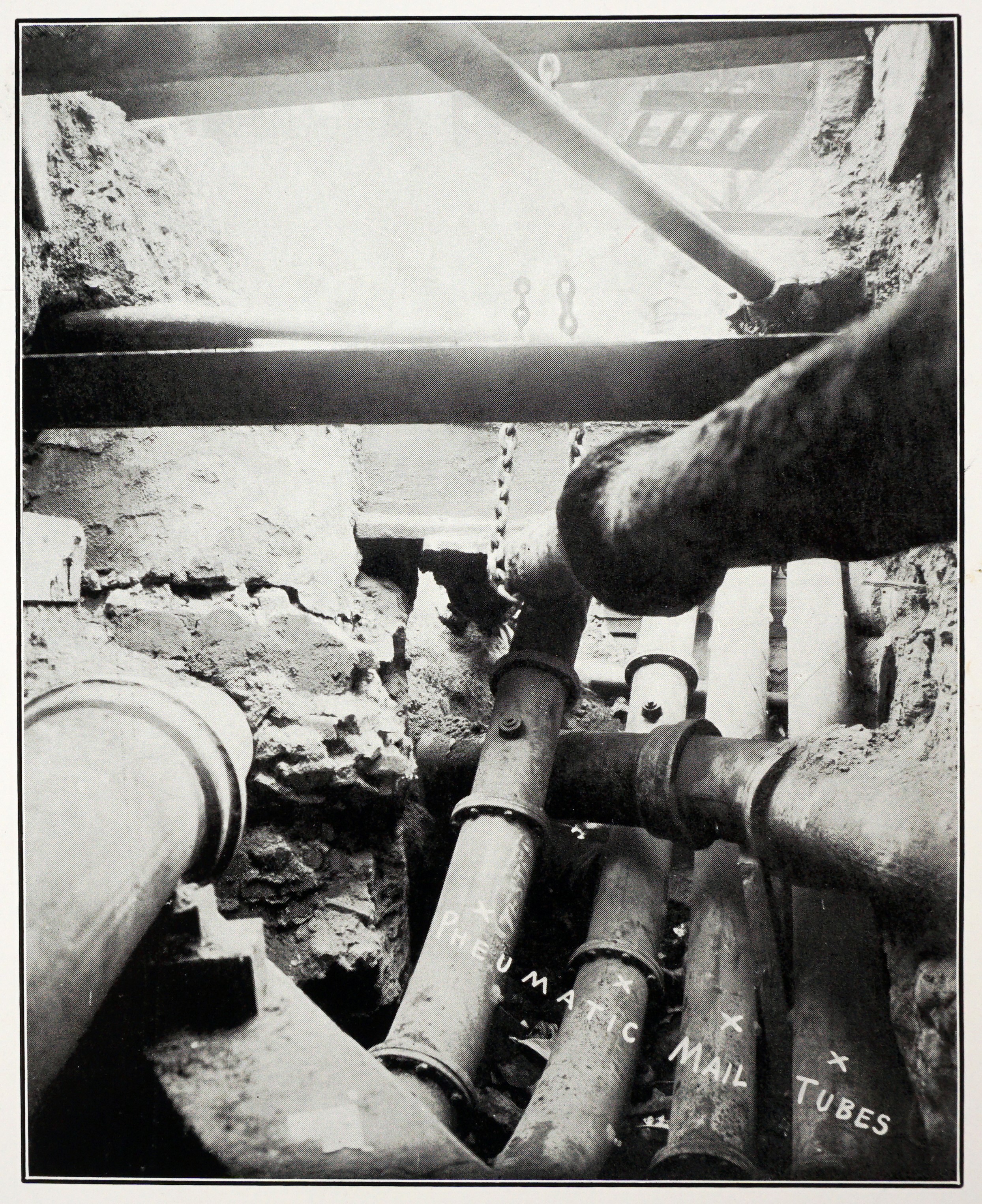
At the height of the dot-com boom in the late-1990s, technology entrepreneur Randolph Stark was walking home through his Wall Street neighborhood and saw crews digging up the street to lay fiber optic cables between the banks and the stock exchange. Stark was walking home from a tech meet-up in Manhattan. Earlier that evening, a colleague had mentioned to him that New York used to have miles of pneumatic tube lines that shot up to 20,000 letters a minute between Post Offices. On the walk home from the meet-up, as Stark was looking at the heavy machinery digging up the concrete and asphalt, it all seemed like an unnecessary amount of labor and cost – at about $1000 a foot – when the infrastructures were already there just a few feet beneath the hole that was being dug anew (Figure 1). He then envisioned a new business venture: running fiber optic cables in the old pneumatic tubes that were laid in the 1890s. This would allow companies, apartments, and office buildings to get faster Internet connections since the data would have less distance to travel.

There are significant parallels between the fiber optic age of the Internet and the era of the pneumatic tube mail system. Like our own moment, the age of pneumatic tubes created ways for people to send messages at unprecedented speeds. Starting in 1897, 27 miles of tube were laid underneath the streets of New York City in order to use compressed air to shoot canisters of mail around the city between post offices. The pneumatic tube mail system, which pushed brass canisters that could hold 600 letters each, were popular in Europe prior to their launch in the United States. But starting in the late-nineteenth century, pneumatic tube systems would be an important part of mail delivery in Philadelphia (the first city in the United States to start using pneumatic tubes), New York, Boston, St. Louis, and Chicago. The canisters, or “carriers” as they were called, would leave the Post Office every 10 minutes and would fly underneath the city streets, able to deliver a message from Times Square to the General Post office in three minutes even in a deep snowstorm. With these tubes running underground and connecting people in new and technologically advanced ways, the era felt as if the possibility of instant connection was now at hand. Noticing the parallels between the pneumatic era and the fiber optic one, Stark asked himself, “Why don’t we have pneumatic tubes running to every house? Why did that never happen?”
There are moments in history when technologies allowed us to connect with each other at unprecedented speeds. These moments gave people the ability to send messages at rates that seemed to eliminate waiting altogether. The rise of the pneumatic tube mail system was one such moment. Cities across the country were clamoring to install pneumatic tube mail systems. Sending mail in canisters pushed by compressed air under the streets of a city was seen as the essence of being cosmopolitan and modern. Pneumatic tube systems were not simply an efficient way to deliver mail and packages across cities with congested streets now packed with automobiles; instead, they were symbols of modern life. Pneumatic tubes represented a technological leap forward allowing us to connect instantly.
The geographic placement of the tubes, underground and out of sight in urban centers, helped fuel a cultural imaginary around the idea of “instant messaging.” The pneumatic tube geographies were central to their success and shaped the way that the medium was not only used from day to day, but also how the public imagined the role of this new medium in their identities at the turn of the twentieth century. The underground placement of the pneumatic tubes served two purposes. First, it was practical, allowing the message canisters to be sent throughout the city without interrupting life above the surface. The ability to send messages without dealing with the crowded city streets or severe weather was one of the main selling points of the pneumatic tube system. It could deliver consistent speeds regardless of how congested or impassable the streets got above. Second, by being out of view, it allowed the imagination to create a mysticism around the system that could be totally disconnected from the physical reality of the pneumatic tubes. For example, in a newspaper cartoon from 1915 that advocated for extending the system, it shows a clunky mail car stuck at a bridge crossing while a missile-shaped canister filled with mail shoots through a tube under the river. The cartoon contrasts these by saying “What We Have” next to the mail car, and “What We Ought to Have” next to the mail-missile (Figure 2).

In this article, I explore the ways that “instant connection” through a messaging technology had a powerful cultural allure, regardless of whether or not the systems could actually connect people instantly. Instantaneous communication is still an enormously powerful concept in our own culture. It is the motivator behind that feeling that we are unable to leave the house without our phone for fear that we’ll be out of touch. Being able to reach out and connect instantly, without the need to wait, is a dominant touchstone for our era. The seeds of this enchantment of the instant were planted back in the mid- to late-nineteenth century with the launch of the telegraph and the pneumatic tube systems. Yet, this notion of instantaneous communication is a mythology that drives consumer attitudes more than it delivers a wait-free mode of communication. That is to say, the ways that this enchantment changes how we think are more powerful than the technological abilities of the system itself, whether that be text messages on a mobile phone or pneumatic tubes shooting messages around a city.
Archaeologies of Media Geography
This article employs a media archaeology methodology by identifying the genealogical link between contemporary media (Internet, mobile technologies) and media of the past (pneumatic tube mailing systems). By situating each technology discussed within their specific cultural and historical moment – noting the contours and infrastructures that contextualized these mediated connections – I utilize media-specific analyses (Hayles, 2004) while at the same time thinking “intercontextually” to make links between media of the past and our own technologies (Huhtamo and Parikka, 2011; Chun, Fisher, and Keenan, 2005; Gitelman, 2006; Kittler, 1999; Standage, 1998; Marvin, 1988). As such, I work to create genealogical traces from these media of the past to the digital age of mobile devices in order to understand the affect of their invisible infrastructure across geographies of everyday life. The impact of this invisibility reinforces mythologies of the instant that function outside the realms of material reality. This mode of deployment creates what Lisa Parks (2012: 66) has called a “infrastructural illiteracy” that, in effect, creates a public that “are socialised to know very little about the infrastructures that surround them in everyday life, whether electrical systems, sewer pipes or broadcast networks.” She continues, “Not only are people socialised to be unaware of such systems; infrastructures are often designed purposefully to be invisible or transparent, integrated with the built environment, whether submerged underground, covered by ceilings and walls, or camouflaged as ‘nature’” (Parks, 2012: 64).
This approach draws from Shannon Mattern’s (2017: xx) methodological approach to what she terms “urban media archaeology.” By linking media of the contemporary city to the often-overlooked media or forgotten technologies of the past, Mattern calls for “urban media histories [that] are cyclical, entangled, a messy mix of discourses and dirt, imaginaries and I-beams, sketches and sensors” (2017: xx). Mattern’s work builds on the research of media historians like Carolyn Marvin (1988), Jay David Bolter and Richard Grusin (1999), and Lisa Gitelman (2006) who argue against a model of media built on moments of historical disruption. Instead, their research points to the ways that media exist in a material and conceptual genealogy. As Bolter and Grusin (1999: 15) write, “No medium today, and certainly no single media event, seems to do its cultural work in isolation from other media, any more than it works in isolation from other social and economic forces.” Gitelman (2006: 2) argues that such an approach is key because “If there is a prevailing mode in general circulation today, I think it is a tendency to naturalize or essentialize media – in short, to cede to them a history that is more powerfully theirs than ours.” These methods work against a technological determinist notion that these technologies are either 1) a natural progression from obsolete media to newer and better media, or 2) ruptures from the past that establish new, innovative technologies that solve the problems of the past. Thus, as new technologies are taken up in a culture, we can trace the ways these media “remediate” older forms while drawing on the conceptual and cultural imaginaries that afford such an uptake.
By tracing the topoi of invisibility and the instant across two technological eras, this article also builds on the “topoi studies” established by Erkki Huhtamo (1997: 222). Huhtamo’s methodology is to study concepts (or topoi) as they recur in different eras, pointing to the ways the concepts simultaneously elucidate a cultural imaginary and gesture to a genealogy of a concept. These topoi “can be considered formulas, from stylistic to allegorical, that make up the ‘building blocks’ of cultural traditions” (Huhtamo, 1997: 222). These “cultural, and thus ideological, constructs” shape the human experience with media (Huhtamo, 1997: 222). They inform not only the embodied approach we take to these media, but also the value a society gives a medium as it takes prominence in that era.
One particularly apt topos that emerges is the ways that the instant compresses geographic distances. “New” media often replace their predecessors in the imaginaries they build around being able to reduce geographic distance and connect people quicker than previous technologies. As Marvin (1988: 194) writes, discussing nineteenth century technological inventions like the telephone, “The more any medium triumphed over distance, time, and embodied presence, the more exciting it was, and the more it seemed to tread the path of the future.”
The rise and fall of the pneumatic tube mail systems in the United States offers commentary on our own technological moment and our feelings about the relationship between time, messages, and technology. Technologies for instant communication don’t eliminate our wait times; instead, they function to give the public a sense of technological advancement. We are drawn to the myth of ever-accelerating connection speeds that will allow us to connect instantly. This myth reveals our desire for tools that bridge the gap between us and those who are geographically separated from us. These tools give us hope that we can stay intimately connected with those who are far away. As people move away from families and loved ones, as they switch neighborhoods or states or countries, they seek tools that will help bridge the intimacy gap. Even within a city like New York, these tools promise connection in a space that continually feels disconnected and isolating for people despite the size of its population. Such promises of wait-free communication and connection are powerful and help create an investment in these technologies.
Modernity Through the Tubes
Molly Wright Steenson (2011: 86), a media theorist who studies the Parisian pneumatic tubes, wrote, “If ‘history passes through the sewers,’ as Victor Hugo wrote in Les Misérables, then perhaps modernity passed through the pneumatic tubes.” The pneumatic tube mailing system in Paris, or the Poste Pneumatique, ran from 1866 until 1984 and was one of the most extensive in the world. One of the ways that “modernity passes through the pneumatic tubes” is that the tubes present an idea more than they offer a solution to the problem of time and distance. In a technological culture that uses innovation and advancement as its fulcrum, the thing that is lifted up is the mythology that is thrust into the public’s imagination. As a technology speeds up our ability to connect with one another, as the pneumatic tube was able to do, the words being sent through the letters in the tubes aren’t the only content; as this article argues throughout, the content is also time. It is not simply that someone received a love letter; instead, they got a love letter sent through the pneumatic tubes. As Paul Virilio (2007: 51; see also Redhead, 2004: 50) has noted, the mark of an accelerated culture is content defined by its speed.
Pneumatic tubes began delivering mail for the first time in London in 1853 around the same time as the railroad began connecting distant parts of England and speeding up travel times. This was a noteworthy moment in communication history because it signaled a speeding up of the transmission of messages. As Tom Standage (1998: 2) notes in his book The Victorian Internet, up until this era, sending messages took the time required by a messenger on foot or on horseback. He writes, “This unavoidable delay had remained constant for thousands of years; it was as much a fact of life for George Washington as it was for Henry VIII, Charlemagne, and Julius Caesar. As a result, the pace of life was slow.” It wasn’t until the appearance of “something that moved faster than a horse or a ship” – i.e., the telegraph, railroad, and pneumatic tube – that communication media sped up the pace of life and peoples’ connections with one another (Standage, 1998: 3).
Other cities soon followed London to install their own pneumatic tube mail system, such as Berlin and Vienna. In New York, one of the first experiments with pneumatic tubes was a human-sized subway car that was propelled down the length of a city block by compressed air, perhaps the first ancestor of the Hyperloop currently being built in cities around the world. This experiment – which ran under Broadway between Warren and Murray Streets and was the city’s first attempt at underground transportation before the subway was built – sat immediately across the street from City Hall and vied to become the prominent mode of transportation in New York. In the end, it ended up being more of an amusement ride since the air pressure required to propel the car couldn’t send it too far. Regardless, the promise of pneumatic tubes was planted in the subconscious of New Yorkers.
Philadelphia, home of the Post Office Department and the foundations of the postal system in the United States, was the first city in the United States to launch their pneumatic tube mail system. The kickoff for the tubes was a memorable event. The inaugural items sent through tubes were a Bible wrapped in the American flag, a cat, a dog, and China cups, and concluded with everyone’s lunch being delivered undisturbed. (Later events reported that there was a 13-year-old boy who was sent through the tubes in one of the large experimental canisters in Chicago.) The tubes in the United States were 8-inches in diameter, which set them apart from their European counterparts which mostly had 3-inch tubes. The bandwidth, as we would term it, available to the U.S. Post Office Department was more than seven-fold that of the Europeans. (That said, France had 217 miles of tubes in the country, compared to the 42 miles in the five cities that employed pneumatic tubes for mail in the United States.)
Once the system was in place, people began sending letters and small packages to one another at an extraordinary pace through this modern system. Each day, tens of thousands of notes, memos, receipts, love letters, and business deals were sent through the tubes. The system was enormously expensive to install and maintain. Each year, Congress established a commission to look into whether the pneumatic tubes were actually worth the cost. One report from 1910 noted that it cost $120,000 per mile to install the tubes (equivalent to around $3 million dollars today per mile) and that the government paid $17,000 per mile each year to maintain the tubes (equal today to about $423,000 per mile). At this rate, the Chairman of the Committee on Post Offices and Post Roads noted, the tubes would require an appropriation of about $1 billion (equivalent today to $25 trillion dollars) per year to keep this system afloat. To lay this infrastructure and maintain it was not dissimilar to the scene that Randolph Stark stumbled across in his Wall Street neighborhood – in the dot-com boom era of the late-1990s, digging those trenches for fiber optic cables cost around $5.2 million per mile.
In each of these committee reports on the pneumatic tubes, tests were conducted to see if the tubes were actually faster than other modes of message conveyance. Each year, postal workers took part in a speed test of the delivery systems available. In these tests, workers would receive two letters at a particular station, postmark it, and then send one through the tubes at the same time one would be loaded onto a mail truck (Figure 3). They would be timed. The race would be on to see if the government could find justification for spending the amount they did every year on the tubes. In 1931, as a letter left the General Post Office, directly across the street from Penn Station, it would take 17 minutes for it to sail through the tubes across the Brooklyn Bridge and into the receiving room at the Brooklyn Post Office. As a postal vehicle left the General Post Office, it would arrive at the Brooklyn station 40 minutes after departure. To get to Wall Street from the General Post Office was about the same time for the pneumatic tubes, clocking in at 17 minutes; however, it took the mail truck 78 minutes through the slow crawl of Manhattan traffic.

Over the years, the delivery times for the pneumatic tubes didn’t change at all; the automobiles, on the other hand, got slower and slower. In the 1931 and the 1949 test, it took a letter 12 minutes to travel through the tubes from the General Post Office to the Gracie Postal Station on 87th Street on the Upper East Side. To get there by automobile in the early-1930s took 38 minutes; 18 years later, it took an hour. Congress, who oversaw everything done by the Post Office Department, ran this test countless times over the years and produced the same results time after time. In each of the reports, experts, business owners, and everyday patrons would testify to the same thing: the tubes are fast, they are faster than other options, and they deliver the mail even in conditions that limit over-ground delivery such as intense snow storms.
The Fall of the Pneumatic Era
During its use in the United States from 1893-1953, the pneumatic tube mail system was incredibly successful. It did connect people in ways that were unprecedented. While it didn’t remove the need to wait (waiting is always a part of sending and receiving messages, no matter how fast the technology is), it did provide a new way to send messages at speeds that made people feel like they were living in the future. But that feeling is always connected to the human experience of time rather than to any objective numbers about how quickly a pneumatic message could be delivered as compared to one delivered by car. The human perception of time shifts along with the technologies of an era and is often influenced by the cultural imaginaries about how the pace of life is being altered by new technologies.
In other words, what it means to wait for a message changes from era to era. Waiting is experienced in its context rather than in the actual hours, minutes, or even seconds someone is kept waiting. The delivery of mail by the pneumatic tubes didn’t change in time from year to year. Each year, it took a message four minutes to sail through the tubes from the General Post Office to Grand Central Station. It remained that way for the 54 years that the system was in place. Regardless, the perception of time across those decades had shifted in incredible ways. Cars had been invented and adopted at a remarkable pace; planes had been invented and were delivering mail by the 1910s. World War I and II had taken place in this span and urbanization was on the rise. The population of New York had grown around five-fold over these years, ballooning from around 1.5 million to 7.8 million by the time the tubes were decommissioned. Everyday life looked very different in New York when the tubes were shut down for good than when they first began. Though they remained constant in their ability to send messages at a certain pace, the human perception of time, along with the demands put on that system, transformed what it meant to wait for a message.
The initial failure of the pneumatic tube system came down to one man: the Postmaster General appointed by President Woodrow Wilson, Albert Sydney Burleson. If ever there were a nemesis of the pneumatic tubes, it was Burleson, who worked with Congress to produce report after report on the efficacy of the tubes only to ignore their findings and shut down the entire pneumatic mail system for the first time in 1918. There were near universal claims that the system was helping all those who used it. However, the system remained extraordinarily expensive and Burleson didn’t want his department to front the costs.[1] In the end, Burleson requested that President Woodrow Wilson veto the congressional bill that would keep the system alive. The whoosh of the tubes across cities like New York went silent from 1918 to 1923.
The New York system was revived in the early-1920s after Burleson’s tenure as Postmaster General had ended, and lasted until the 1950s. There were several official reasons given for the decommissioning of the pneumatic tubes. First, the ability for automobiles to carry massive amounts of mail around the city was noted as an advantage over the tubes, which could never increase their capacity unless they were replaced with larger tubes and larger power stations to create the necessary pressure. The system was also difficult to fix. With pipes four-to-eight feet underground, crews had to shut down streets as they dug down to open up pipes to do maintenance or repair. A New York Herald newspaper article from 1909 describes the arduous process for finding and fixing a stuck carrier in the tubes. Teams of two or three workers would be sent out along the pathway of the tubes. Every two blocks, a portion of pipe comes to the surface for these workers to be able to check the air pressure. They open each of these until they come across the one that’s missing the air pressure. “They know they are ‘getting warm,’” the article notes. Following this, they:
try to force the carrier either forward to the next station or back to the station whence it came by extra air pressure. If this means fails the chances are the street will have to be torn up. [. . .] One bad break occurred at the New York terminal of the Brooklyn Bridge by reason of some excavations. In this case it was found necessary to tear up the pipes and relay them.” (New York Herald, 1909)
Yet more than for any other reason, pneumatic tubes were probably decommissioned – as is true of many technologies – due to the shifting perceptions about how well the technologies align with our expectations of time and speed across the geographies they connect. Just as notions of waiting shifted across the years in a place like New York City, so too did expectations around the “instant”. Technological obsolescence is often driven by an increasing separation between notions of synchronicity (everyone being on the same clock, sharing the same information) and delay. “That is, the instant is often defined in contrast to the ways we define delay” (Lampert, 2012). What constituted instant communication in the era of the telegraph or in the era of the pneumatic tube was specific to those eras. Such notions did not hold true fifty years later, as people’s perception of the instant changed with the rise of new modes of transportation and new global connectivity across two world wars.
Part of the story of the abandonment of the pneumatic tubes is one that’s very familiar: technological obsolescence. Technologies get replaced by newer ones that are presented as solving the problems of the old. The tube system was set up in an era when postal workers were delivering mail by horse-drawn wagons (Figure 4).

Though railroads were a part of this delivery process, the “last mile” – which is the industry term for the very last portion of a communication infrastructure that delivers it to the home or business of the user – was fulfilled by a slow and soon-to-be-outdated mode of transportation. Once cars made horse-drawn mail wagons obsolete and became a prominent mode of mail delivery, they changed the speed at which the last mile was achieved. Pneumatic tubes were never a “last-mile technology,” and they never could be on a practical level. Instead, they allowed the mail to be shipped from one hub to another. A person still had to hand-deliver the mail or walk to the postal station to pick up the message. Soon on the heels of the installation of the pneumatic tubes came the automobile, which brought its own notions of speed (though its rapid adoption would create gridlock across Manhattan).
These definitions of speed are shaped by the ways that a technology transforms an individual’s sense of the instant and of delay. One rich example was recently shared by author and musician Damon Krukowski (2017). Growing up in Boston in the early-1980s, he distinctly remembers a phenomenon that would happen when the Red Sox would hit a home run or win a game. As soon as this would happen, a roar would permeate throughout the city. People in Wrigley Field would join in the chorus with those watching at home on their television sets. Everyone was in synchronicity. Yet, once television sets switched over to digital broadcast, there was a delay initiated by the translation from analogue systems to the digital receivers. This, coupled with people watching at home now through online streaming services that had their own network latency to deal with, produced a Boston that would erupt into cheers at different moments. The home run or the winning out would be received by people at different intervals based on the technologies that they were using. Though people were using the latest technologies, notions of the instant had changed because of these technologies. What resulted were interesting delays that emphasized the individual’s experience – instead of the collective experience – of a moment.
Thus, the pneumatic tubes created distinct experiences of the instant and of delay in their eras. These notions were shaped entirely by the context through which people experienced time. And, while the tubes themselves didn’t change, part of their message content was time, and time was shifting year after year as people’s perceptions changed. Waiting and delays were built into the very fabric of the instant that led to both the rise and the fall of the pneumatic tubes, which were replaced by slower but cheaper trucks that could haul a massive number of letters. In the following decades, email would take on the same myth of instantaneous connection that was the catalyst for the rise of the pneumatic tubes.
Reviving the Tubes for the Dot-Com Era
Once the pneumatic tube mail system was decommissioned in the 1950s, the pipes remained dormant under the city streets, out of view and a lost part of the history of message exchange in the United States. Randolph Stark was in his mid-20s when he first heard about the pneumatic tubes at the technology meet-up in Manhattan. Even though the tubes he was trying to resuscitate had been decommissioned for a half-century, there was still a living memory of the mail tubes. People used the tubes at the Post Office until the early-1950s, and tubes were a part of daily life in department stores, banks, and the New York Public Library throughout the 20th century. Americans growing up in the 1950s can draw on memories of standing at the counter at a department store, handing the clerk money for a purchase, which would get magically sucked away with a whoosh up a tube to a different floor of the store. Sailing back with a familiar clank, the clerk would retrieve the tube that contained the customer’s receipt. The legacy of the pneumatic tubes is still thriving in certain sectors such as hospitals and banks.
At public libraries in Manhattan and Brooklyn, books were delivered through pneumatic tube systems, not only allowing customers access to closed book stacks in the back of the library, but also delivering the books with a speed that resonates with our own enchantment of information access. Accessing knowledge through the tubes at an unprecedented speed gave patrons the sense that ideas were available to them through technology that reduced the amount of time they had to hunt for it. This system at the Brooklyn Public Library remained in place until the early 2000s, when the system was decommissioned and removed after many books exploded from the pressure in the tubes. Stark saw the abandoned tubes as a tool to solve a major problem for the Internet. “Everyone was trying to solve the last-mile problem,” Stark told me during an interview, referring to the last leg of getting Internet to the everyday customer. Laying cable was one thing, but getting the cable distributed to the customers and having it be faster than the competition was a key challenge of the dot-com boom (and remains so today). The first web browsers had been introduced earlier in the decade and already people were unwilling to wait for content over their modems. The Internet gave people a similar feeling as those in the age of the pneumatic tube; the technology signaled that we were living in the future. That said, the slow crawl of data across the line disrupted this mystique of instant connectivity and became something that the telecommunication companies sought to remedy.
The move from dial-up Internet to DSL (digital subscriber line) demonstrated the last-mile challenge as users demanded faster speeds for their increasingly large websites and digital files. DSL allowed customers to be constantly connected to the Internet and have a dedicated line that wouldn’t fluctuate as much based on how many users were accessing the network; however, DSL degraded in speed to the point that it was unusable if the customer was more than three miles beyond the central hub run by the user’s Internet company. Stark’s project addressed this challenge by making people connected in geographically closer ways to these centers. “During the height of the dot-com boom, time was the most expensive thing,” he said. Any proposal that would speed up the digital age was attractive and Stark’s project was very alluring to companies like Goldman Sachs, which initially sought to work to help him launch his pneumatic tube dream.
Stark was surprised at how extensive the pneumatic tube system was under the streets of New York. These tubes connected nearly all of the Post Offices in the city during the early-1900s, and there was a Post Office station at least every 12 blocks to accommodate people having to walk to pick up their mail before it was delivered directly to people’s homes. The tubes spanned beyond Manhattan through tubes that ran across the Brooklyn Bridge to connect Manhattan with the General Post Office in Brooklyn.
Stark’s plan was to lay fiber optic cables in these tubes and make each Post Office a hub for the Internet in that specific neighborhood. Just as each Post Office served as a hub for the delivery of pneumatic tube messages, the fiber optic cables would shoot off from the Post Office station to the nearby apartment buildings and companies, allowing them to be closer to a main hub for the Internet. In each of these locations, Stark would work with telecommunication companies to set up servers that would allow users to connect with the Internet without needing to have their line run a distance that would slow down the transfer of data. Messages and data could then stream to people’s computers with the speed expected of this new system.
Stark patented the idea. Yet, since their decommission in the 1950s, no one knew who owned the pneumatic tubes. After digging through the archives, Stark discovered that the company who owned the pneumatic tubes was sued by the city over a property tax lawsuit. The company then abandoned the tubes to the city, but this transfer was lost in the city’s records and the city never did anything with this neglected infrastructure. Stark began to work with New York on the ability to control this right-of-way for laying fiber optic cable. The city owned the tubes, but Stark owned the idea for using the tubes for the fiber optic age. The city would have to work with him to revive this forgotten infrastructure.
Months later, the dot-com bubble burst and all financing for projects evaporated. Stark noted, “The dot-com crash started to happen in late-2000, starting in the telecom sector. So it didn’t matter if I had gold-plated WiFi cables, no one had money to do anything. Financially it was a terrible time.” Then, soon thereafter, the World Trade Center towers came down on 9/11 and anything having to do with New York City infrastructure and innovation came to a halt. Entrepreneurs and tech innovators were no longer given access to details about the city and its buildings; all records, maps, and schematics were removed from public access as a security measure.
As the city slowly began to emerge from the trauma of 9/11, planners began to think about how to expand the infrastructure for the increasing demand for Internet access. The city maintained an exclusive contract with Verizon to oversee all fiber optic access to New York City residents. This contract dates back to the same era when the pneumatic tubes were laid, in the 1890s, when Empire City Subway (ECS) was given exclusive access to run the conduit system that held all of the telephone lines. ECS eventually became a subsidiary of Verizon and they’ve continued their control over the cables run throughout the city into the Internet era. The advantage of sticking with Verizon was that the city wouldn’t pay for the laying of the new cables needed; Verizon would cover this cost. In exchange, Verizon had a lucrative monopoly. “I was about a year too late,” Stark told me.
One site that ended up successfully redeploying the pneumatic tube system was at the old Western Union Building at 60 Hudson Street in New York. This site was the central location for their telegraph message service, much of which would be transferred in the building by pneumatic tube after it was put on paper. Tubes connected the multiple floors of the building, which was erected in 1928. As the telegraph faded in use and the telecommunications industry was deregulated in the 1960s, Western Union vacated the building, leaving in 1973. Soon after, MCI moved into the building followed by other telecommunications companies seeking to utilize the old tubes and infrastructures already in the building. As detailed in his book, Tubes: A Journey to the Center of the Internet, Andrew Blum (2012: 174) notes that the ability for these communication companies that would establish the Internet to be in the same place was of key importance to the rise of this new medium for sending messages. The “meet me” rooms of 60 Hudson Street, where the servers of one company connects directly with another company’s servers, reduces latency because the data has a very short distance to travel. “Inevitably, those networks began to connect to one another inside the building, and 60 Hudson evolved into a hub. It’s the paradox of the Internet again: the elimination of distance only happens if the networks are in the same place,” he writes (Blum, 2012: 174). Now, 60 Hudson Street is one of the key sites for the Internet globally, as the undersea Internet cables that connect the United States with other countries around the world come ashore in Long Island and New Jersey, eventually meeting in this building. Here, the cables connect servers through the pneumatic tubes before sending out their data across this part of the country. As Blum notes, this building’s connection with London’s Telehouse Internet hub constitutes one of the busiest Internet connection linkages in the world.
Conclusion
Users of emerging technologies are continually told that new systems will speed up the ways they keep in touch with one another. There is no doubt that technologies since the telegraph and pneumatic tube system have indeed sped up human communication; however, users will always have a time lag that makes them wait. The notion of the “instant” that accompanies all of these emerging technologies is never fulfilled yet has an extraordinary impact on how users of these media think about social connection. Central to analyzing this impact is studying how users think about wait times for messages from one another.
While our technologies may be giving us a sense of an ever-accelerating pace of life, the time gap between our messages will continually be shaped by acts of waiting as messages are sent across geographic distances. How we wait for messages from each other will say more about our social lives in an increasingly urbanized landscape than the latest technologies we use to keep in touch.
References
Anderson, A. N (1967) “Albert Sidney Burleson: A Southern Politician in the Progressive Era,” doctoral dissertation, Texas Technological College, USA.
Blum, A. (2012) Tubes: A Journey to the Center of the Internet. New York: Ecco.
Bolter, J. D. and Grusin, R. (1999) Remdiation: Understanding New Media. Cambridge,MA: The MIT Press.
Chun, W. H. K., Fisher, A. W., and Keenan, T. (2005) New Media, Old Media: A History and Theory Reader. New York: Routledge.
Gitelman, L. (2006) Always Already New: Media, History, and the Data of Culture. Cambridge, MA: The MIT Press.
Hayles, N. K. (2004) “Print is Flat, Code is Deep: The Importance of Media-Specific Analysis,” Poetics Today, 25(1): 67-90.
Huhtamo, E. (1997) “From Kaleidoscomaniac to Cybernerd: Notes Toward an Archaeology of the Media,” Leonardo, 30(3): 221-224.
Huhtamo, E. and Parikka, J. (2011) Media Archaeology: Approaches, Applications, and Implications. Los Angeles: University of California Press.
Kittler, F. A. (1999) Gramaphone, Film, Typewriter. Trans. G. Winthrop-Young and M. Wutz. Stanford, CA: Stanford University Press.
Krukowski, D. (2017) “Ways of Hearing,” 99% Invisible, Episode #269. Available at: http://99percentinvisible.org/episode/ways-of-hearing/.
Lampert, J. (2012) Simultaneity and Delay: A Dialectical Theory of Staggered Time. New York: Bloomsbury.
Marvin, C. (1988) When Old Technologies Were New: Thinking About Communication in the Late Nineteenth Century. Oxford: Oxford University Press.
Mattern, S. (2017) Code and Clay, Data and Dirt: Five Thousand Years of Urban Media. Minneapolis: University of Minnesota Press, pp. 355-374.
Parks, L. (2012) “Technostruggles and the Satellite Dish: A Populist Approach to Infrastructure,” in G. Bolin, ed. Cultural Technologies: The Shaping of Culture in Media and Society. New York: Routledge, pp. 64-84.
Redhead, S. (2004) The Virilio Reader. Edinburgh: Edinburgh University Press. “Shooting New York’s Letters from Harlem to the Battery in Twenty-five Minutes,” New York Herald, June 6, 1909.
Standage, T. (1998) The Victorian Internet: The Remarkable Story of the Telegraph and the Nineteenth Century’s On-Line Pioneers. New York: Bloomsbury.
Steenson, M. W. (2011) “Interfacing with the Subterranean,” Cabinet 41 (2011): 82-86.
Virilio, P. (2007) The Original Accident. Cambridge: Polity Press.
Notes
[1] This was happening at the same time that the Postmaster General was advocating for segregation of the mail workers — that blacks and whites should not work together at the Post Office Department. In this cultural moment, the mail was like all media delivery networks that had come before: it was neither neutral nor free from the societal pressures that would shape how it got used. It would be useful for some and others would be excluded entirely whether by the inability to afford participation or the cultural exclusion from use due to race. See Deanna Boyd and Kendra Chen, “The History and Experience of African Americans in America’s Postal Service,” National Postal Museum, https://postalmuseum.si.edu/AfricanAmericanhistory/p5.html. For a full history of Albert S. Burleson, see Anderson, A. N (1967) “Albert Sidney Burleson: A Southern Politician in the Progressive Era,” doctoral dissertation, Texas Technological College, USA.
Acknowledgement
The research and material in this article has been drawn, in part, from a forthcoming book that is funded through the Alfred P. Sloan Foundation.
Jason Farman is an Associate Professor of American Studies and Director of the Design Cultures & Creativity Program at the University of Maryland, College Park.
Email: jasonfarman@gmail.com

The ‘version of record’ of this article is available as part of the special issue on Geospatial Memory (Media Theory 2/1) here: http://journalcontent.mediatheoryjournal.org/index.php/mt/article/view/39
The full issue on Geospatial Memory (MT 2/1), edited by Joshua Synenko, is available here: http://journalcontent.mediatheoryjournal.org/index.php/mt/issue/view/2
Leave a Reply