

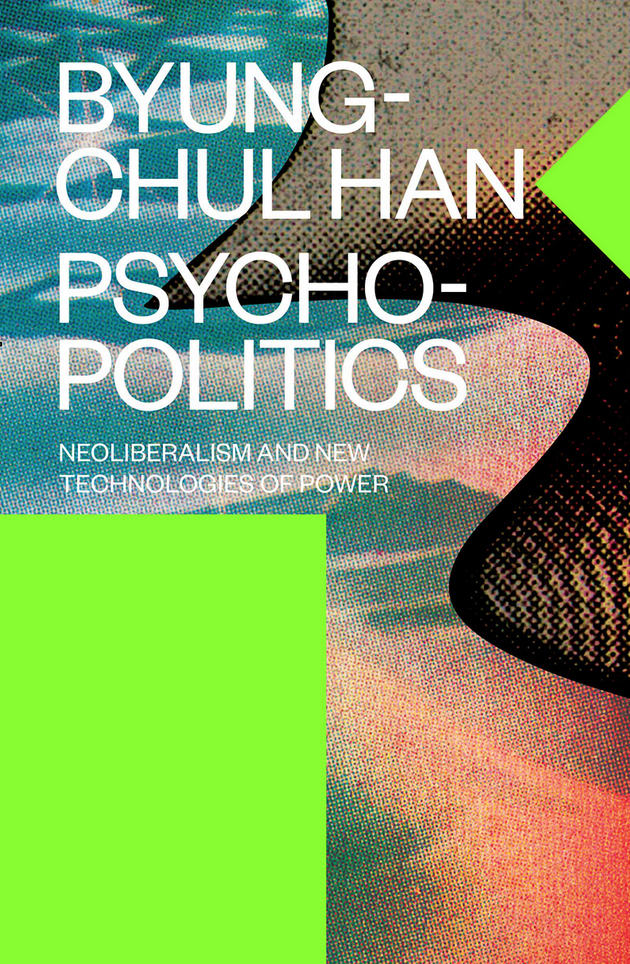
 Psychopolitics: Neoliberalism and New Technologies of Power by Byung-Chul Han, translated by Erik Butler.
Publisher’s website: https://www.versobooks.com/books/2505-psychopolitics
Chained to the Digital Camp
Capital thrives on chaos and the ‘libidinization’ of value. Its ceaseless self-reinvention is systemically violent; it grinds habit, destroys existential territories and deracinates stability. The working of capital is like that of a RIP [radically invasive projectile] bullet. Small, compact and elegantly shaped, a RIP doesn’t just penetrate the body. It triggers a series of explosions yet cannot be removed from the body without dismembering it. The aesthetic and affective tools of late capitalism – easification, gamification and that forever-out-of-reach-remaining ‘final gratification’ or ‘added value’, which, after a century of advertising, is experienced as deserved in all spheres of life: wealth, talent, even looks – are similarly smooth yet deadly. Agent-lessly, they produce automated misery.
Byung-Chul Han’s Psychopolitics: Neoliberalism and New Technologies of Power, originally published in German (Han’s adopted tongue) in 2013, is an attempt to anchor neoliberal strategies of subjugation in a single concept, or, rather, operation, which he inscribes in Foucault’s biopolitics, Deleuze’s society of control, and Stiegler’s psycho-technological telecracy (the reduction of people to compulsive creatures of consumption through televisual communication). Written in a characteristically aphoristic style reminiscent both of Lao Tzu and Nietzsche, yet resonating with the cultural topicality of thinkers like Baudrillard and Žižek, Psychopolitics is a compilation of Han’s previous ruminations on the internalization of power operations, the disappearance of time and participatory surveillance. Importantly, the book also sheds new light on the implication of big data analytics for micro-targeting and the shaping of the digital unconscious. Its chief claim is that the cherished western concept of freedom has been a failure. So much so that it has led to servitude. Centuries of biopolitical discipline in educational, religious, medical and penitentiary institutions (Foucault) have led to remote, technologically sophisticated mechanisms of control that dominate fragmented individuals or ‘dividuals’ (Deleuze). This has further led to pervasive digital surveillance and the idolatry of dataism – ubiquitous data collection, both for the purpose of value extraction and overt control – that Han defines as a ‘technology of domination that stabilizes and perpetuates the prevailing system by means of psychological programming and steering’ (79).
Without a doubt, we’re living in the age of coercion, the politically correct words for which are growth, opportunity and potential. Agamben’s notion of sacerization, rooted in the Schmittian state of exception and the spatio-temporal dispositif of the WWII concentration camp, which he interprets as the blueprint of modernity, could not be more topical. In particular, his understanding of the denigration and expendability created in and by the camp, not as a discrete historical event, but as a performative calibration that continues to operate in the repetitive cycles of neoliberal coercion. The reason why, as Agamben suggests, ‘we are all virtually homines sacri’ (1998: 123) is paradoxical, like the ancient Roman law, according to which homo sacer may be killed but not sacrificed. Excluded from the polis, homo sacer is condemned to bare life. Yet, the very power that excludes her – the sovereign ban – also includes her by way of exclusion, that is, as an expendable, worthless, sub-human creature.
Han suggests that in digital neoliberalism, the ‘homines sacri of today’ are not excluded but, rather, ‘shut into the system’ (24). This could not be truer. Eggers’ 2013 Orwellian novel The Circle, set in an omnipotent corporation which rules through digital interfaces that link and store everyone’s records, data and transactions in, literally, all spheres of life, is proving to be an increasingly accurate description of the contemporary techno-neoliberal ‘system’. However, Han’s reading of Agamben misses the paradoxical relationship of subjugation to freedom, which is not one of separation or opposition. For Han, neoliberalism merely ‘exploits freedom’ (3). Similarly, his reading of Hegel and Marx at the expense of such authors of Bentham, Berlin and the proponents of negative freedom – the freedom to throw off restraints and do exactly as one pleases, rooted in the disastrous concept of the human being as a rational agent – make it impossible to arrive at any other conclusion except that we need to disengage from the conformity-inducing social media and pursue purposeful idiocy. A call to idiocy is therapeutic and, frankly, delightful. Etymologically, ‘idiocy’ refers both to a specific mixture of bodily humors and to a person’s particular perception of the world based on this mixture of humors. While intelligence signifies choices confined to the already existing system (inter-legere means to read between), idiocy is willful and obstinate (83-85).
However, despite the beauty of this suggestion – consider Dostoyesky’s Idiot ‘s (Count Myshkin’s) obsession with the question of all questions, which he can neither answer, nor, for that matter, remember, but which continues to thwart all his wordly actions – one wonders whether a less humanistic and a more media-aware approach might have led to a different conclusion. For example, a debate of algorithm-driven data politics, and its implications for humans, non-humans and the environment, instead of a theory that relies on the outdated separation of emotions from the ratio, body from mind, and the resulting ‘progression’ from the biopolitical disciplining of the body to the remote, agent-less programming of the mind. Having said that, Han’s sustained concern, in his widely translated works has been precisely with turbo-capitalism’s systematic destruction of subjectivity and human agency.
Exiled, Burnt Out, Torn Apart
In his best-known book to date, The Burnout Society (Stanford Press, 2015,) initially published in German in 2010, Han outlines the plight of the neoliberal subject-project. Driven by the achievement imperative, the subject-project – in whom the Freudian superego, the ego, and the id have merged into the ideal me – is no longer exploited by another. She exploits herself. This is due to the general projectification of life and the neoliberal responsibilization of the citizen, whose consequence, among many others, is the relegation of social problems to the psyche of the individual. As a project, the subject is expulsed from the space-time it occupies, since to project means to launch, both in space and time. Although the meta purpose of frenetic hyperactivity is performance efficacy – the subject performs to become her ideal self – the obverse is achieved: utter inefficacy. Manifesting as burnout and depression, the failure to complete the project of becoming-subject results in (self) reduction to a state of expendability.
In The Scent of Time: A Philosophical Essay on the Art of Lingering (Polity, 2017) originally published in German in 2009, Han discusses the relation of truth to time; more specifically, the disappearance of truth, not as an absolute value, but as the stability of basic assumptions. He also addresses its counterpart: contra-temporality. Lacking in rhythm and the semantics of the path – the spatial and temporal becoming formerly associated with distance, effort and expectation, now flattened into the instantaneous availability of all things and people – contra-temporality creates a sense of missed opportunities and failed connections. This is exacerbated by the digital recorders’ repeated hauling back of past moments, which destroys the difference between the familiar, the semi-forgotten, the deeply intimate, and the so distant as to be unthinkable. Echoing Deleuze and Guattari, Han suggests that without intermediary spaces and times – or intervals – the structure of the experiential world disintegrates into ‘the chaos of fleeting impressions’ where chaos is not creative turbulence, but infinite, disorientating speed that destroys all possibilities of meaning-making (2017c: 17-18).
In The Agony of Eros (MIT Press 2017), originally published in German in 2012, Han, following Schmitt, puts forth the concept of the ‘immunological other’: the incomprehensible, even dangerous other of irreducible difference. By definition, the globalized world is a world of standardized sameness needed for the mass-circulation of commodities. It is an ‘excess of disinhibition and the dissolution of boundaries’, a form of discharge (2017b: 31-33). The immunological threshold that separates radical difference from ‘more of the same’ must here be lowered as a strong immunological reaction to otherness thwarts global communicational and distributive flows. Knowledge, which is profoundly transformational, has to be reduced to information, too. Information is multipliable and travels faster. The main argument of The Agony of Eros is that the levelling working of globalization has separated logos from eros and is producing increasing experiential and cognitive impoverishment. Without logos, eros is bereft of authentic desire, vitality and affect. Without eros, logos is reduced to banal ‘data-driven calculations’ (2017b: 81).
In In the Swarm: Digital Prospects (MIT Press 2017), initially published in German in 2013, Han takes on the digital erosion of privacy, which he, after Barthes, defines as the right ‘not to be an image and an object’ (2017a: 14) Juxtaposing the German Rücksicht, which refers to consideration, to the Latin spectare, which is voyeuristic, he develops the theme of pornography both as a permanent over-visibility and over-presence of images, things and people, and as an overexposure to such over-visibility. He further argues that the tyranny of transparency and the practice of participatory surveillance on social media reiterate the compulsion to conform while simultaneously weakening the potential for revolt. Digital ‘shitstorms’ are, for Han, an authentic phenomenon of digital communication in that they neither sustain engagement nor deepen dialogue. All they do is act as simulacric exhaust valves: they discharge affect.
The Violence of Freedom
Given this background, it’s not surprising that Psychopolitics opens with a passage on the crisis of freedom that revisits many of the above concerns: the self-exploiting subject-project, the fragmentation of experience, the erosion of community and the impossibility of resistance. Drawing on Marx and the Indo-European etymology of the word ‘freedom’ – to be among friends – Han anchors the concept in non-commodified human relations (2-3). For him, as for Marx, individual freedom is an illusion. However, Han doesn’t pursue the specifically capitalist paradox of enslavement through freedom and vice versa, by, for example, harnessing the theme of Nietzchean resentment. The already mentioned negative freedom – the freedom of the supposedly rational, self-standing agent is not only individual. It is inscribed in a long history of appropriation and amassment of signs, goods and territories, a strategy of self-legitimation and self-insertion into the social sphere that began with the bourgeoisie, continued with the industrial entrepreneurs and the myth of the self-made man, was further perfected by the early twentieth century magnates, the late twentieth century financial engineers and yuppies and the twenty-first century netocrats (the masters of digital networks).
In many of these cases, the accelerated production of ‘value’, often oblivious of environmental consequences, was driven by the desire to make up for historical ‘failure’ and denigration. In this context, freedom is inextricable from success as a retribution for past failure. For example, one could see (some of) the early white settlers in the US as the disenfranchised of Europe who ‘succeeded’ in the US by stealing from and enslaving Native Americans; in other words, by creating the exploitative and denigrating conditions similar to those they had fled from. Subjugation and freedom are not only consecutively ordered. They also coalesce in particular forms of freedom and valorization. For example, a phenomenon Han critiques throughout the book is emotional capitalism. Despite the fact that the rise of emotional capitalism is concomitant with the digital turn (the prevalence of software over hardware) and with the spread of therapy culture, it is also, in part, a ripple effect of decades of feminist struggle for the valorization of emotional and affective labor.
Freedom and subjugation are not polar opposites; they are locked in a mutually structuring relationship, just like day and night are. There isn’t such a thing called ‘day’ that is taken out in order to make room for a thing called ‘night’. Day is always already in the process of becoming night, much like night is always already in the process of becoming day. Despite the fact that it’s impossible to apply such a cyclical logic to the structuring dynamic of subjugation and freedom, understanding subjugation in terms of freedom and freedom in terms of subjugation is crucial in the current age of increasing automation where the subject-project auto-exploits and where the prevalent brand of violence is the ‘violence of positivity’. As Han persuasively argues contra Klein and her account of shock and disaster capitalism, far more dangerous than the overt violence of the shock-treatment-induced ‘de-patterning [of] neuronal habits’, is the tyranny of participation and the violence of ‘like’, a violence that seeks to involve and seduce, not to assault, punish or (visibly) hurt (35-36).
This is why Han’s repeated emphasis on what may, after Agamben, be called the ‘digital camp’ could not be more apposite (though, to be clear, this is not the phrase Han uses). He correctly identifies that smartphones, which he dubs ‘mobile confessionals’; ‘like’ clicks; and participatory surveillance on social media bear an uncanny semblance to such religious props, symbolic utterances/gestures and architectures as the rosary, ‘amen’, and the physical space of the church (with the church-goers ‘holier-than-thou’ attitude) (12). After all, religare signifies to bind by means ritual, which derives its efficacy (i.e. modifies behavior) through a specific ordering of time, space, (symbolic) objects, human gestures and utterances.
Han also insightfully links gamification and playbor to this particular form of subjugation. Over-layering leisure and/or work activities with game principles that combine the freedom of play with rules, goals and tight feedback loops, gamification and playbor elicit engagement. They extract and channel energy like no other activity. They are far more efficient than any amount of Foucaultian disciplining. He also presciently suggests that big data will be used for micro-targeting in political campaigns that portray the candidate according to the targetee’s already existing opinions and tastes (the German version of Psychopolitics was published before Cambridge Analytica harvested personal data from over 87 million Facebook users without their consent, then used it to target American voters with individually tailored political advertising in the 2016 presidential election).
And yet, insights that might be gleaned from reading religious and smartphone rituals, play and work, not as mutually exclusive but mutually constitutive, are overridden by Han’s overly humanistic approach and his overreliance on the chosen philosophical lineage. For example, Han uses Foucault’s theorization of Bentham’s Panopticon as an architectural provision that enforces transparency. However, as Božović has shown his 1995 Panopticon Writings, the Panopticon does not exteriorize by bringing the hidden to the surface. On the contrary, the Panopticon creates transparency as a byproduct of fiction and opaqueness, of the myriad possibilities of who is watching whom, how, when, why, with or without whom. Contrary to Foucault, who claims that Bentham’s Panopticon is a ‘cruel, ingenious cage’, Božović, following Bentham, shows that ‘constructing the Panopticon produces a prison, but also a god [a mysterious force] within it’ (2010: 6-7).
Coupling self-subjugation and self-exploitation to machinic enslavement and the predictive working of big data, Han’s theorization of the neoliberal condition creates a ‘cage’, too. While big data analytics, with its predictive and prescriptive working, certainly begs the question of the embeddedness of bias and prejudice in the algorithm, not to mention the linking of employment, medical, consumer and financial records, which make it impossible for vulnerable members of society to find a job or obtain a bank loan for the simple reason that they’ve been classed as ‘trash’ (65) by companies such as Acxiom, Han’s reading of algorithmic logics is too humanistic.
The point is: are algorithms and data-gathering programs really surveying anyone? Or, might a more medium-attuned view of data as completely unconcerned with content, interiority, and the human psyche, be a better way of approaching a technologically distributed subjectivity? The horizon of social and political action (individual or collective) has changed drastically since the introduction of algorithms capable of making autonomous decisions. However, even profoundly humanistic concerns with, for example, experience and power relations, of such theorists as Benjamin and Adorno, have benefited enormously from the analysis of technical media. Not as objects but as perceptual environments that organize the spatial and temporal hierarchies of things, events and people, modes of participation and reflection, possibilities of multiplication, affect, and metacognition – e.g. Benjamin and Adorno’s respective analyses of film, newspapers and radio. Haggerty and Ericson’s theorization of the assembling and disassembling work of algorithms, which break people down into ‘informational flows’ (2006: 4), may be more appropriate; or, Grusin’s notion of ‘radical mediation’ which does not stand between subjects, objects or entities (2015: 129) but is ‘the process, action, or event that generates the conditions for the emergence of subjects objects and entities’ (2015:141).
The coercive working of the digital camp, including big data’s foreclosure of the future, which, as Han rightly argues, is a threat to what we are accustomed to call ‘free will’, is rooted in strictly non-psychological factors: speed, tempo, the stimulus-response, action-reaction flows, the gadgets and the network. The digital camp is about the ordering of time, space and the orchestration of interaction. It has nothing to do with individuals or their intentions. This is why any discussion of ‘freedom’ requires a more precise framing. The so-called positive freedom, a concept inherited from T.H. Green, foregrounds the pre-existing conditions, rules and actors in any given situation. Within this framework, human beings are regarded neither as ‘naturally free’ nor as sufficiently rational to be allowed to do as they please (Dimova-Cookson, 2003: 516). Instead, freedom is constrained to the existing configuration of the playing field. As in the advanced stage of a chess game, the possible moves are limited.
In the current context, digital guerilla tactics, such as culture jamming and (h)activism that have successfully used the simulacrum against itself as cultural workers like The Yes Men and etoy have shown, or the data obfuscation movement and inventions like Brunton and Nissenbaum’s browser TrackMeNot (which overwhelms data-tracking programs with an avalanche of useless data thus disguising the user’s own data), may be the only possible moves. As Han himself notes, the current era is the era of the ‘emptying out’ of institutions and individuals (9). It is also the era of the crisis of representation. Just like everyone else, politicians are subjected to the tyranny of transparency and obligatory likeability. They, too, have been commodified. It would follow that technical savviness, coupled with persistent vigilance is the only way out. Obviously, one could argue that having to become a computer expert against one’s will is already an infringement on one’s freedom. While this may be true it appears to be the only possible action-critique of the current condition.
Han’s Psychopolitics offers the much-needed account of the steadily proliferating modes and sites of coercion. However, the book’s reliance on such outdated-ly holistic notions as ‘soul’, ‘psyche’, initial or potential freedom does little in the way of immanent critique. Deeply influenced by Hegel’s negative dialectics, Han’s engagement remains transcendent, although this is by no means to say that the book does not perform many important tasks, such as articulate the loss of otherness, difference, authenticity, time, sleep, potentially also future and free will, while simultaneously reinstating the importance of profound yet pristine clear negative critique in the age of over-positivity, where a cheerful attitude to a disastrous situation is considered a moral obligation.
References
Agamben, G. (1998) Homo Sacer: Sovereign Power and Bare Life. D. Heller-Roazen, trans., Stanford: Stanford University Press.
Bard, A. and Söderqvist, J. (2002) Netocracy: The New Power Elite and Life after Capitalism. Harlow: Pearson Education Ltd.
Berlin, I. (2002) Freedom and Its Betrayal. Princeton: Princeton University Press.
Božović M. (ed.), (2010) The Panopticon Writings by Jeremy Bentham. London: Verso.
Brunton, F. and Nissenbaum, H. (2015) Obfuscation: A User’s Guide for Privacy and Protest. Cambridge MA: MIT Press.
Deleuze, G. (1995) ‘Postscript on Control Societies,’ Negotiations 1972-1990, M. Joughin, trans., New York: Columbia University Press.
Dimova-Cookson, M. (2003) ‘A New Scheme of Positive and Negative Freedom: Reconstructing T.H. Green on Freedom’, Political Theory, 31 (4): 508-532.
Dostoyevsky, F. (2002) The Idiot, L. Volokhonsky, trans., New York: Everyman’s Library.
Eggers, D. (2013) The Circle. London: Penguin Books.
Grusin, R. (2015) ‘Radical Mediation’, Critical Inquiry, Vol.42, No.1: 124-148.
Haggerty, K.D. and Ericson, R.V. (2006) The New Politics of Surveillance and Visibility. Toronto: University of Toronto Press.
Han, B-C. (2015) The Burnout Society, E. Butler, trans., Stanford: Stanford University Press.
Han, B-C. (2017a) In the Swarm: Digital Prospects, E. Butler, trans., Cambridge MA: MIT Press.
Han, B-C. (2017b) The Agony of Eros, E. Butler, trans., Cambridge MA: MIT Press.
Han, B-C. (2017c) The Scent of Time A Philosophical Essay on the Art of Lingering, D. Steuer, trans., Cambridge: Polity.
Stiegler, B. (2010) For a New Critique of Political Economy. D. Ross, trans., Cambridge: Polity.
 Dr. Natasha Lushetich is Senior Lecturer in Interdisciplinary Practices and Visual Studies at LaSalle, Singapore. She is the author of Fluxus The Practice of Non-Duality (Rodopi 2014), Interdisciplinary Performance (Palgrave 2016) and editor of The Aesthetics of Necropolitics (forthcoming with Rowman and Littlefield, December 2018).
Email: natasha.lushetich@lasalle.edu.sg
Leave a Reply