

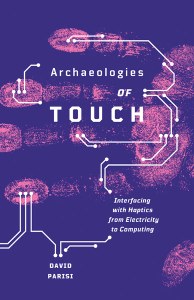
 David Parisi (2018) Archaeologies of Touch: Interfacing with Haptics from Electricity to Computing. Minneapolis: University of Minnesota Press.
Publisher’s website: https://www.upress.umn.edu/book-division/books/archaeologies-of-touch
David Parisi’s Archaeologies of Touch is an important work which will henceforth serve as an indispensable referent for those seeking to understand the history and condition of touch and its technological mediation. It is a work of deep erudition and study, carefully plotted, and written with penetrating insight, establishing Parisi (alongside figures such as Mark Paterson) at the vanguard of the developing field of haptic media studies.
Touch has, to a very significant degree, held a place as the great un-theorised within media theory. On the one hand, media and intellectual history has persistently theorised modernity as an ocular or auditory modernity, one in which touch has been marginalised, devalued as incapable of signifying or registering meaning amidst the discourses of rationality, objectivity, and industrial precision. On the other hand, Marshall McLuhan’s foundational theorisations considered touch as a kind of pan-sensual unifying force, as “the interplay of senses, rather than the isolated contact of skin and object” (1994: 314). In this imagining touch does not really possess its own positive character, but is instead positioned as a kind of sensorial unifying element in the phenomenological experience of mediation. In both understandings touch takes on a kind of pre-lapsarian value, signifying something lost in the welter of modernity, but something which also persists outside the organising logic of modern technorationality, and hence offers potential resources for its critique and subversion.
Parisi’s history serves to demonstrate that both understandings are in need of revision. Touch, Parisi argues, has been the “object of a hegemonic – rather than counterhegemonic – instrumental rationality operating in industrial and postindustrial capitalism” (36). Far from touch serving as an asignifying and transhistorical sensorial force, touch has been produced and transformed time and again through its incorporation into a shifting, metastable haptic apparatus, which Parisi analyses through both an archaeological and a genealogical lens. Touch does not exist outside of its technohistorical instantiation, and indeed many of our “intuitions” about the power of touch to communicate and to perceive stem not from any inherent nature of the sense, but from specific material circumstances, especially the protocols of the 19th century laboratory.
Parisi’s archaeology is divided into five ‘interfaces’ – the anachronistic term serving as a self-reflexive nod to the way the work functions as a critical history of the present. The historical analysis is extremely dense, and the following summary can provide only a bare overview of the key turns in the history Parisi uncovers.
Interface 1 examines the 18th century, and looks at the way touch was employed within the ‘electrotactile machine’, as a way of experimenting with as well as spectacularly reproducing the effects of the new science of electricity, ultimately producing “an increasingly refined tactile form of knowledge” (44). The effect of this was that “[r]ather than marginalizing and alienating touch, direct and structured appeals to an epistemically oriented touch underpinned Enlightenment scientific encounters with electricity” (44). Parisi describes experiments such as Alessandro Volta’s ‘crown of cups’, which drew upon the power of touch to demonstrate the way in which power is discharged from a battery. Parisi demonstrates here what he terms the “generative function of shock” (6): electric shock understood not in terms of a traumatic or neurasthenic response to modernity, but as a mode of measuring or accounting for the novelty of new technological possibility.
Interface 2 focusses on the 19th century, especially the work of Ernst Weber and the project of what Parisi terms ‘tactile modernity’. During the 19th century, touch was systematically ‘shattered’ and then reconstituted through experiments like those conducted in Weber’s laboratory, which attempted to isolate through experiment the various modalities of touch, subdividing it into “roughness, warmth, cold, pressure, size, location, and weight” (136). Parisi demonstrates that rather than touch constituting a unified pan-sensorial quality which would elude scientific experimentation, touch was “remapped and subsumed…within a new frame of disciplinary methods, doctrinal dictates, and instrumental measurement techniques” (150).
Interface 3 focusses on the first half of the twentieth century, during which there was a concerted effort to operationalise the haptic as “the tongue of the skin”, as a vector for communication. Where touch had previously been understood as too alienated from the ‘higher’ senses of the optic and the auditory to communicate language, now researchers drew upon the ordering of touch produced through the 19th century to experiment with tactile communication techniques. The Teletactor of Robert Gault, for instance, attempted to transform the vibrations of speech into a series of haptic signals which could be ‘read’ through the fingertips. A technical apparatus which had been drawn upon to produce knowledge about touch was now reconfigured towards “the communication of knowledge through touch” (193). Parisi notes that while the overwhelming complexity of such a project led to its failure, this was a failure which nevertheless served to “map[…] (touch) with much greater care and precision than was thought possible at the start of the century” (211).
Interface 4 analyses the second half of the twentieth century and its focus on “human-machine tactile communication” – rather than translating human language into a haptic language, the emphasis shifted to producing means for humans to interact haptically with machines. Parisi charts this development from the early industrial manipulators incorporating touch feedback systems to more complex syntheses of the body of research on human sensorial discriminatory capacity with other technical apparatuses aimed at producing haptic response. One example discussed is the “really there index”, designed to “evaluate the operator’s direct sensing of the remote task and his identification with the remote hands as his own” (229). This work developed into the field of computer haptics, the effort to quantify the coordinates of touch’s instantiation in an “operative technical logic” (218). The other key aspect of this period was the attempt to produce a haptic ‘holy grail’ – a haptic interface capable of perfectly simulating the experience of touch, such that in Ivan Sutherland’s words, one might be able to produce an “ultimate display” in which even the fatal impact of a bullet might be successfully ‘simulated’ (214). As with the developments of Interface 3, these projects never reached the fevered heights of such dreams nor entered into widespread commercial manufacture, though some elements were incorporated into contemporary haptic technologies, such as smartphones and touch-enabled gaming platforms like the Nintendo DS.
Interface 5 examines the 21st century evolution of haptics, shifting focus from the significance of technological and scientific discourses towards an analysis of the “cultural construction of technologized touch” (279). In this section Parisi discusses how touch, rather than being buried or marginalised as a sense of modality, has been actively promoted by commercial interests – we live in an era in which, according to Nintendo’s copywriters, “touching is good”, in what Robert Jütte has suggested might even be considered a “haptic age” (272). And yet, this celebration or promotion of haptics remains equivocal and caveated, even amongst its most fervent promoters. In the book’s coda Parisi discusses the curious events of the 2015 developers’ conference for the virtual reality technology Oculus Rift – in an event expected to function as a celebration of the potential of Oculus’ new Oculus Touch system, Chief Scientist Michael Abrash took the opportunity to advise that virtual reality’s capacity to convincingly simulate touch was still a good way off being realised, still awaiting a technological transformation which would amount to a “world changing magic” (325). The supreme challenge of convincingly simulating touch through media-technological means remains apparently as utopian an ideal today as it was to experimenters a hundred years prior.
Parisi’s work is ambitious and challenging at a methodological level. It is obviously framed as a media archaeology, and hence as part of the broader body of work influenced in the English-language academy by what is termed ‘German Media Theory’. Media Archaeology has, as a general orientation, embraced the study of media technologies and practices which have been obscured or effaced by normative linear narratives of media technological progress – Siegfried Zielinski in particular has argued for a variantology which would “discover fractures or turning points in historical master plans that provide useful ideas for navigating the labyrinth of what is currently firmly established” (2006: 7). Parisi notes the vitality of the media archaeological approach, but raises the caveat: What if there is nothing firmly established? For Parisi, “…where touch (and other nonaudiovisual) media are concerned, no linear and teleological narrative exists for media archaeologists to problematize and overturn” (28). The “disciplinary privilege” (29) from which the media archaeological perspective operates is not tenable for a study of haptic media. At the same time Parisi identifies that there is a sort of vulgar teleology in contemporary Silicon Valley claims that a simulacra of human touch will emerge after the ‘next big breakthrough’, just as there is a tendency towards the ahistorical phenomenological understanding of touch which predominates in critical theorisations of the mediation of the senses. The challenge that Parisi sets himself methodologically then is to both construct a history of the technological mediation of touch which establishes for the first time what its key moments, innovators, and theories have been, while at the same time demonstrating the contingency and blindspots of this very history.
In a recent review of Archaeologies of Touch Ricky Crano (2018) argues that although Parisi’s analysis is thorough and successful, the project of ‘Haptic Media Studies’ which Parisi hopes to lay the groundwork for in his book is essentially rendered by the same book as being dead in the water. For Crano, such a field essentially begins and ends with Archaeologies of Touch, to wit:
If there is a flaw in the project, it is that the “haptic subject” that Parisi ultimately reveals remains so scattered and incomplete and largely underwhelming in its cultural effect. Archaeologies of Touch is a significant achievement in media research, yet Parisi envisions it as but the tip of the iceberg for an emerging subdiscipline. His genealogy, capped by an incisive condemnation of the current reductivism of touchscreen technoculture, would seem to cut short the task going forward for such a subfield.
Though Crano caveats this critique by arguing that “this should be seen as more a commendation than a criticism of Parisi’s powerful work”, I would nevertheless put greater emphasis on the subtlety and value of the work’s central aporia. Parisi convincingly demonstrates that touch has factored as the object of a hegemonic instrumental rationality across modernity. And yet, at the same time, touch has been neglected, remains neglected, as a modality, as an object of critical study – the very novelty of Parisi’s book itself demonstrates this to be true. The productive failure of the haptic subject to signify coherently and to reproduce itself, its continued quasi-disappearance and imminent reappearance in different forms throughout history, the liminality of touch’s mediation, demonstrate not that the haptic subject is an “underwhelming” figure of study, but rather a fascinating challenge to the question of what it means to mediate the senses.
In terms of the productivity of the haptic media studies frame, Parisi alongside Mark Paterson and Jason Archer, has already edited a successful special edition of New Media & Society (Vol 19, Issue 10) (to which, full disclosure, your humble correspondent was a contributor) demonstrating the fecundity of a haptic media studies frame for studying a range of fields which Parisi does not consider in great detail in his text, such as clinical medicine, contemporary disability studies, architectural histories, and so on. This demonstrates that are indeed a range of haptic media technologies which remain to be considered, and Parisi’s immensely learned work will be taken up by other scholars who will in turn be able to push this burgeoning field in further new directions.
Parisi has provided a detailed and rigorous analysis of the historical media-technological production of the haptic subject. Extending this analysis will mean re-examining and developing other media and cultural histories of touch – such as the work of Mark Paterson, Constance Classen, and Robert Jütte – to consider what it is about touch which makes it so difficult to grasp. This text will be an indispensable tool for all those working in the disciplines of media history, as well as studies of the body and of mediation more broadly.
References
Crano, R. (2018) ‘Review of Archaeologies of Touch: Interfacing with Haptics from Electricity to Computing by David Parisi (University of Minnesota)’, Lateral 7(2).
McLuhan, M. (1962) The Gutenberg Galaxy: The making of typographic man. Toronto: Toronto University Press.
Zielinski, S. (2006) Deep Time of the Media: Towards an Archaeology of Hearing and Seeing by Technical Means (trans. G. Custance). Cambridge (Mass.): MIT Press.
Christopher O’Neill is a PhD candidate in the School of Culture and Communication at the University of Melbourne, Australia. He is currently completing a thesis examining the genealogy of wearable sensor technologies, focusing on the fields of medicine, labour, and security. His work has appeared in New Media & Society, Science, Technology & Human Values, and Platform: Journal of Media and Communication. He is a member of the Graduate Academy in the Research Unit in Public Cultures at the University of Melbourne.
Leave a Reply