


Abstract
Between 1959 and 1963, the German Informel painter K.O. Götz produced a series of works inspired by what he perceived to be television’s potential to initiate a new form of “kinetic electronic painting” (Götz, 1961: 14). His corresponding production of the Rasterbilder (Raster Pictures) and the film Density 10:2:2:1 were mapped on the technical and formal possibilities of analogue electronics in general, and of television in particular; however, these works were made without any direct use of the new medium, to which Götz had failed to gain access. This article argues that the concept of “imagined affordance” (Nagy and Neff, 2015) enables a critical reassessment of Götz’s elusive relation to television. Rather than focusing on the lack (of cognition or access) that this concept implies, I argue that “television” functioned as a flexible paradigm through which the artist was able to combine Modernism with the emergent field of information aesthetics. Inspired by the discretized aesthetic of the electronically-produced image, the Raster Pictures and Density 10:2:2:1 predate – albeit in an analogue manner – the first works of computer-generated art by several years.
Keywords
Affordance, K.O. Götz, television, kinetic painting, information aesthetics, Informel
K.O. Götz’s Kinetic Electronic Painting and the Imagined Affordances of Television
ALINE GUILLERMET
University of Cambridge, UK
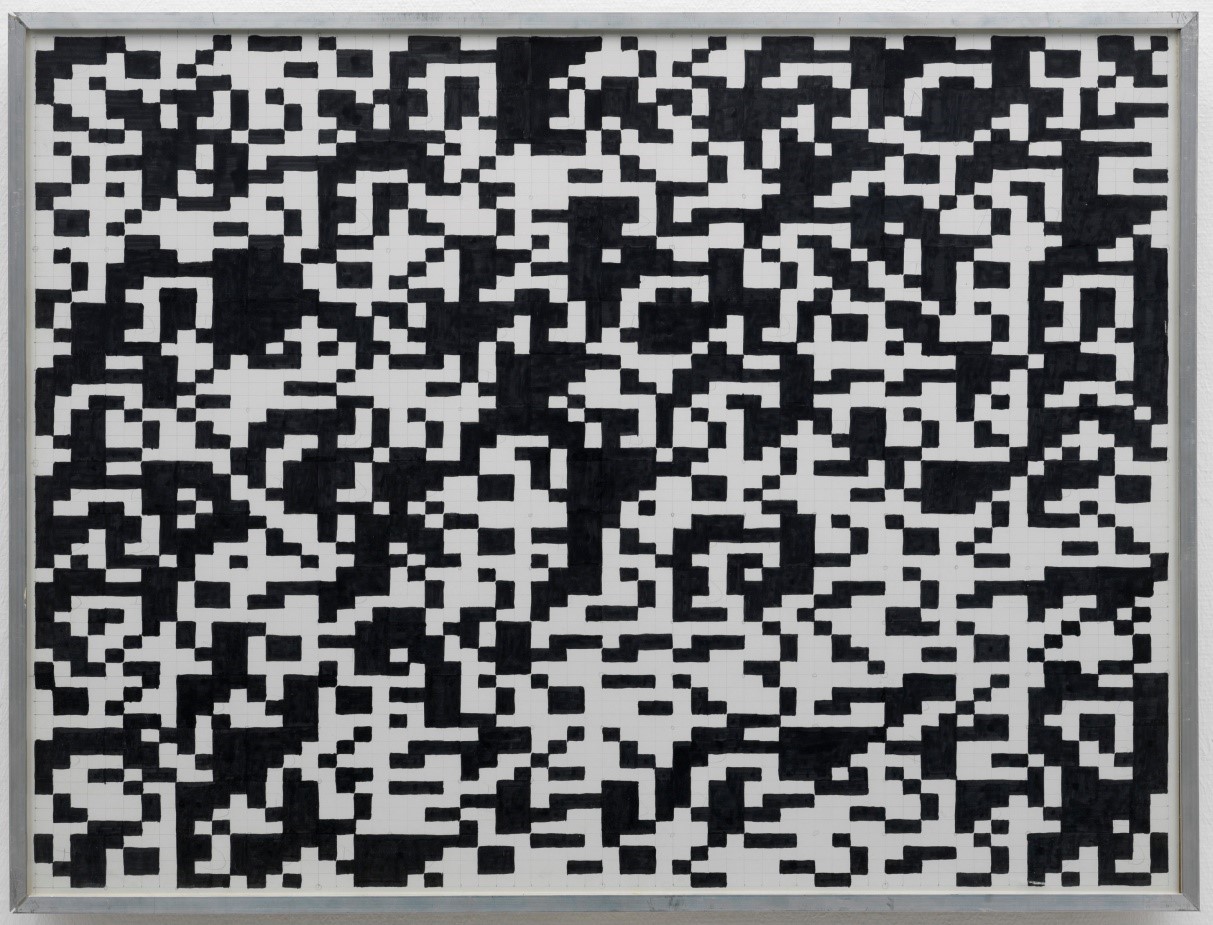
Between 1959 and 1963, the German Informel painter Karl Otto Götz (1914–2017), then professor of painting at the Düsseldorf Art Academy in West Germany, produced a series of works that led him to be discussed as an emerging “television artist.”[1] The first corpus, known as the Rasterbilder (Raster Pictures, 1959–61), is a series of black and white geometric abstractions composed of small squares, arranged in a gridded canvas according to statistical rules derived from information theory. The second of these works is the animated film Density 10:2:2:1 (1962–63). While Götz considered the former to be the “preliminary stage” to his overarching attempt to generate “electronically programmed” pictures (Götz, 1995: 29), the latter goes some way toward realizing this ambition. Shot between 1962 and 1963, Density 10:2:2:1 consists of stills of hand-drawn raster permutations animated to produce moving sequences of flickering patterns. Both works were inspired by what Götz perceived to be the affordances of electronic technology in general, and of television in particular, namely their capacity to realize a new form of kinetic abstraction. To some extent, Götz’s project therefore sought to update the modernist exploration of kinetics, most notably Hans Richter and Viking Eggeling’s experimental films of the 1920s, which developed the idea of abstraction as a universal language of perception. The film Density 10:2:2:1, which uses animation techniques, also shares affinities with the work of Oskar Fischinger and Norman McLaren, both of whom furthered the development of abstract animation from the 1930s onwards. However, while Götz’s raster works, as this article argues, originate in a modernist framework, his project of “kinetic electronic painting” (1961: 14), with its reliance on a new techno-aesthetic framework, also markedly differ from these earlier approaches.
The idea of using electronic technology to create moving images began with radar experiments that Götz conducted in Norway during World War II. Struck by the aesthetic potential of the “Braun tube,” as the early cathode-ray tubes were known, he believed that analogue electronics had the potential to transform abstract painting: “A representation of forms of all kinds is possible with the help of the directed electron ray” (Götz quoted in Mehring, 2008: 33).[2] After the war, Götz intuited that the new medium of television would offer a more sophisticated means of realizing his vision of “kinetic electronic painting.” As Christine Mehring reminds us, “television,” in postwar Europe was understood not primarily as a mass medium, but rather in terms of “its purely technical and formal possibilities” (2008: 32). Indeed, Götz’s interest in television was largely theoretical, resting on his (sometimes misconstrued) understanding of analogue electronics, and the discretized image that they enabled. Yet, for reasons that I shall develop, the works that Götz made as a so-called “television artist” were produced without his ever having access to television technology, complicating the matter further. Consequently, Mehring has argued that Götz’s raster production has less to do with the television itself than with “a yet undetermined new medium that most closely resembled television” (2008: 36). Given these circumstances, it becomes apparent that Götz’s “television works,” as we might call them, are only loosely connected to the actual technological affordances of the medium that supposedly defined them.
Peter Nagy and Gina Neff’s concept of “imagined affordance” (2015) sheds light on the specific dynamic that arises when an artist projects ambitions, informed by their own background of expertise, onto a technology to which they do not have access. Nagy and Neff aim to redefine the concept of “affordance” through an examination of three intersecting factors: the material features of the given technology; the users’ perceptions or expectations of those features; and the specific ends for which these features are designed. In particular, the authors argue that a contemporary theory of affordance needs to take into account the beliefs and affects of users in their interaction with “the blackboxed muck of socio-technical systems” (2015: 4). “Affordances can and should be defined,” they write, “to include properties of technologies that are ‘imagined’ by users, by their fears, their expectations, and their uses […]” (2015: 4). One specific aspect of Nagy and Neff’s definition of “imagined affordance” will prove particularly useful for Götz’s work. Building on J. J. Gibson’s definition of “imagery” as “an extension of perceptual knowledge, which is ‘not so continuously connected with seeing here-and-now as perceiving is,’” they state: “The point is not solely what people think technology can do or what designers say technology can do, but what people imagine a tool is for” (2015: 4-5).
In the 1960s, Götz published a number of articles indicating that he possessed a solid theoretical understanding of television’s technical affordances (Götz, 1959; 1960; 1961). Yet he had already begun to project aesthetic possibilities onto television at a time – World War II – when it was for him still a medium “merely imagined” (Mehring, 2008: 35). Moreover, having failed to gain access to electronic technology after the war, he remained unable to test his hypotheses. His professed ambition to use a television to produce “kinetic electronic painting” remained, therefore, in the realm of the imaginary. Such a realm, however, ought not to be defined in terms of the lack of cognition or access that the psychic dynamic of desire implies; on the contrary, Nagy and Neff’s conceptual innovation invites a deeper scrutiny of television’s imagined affordances, as they might have pertained to the artist. In this article, I argue that the affordances of television, which enabled Götz to imagine the medium as a tool for painting, indicate a larger discursive field that reconciles the theoretical underpinnings of Modernism with the statistical principles of information aesthetics. In so doing, I aim to show that Götz’s raster works are a continuation of the intellectual framework that shaped his broader painterly practice. In the first part of this article, I argue that Götz’s ambition to use technology to make kinetic painting can be traced to his interest, in the mid-1930s, in Richter and Eggeling’s experiments with kinetics. In the second part, I focus on the role that information aesthetics played in defining the newly-quantified image field that enabled the Raster Pictures. In the third and final part, I discuss the imagined affordances of television as exemplified by Density 10:2:2:1.

Early kinetic painting
By the late 1950s, Götz had become a leading figure of a European style of gestural, abstract painting, known as Informel [fig. 1]. In 1959, he was appointed professor of painting at the Düsseldorf Art Academy and, in parallel to his exploration of Informel, began producing the first Raster Pictures. These works, he insisted, had “nothing to do with [his] paintings” (1995: 23, 31); they merely (and apparently entirely coincidentally) “resembled Informel pictures because there were no clearly defined forms” (1995: 24). Art historians have taken issue with this assessment, arguing that the Raster Pictures and the Informel paintings were closely connected through a shared interest in developing a new abstract visual language (Beckstette, 2009; Mehring, 2008). Mehring goes further, asserting that “[t]he Informel painting Götz became best known for, in fact, seems saturated with the ambitions of an electron painter” (2008: 36). But, as I now argue, the reverse is also true. The dream of electronic painting, at the origin of both the Raster Pictures and the later Density 10:2:2:1 film, predates Götz’s awareness of either radar or television, going back instead to the early moments of his career as a painter. In the 1930s, Götz’s fascination with Richter and Eggeling’s abstract films, and the works he produced as a result, created the conditions for the advent of both his Informel style in the early 1950s, and the Raster Pictures from 1959 onwards. Consequently, both corpora of works are embedded in a similar modernist framework, which emphasizes the importance, in developing an abstract language, of medial autonomy. This would prove crucial to the way in which Götz conceived of a new kinetic painting informed by electronics.
Götz writes that his mid-1930s discovery of Richter’s book Filmgegner von heute – Filmfreunde von morgen (Film Enemies of Today, Film Friends of Tomorrow) (1929), prompted his experimentation with film (Götz, 1994: 143). It is likely that he had also already seen Richter’s abstract film Rhythmus 21 (1921);[3] he would in any case certainly have been aware of it, given that one illustration in Richter’s book, captioned “Here the rapid growth of a square,” directly references the opening sequence of the film (Richter, 1929: 10). As a result, in the summer of 1936, Götz used two series of his own works made between 1935–36 as source material for his first filmic experiments: the Photomalereien (Photo-paintings), composed of over-painted photograms;[4] and the Spritzbilder (Spray-paintings), realized by overlaying several stencils on a blank surface, and applying paint by means of a mouth atomizer that allowed the artist to diffuse it evenly. The resulting abstract shapes were later reworked by painting onto some of the areas, or drawing figurative patterns over them (Oellers, 2004: 9). The layered aesthetic that characterized both series of works lent itself to animation: with the help of a 9.5mm Pathé camera and three projectors, Götz filmed the paintings so as to develop sequences of complex shapes that morphed into one another when projected (Götz, 1993: 154). He produced three short films, which were all destroyed in the Dresden aerial raids at the end of the war.
While the Photo-paintings and the Spray-paintings remain figurative, they anticipate the artist’s evolution toward abstraction in two distinct ways. Firstly, they were produced using a range of techniques that encouraged the automatic, as opposed to the mimetic, trace. Thus, Götz writes that they were his “first Surrealist works” and even if, by his own admission, he knew very little about Surrealism at the time (Götz, 1993: 153), it is clear that the manner in which both the Photo-paintings and the Spray-paintings rely on existing shapes for inspiration and image transformation parallels the Surrealist techniques of collage and frottage.[5] Secondly, in painting and drawing over automatically-obtained shapes, Götz already favored an abstract aesthetic: “In some of the photo-paintings, I went so far as to work figments of the imagination into the image that had absolutely no resemblance with known objects or beings” (1993: 153).
Although we know little of the destroyed films, we can imagine that the animation, duplication, and layering of the Photo-paintings and the Spray-paintings into new configurations and sequences, which the three projectors enabled, would have further blurred the lines between figuration and abstraction, and produced a result where, to repurpose Götz’s description of the Raster Pictures, “clearly defined forms” are absent. In this, the works conformed to the agenda set by Richter in his book: film, he argued, ought to follow in the footsteps of painting, and emancipate itself from the representation of natural forms, because “what has long been proven in other art forms is also valid for film: being bound by nature is limiting” (Richter, 1929: 33). It was not only Richter’s book that gave Götz the idea of using his own paintings to make his first films; both Richter and Eggeling’s broader experiments with kinetics also provided the theoretical background for bridging the gap between Informel and kinetics in his work. Götz’s conception of kinetics as a modernist pursuit, however, rests on a slight misunderstanding of his interpretation of Richter and Eggeling’s artistic process.
In 1919, the pair produced several Rollenbilder (Picture Scrolls): drawing studies realized on long strips of paper, which depicted the development and transformation of a given shape, based on the model of the musical variation (Hoffmann, 1998b: 76). In Erinnerungen, his artistic auto-biography, Götz mistakenly connects the series of ten drawings that form the Präludium scroll (1919), asserting that the drawings, which developed a visual theme over an approximate length of six meters, “necessarily led to [Richter’s] first abstract film Rhythmus 21” (Götz, 1994: 144). While Richter and Eggeling had originally hoped to set these drawings in motion, this proved more difficult than they had foreseen, and Richter, in fact, finally gave up on the idea. Thus, according to Justin Hoffmann:
They did produce a number of test film strips of which one, the filming of part of the Präludium roll, was later used in Richter’s film Rhythmus 23. All told, however, [Richter and Eggeling] were badly disappointed by the results of their work in the UFA [Universum Film A.G.] studios [in Berlin] when they saw the developed films. Richter came to the conclusion “that these rolls could not be used, as we actually had thought, as scores for films” (Hoffmann, 1998b: 78).
In fact, Richter has specified that Rhythmus 21 was made out of “rows of paper rectangles and squares of all sizes,” rather than based on the scroll format (quoted in Hoffmann, 1998b: 79). This, in itself, is significant in a manner that was lost on Götz. While the direct connection that he had perceived between Richter’s scrolls and kinetic painting was a mistake, the way Richter actually made Rhythmus 21 to some extent already anticipates a quantified approach to the screen, which would prove central to the Raster Pictures. Thus, as Hoffmann argues, Richter had already begun to see the screen as “a precisely calculable form in its own right” (1998b: 79); this comes to light in Richter’s own description of the process: “In the rectangle and the square I had a simple form, an element, that was easy to control in relation to the rectangular shape of the screen” (quoted in Hoffman, 1998b: 79.)
For Götz, the Picture Scrolls also anticipated a problem common to both his Informel and raster production: how to visualize the evolution of what he termed “pictorial schemes” (Bildschemata). Indeed, the Picture Scrolls, although static, already afforded a kinetic perceptual experience: as the eye wanders from one shape to the next, the viewer, in Richter’s words, “experiences the representation in a single stream, which easel painting could not offer” (quoted in Hoffmann, 1998b: 83). For Richter and Eggeling, the scrolls belonged to a broader endeavour to develop a “universal language,” which developed the idea that “abstract form offers the possibility of a language above and beyond all national language frontiers” (Richter, quoted in Hoffman, 1998b: 76). According to Richter, by the time he first met Eggeling in 1918, the latter had already developed “a whole syntax of form elements, when I was just starting with the ABC” (quoted in Hoffman, 1998b: 75).
Götz’s Fakturenfibel (Facture Primer), an artistic diary that he compiled during the war, and which analyzed the development of anthropomorphic and biomorphic shapes over a series of variations, apparently closely parallels this project [fig. 2]. Indeed, in German the term Fakturenfibel refers, precisely, to children’s alphabet books (Bibelisten).[6] Thus, in retrospect, Götz argued that Richter’s scrolls tackled the same problem as his own formal experiments: namely, “how one could best achieve sequences of formal transformations in painting” (Götz, 1994: 143). However, what Götz perceived as a focus on formal variations had more to do, for Richter and Eggeling, with the avant-garde pursuit of establishing a “new visual system of communication … for the new society” (Hoffman, 1998a: 65). Whereas, in Richter and Eggeling’s case, these formal experiments led to a thorough exploration of the relation between film and music, in Götz’s case, the Facture Primer gave rise to paintings in their own right, such as the 24 Variationen mit einer Faktur (24 Variations on a Facture) (1948) [fig. 3]. In the end, this second misunderstanding proved crucial to the development of Götz’s Informel style, which sought to combine the “formal transformations” of the Facture Primer with the speed of the monotype (Götz, 1994: 113). The result was, in 1952, the development of a new technique that would establish Götz’s painterly style for the rest of his career: the fast application of glue and gouache on paper, whose product is then dynamically reworked with a rake, in turn followed by a fresh application of paint (Götz, 1994: 113)

After the war Götz never again tried to “animate” his traditional painterly production (i.e., the Informel paintings); rather, he entirely transferred his interest in kinetics to the Raster Pictures. Two related factors account for this decision. Firstly, Götz held a strong belief in the historical progression of modernist painting (epitomized by what he calls the “dissolution of the classical concept of form”), from Malevich’s Black Square of 1913, through Informel, to “serial painting, raster painting, statistical painting, and electronic painting” (Götz, 1963: 31). For him, new theoretical and technological innovations both continued and refined the progression of the painterly medium. Indeed, formal “dissolution,” so central to abstract painting, takes on a new meaning in the era of information theory and Gestalt psychology: “Dissolution does not mean disappearance,” asserts Götz (1963: 31); rather, it is possible to see the same form, presented against a similarly patterned background, no longer as super-structure (i.e., according to the figure-ground relationship), but rather in terms of the varying degrees of density of its elements. In the latter case, writes Götz, “we have dissolved [the form], in that we have described it at the level of its microstructure” (1963: 31).

Secondly, Götz, like the Richter of Filmgegner von heute – Filmfreunde von morgen, firmly believed that modernist painting’s evolution toward abstraction provided a template for other art forms, and insisted that such progress be media-specific. For instance, Götz perceived, in analogy with painting, a “dissolution of the classical concept of form” in music, judging György Ligeti’s Atmosphères (1961) – a work characterized by the density of its sound texture – to be “Informel music,” and an equivalent to his own Raster Pictures (Götz, 1995: 67).[7] Götz judged, however, that the filmic development of kinetics since the late 1930s – he mentions Oskar and Hans Fischinger, Norman McLaren, and Len Lye (1959: 46; 1960: 155) – had relied exceedingly on existing painting styles and had therefore failed to develop its own formal language:
Mostly, some elements are directly lifted from abstract painting, and are set in motion with the help of animation techniques or of another process, in a way which simply degrades the cinematograph to the rank of reproduction mechanism. […] While the dialectical evolution of the dissolution, into abstract painting, of the old concept of form created its own autonomous means of expression, abstract film has not yet emancipated itself from existing material (Götz, 1960: 155-56).
By contrast, Götz envisioned developing a form of kinetic abstraction that would rely entirely on the technological affordances of electronic media. The new electronic forms of representation that emerged in the wake of World War II – from the radar screen to the television image – promised to facilitate the autonomous development of kinetic painting. In what follows, I argue that information aesthetics played a crucial role in shaping a new form of abstraction specific to the electronic age.
From Informel painting to electronic painting
Götz’s war-time radar experiments led him to coin the term “electron painting,” based on the aesthetically-pleasing images he had obtained by manipulating the “arbitrary deflection of the electron ray” (Götz, 1961: 14). At the time, “electron painting” simply consisted in the rudimentary line patterns that resulted from “applying electrical current to the radar instrument” (Mehring, 2008: 33): “These lines were horizontal, vertical, or diagonal, depending on the place where one connected anode (+ pole) or cathode (– pole),” says Götz; “[t]he straight lines ran in all directions” (quoted in Mehring, 2008: 33). While he would, between 1960 and 1961, begin to speak of “electronic painting” instead (Götz, 1961), the motif of the electron had established a techno-aesthetic framework that would redefine this new form of kinetic painting against earlier instances of the medium.

Until the second half of the twentieth century, various modes of artistic representation – from painting, to photography, to film – shared a reliance upon the materiality of their medium. By contrast, television brings about what Götz calls the first “dematerialized image”: “the electronic picture,” he asserts, “is solely made of flashing electrons” (1959: 47). Götz’s emphasis on the substructure of the electronic image – a configuration of discrete and chaotic elements that exist just below our perceptual threshold – has important consequences for the way that he conceived of, and attempted to produce, his version of kinetic painting.[8] Originally, Götz had envisioned programming his new form of painting directly “within the microsphere of electronic impulses and superimposed frequencies” (1960: 191). While he never found the technical means to realize this project, he drew upon the micro-aesthetic model that the electron inaugurated to produce a series of Raster Pictures.

Individually entitled Statistisch-metrische Modulation (Statistical-metrical Modulation), the Raster Pictures take the form of pencil and felt-tip pen drawings on paper or cardboard, based on various combinations of 2 x 2 cm black and white squares [fig. 4 and 5]. While Götz drew the first Raster Pictures himself (Götz, 1995: 23), the subsequent, larger works were realized with the help of his students at the Academy. Karin Martin (now Karin Götz) painted a couple of the Raster Pictures directly on canvas, such as Statistische Verteilung (Statistical Distribution, 1961), which was made by using a paint brush and tempera (Götz, 1995: 45).[9] Due to its imposing size, the picture Density 10:3:2:1 (200 x 260 cm, 1959-61) [fig. 6] was split between several students, who were given individual Bristol boards to take home; the final picture is made up of eight separate pieces of cardboard mounted on canvas. In each case, the arrangement of the black and white squares followed a specific “program” developed by Götz (Götz, 1995: 44). Programming does not here designate a computerized process, but involves the statistical analysis of the image field, which was conceived as an aggregate of discrete and modular elements, in a striking anticipation of the digital image.

In painting, such a focus on the quantification of abstraction at the micro-level did not develop until the late 1950s, with François Morellet’s random distribution systems of colored squares and triangles on canvas.[10] While Götz’s and Morellet’s experiments were exactly contemporary, it is uncertain whether the former had any awareness of the latter. However, Götz’s writings indicate that when he produced the first Raster Pictures in 1959, his frame of reference did not include painting, but rather the intersecting fields of information theory and aesthetics. Indeed, the way that Götz describes his programming process evokes ideas that were central to the then-emerging field of information aesthetics, in particular those of the German philosopher Max Bense. Before considering the role that television has played in defining the Raster Pictures, it is therefore important to outline what these works owe to information theory and the corresponding development of information aesthetics in the latter half of the 1950s in Europe.
In 1958, two important books were published in this regard: in France, the physicist and philosopher Abraham Moles’ Théorie de l’information et perception esthétique (translated into English in 1966 as Information Theory and Esthetic Perception); and, in Germany, Bense’s Ästhetik und Zivilisation: Theorie der ästhetischen Kommunikation (Aesthetics and Civilization: Theory of Aesthetic Communication), the third volume in his Aesthetica series.[11] The Belgian-born German physicist Werner Meyer-Eppler’s technical introduction to information theory, entitled Grundlagen und Anwendungen der Informationstheorie (Basic Principles and Applications of Information Theory), published in 1959, proved equally instrumental to the development of Götz’s early statistically-determined paintings (Götz, 1995: 23). During the 1960s, Moles and Bense would each pioneer his own version of information aesthetics, with the common ambition to use communication theory as a model to quantify aesthetic perception and artistic production.
Bense’s notion that works of art can be objectively assessed according to their “aesthetic information,” – a statistical measure of the work’s information content based on an order to complexity ratio – would prove to be central to the development of computer-generated art from 1963 onwards.[12] Bense’s collaboration with scientists and artists at the University of Stuttgart culminated, in 1965, in the first exhibition of computer-generated graphics worldwide.[13] Götz read the first three volumes of Bense’s Aesthetica during the 1950s. For the artist, the idea that the aesthetic structure of an artwork could be measured – which Bense appropriated from the mathematician George David Birkhoff – and that, in turn, such measures could be used to produce new aesthetic objects, provided fertile ground for the “programming” of the Raster Pictures, several years before engineers began to use computers for artistic purposes.[14] “I calculated the information content with the help of information theory,” recounts Götz in Erinnerungen. “The configuration of the small and big units was not determined, but rather resulted from statistical rules that I established” (1995: 24).
Moles’ appropriation of information theory, which aimed at developing a scientific theory of aesthetic perception, was equally central to Götz. He met Moles in Paris shortly after having read his 1958 book (Götz, 1994: 271); thereafter, they remained in touch throughout the 1960s.[15] In Moles’ reading of information theory, a message is organized according to a hierarchy of repertoires, or levels.[16] He defined the dynamic between the different levels of signs in an image, from its smaller units or individual “signs,” to their organization into what the viewer perceives as broader patterns, which he referred to as “super-signs”: “A super-sign is a normalized and routinized assemblage of signs from the inferior level” (Moles, 1971: 26).[17] Accordingly, the Raster Pictures are composed of rectangular “building blocks” (Baustein), each made of six 2 x 2 cm squares or “elements” (Elemente), which represent the smallest units used (Götz, 1995: 24). Aggregates of four or eight “building blocks” constitute a small “field”; in turn, small fields can be combined to create bigger fields, or “super-fields” (Superfelder) (Götz, 1995: 24). This application of information theory to the visual arts introduces permutability to every level: not merely to the traditional level of the macrostructure, but also to the microstructural level, down to the smallest chips within individual “building blocks.” In order to differentiate these “quantified pictures” from the rest of his painterly production, Götz insisted that the Raster Pictures were mere “objects of visual demonstration” for the application of information theory (Götz, 1995: 25). However, the works also had a deeper purpose: to provide the preliminary steps towards a form of kinetic painting inspired by the aesthetic and technological affordances that Götz imagined of television. This comes to light in the Raster Picture Density 10:3:2:1, whose design relies on the application of Moles’ principles to the discretized field of the television image.
In his 1961 article, “Elektronische Malerei und ihre Programmierung” (Electronic Painting and its Programming), Götz describes how Density 10:3:2:1 was very precisely modelled on the grid structure that underpinned the television image. While the use of the grid as a structuring principle is hardly unique to Götz – Rosalind Krauss famously demonstrated the centrality of grids to modernist painting, from Malevich and Mondrian, to Jasper Johns and Agnes Martin (Krauss, 1979) – the Raster Pictures literally replicate the pixelated structure of the television screen (in German, raster means both “grid” and “screen”):[18] “It is well-known,” writes Götz, “that the television image is constituted of approximately 450,000 tonal points (Bildpunkten),” and by “some 40 levels of brightness”:
In the model picture Density 10:3:2:1, approx. 400,000 tonal points (elements) were ordered and drawn; we proceeded with only two degrees of brightness, realized with black and white elements, but with four different degrees of density (Götz, 1961: 14).
These four degrees of density – dark, medium, light, and very light –, emerged from different combinations of the black and white chips within the “building blocks” themselves [fig. 7]. The distribution of the different densities relied upon a “numerical system,” namely the arbitrarily chosen series of numbers 10:3:2:1, where the highest density level is allocated to the value (10), and the lowest to the value (1) (Götz, 1961: 23). In pictorial terms, this means that out of the sixteen super-fields, ten would be assigned the darker level of density, three the medium level of density, two the low level of density, and one the lowest. Once this was established, Götz worked his way down from the super-fields to ever smaller field units, programming all permutations down to the smallest “building block” and its six square components (Götz, 1961: 23).

Despite the centrality of the television’s affordances to the production of the Raster Pictures, Götz did not own a television set until 1965; it is unclear whether he had had first-hand experience of the medium prior to this date.[19] His understanding of television was arguably derived therefore from two very different sources: on the one hand, his wartime radar experiments, and on the other, his later wide-ranging reading on the topic of information theory. Even though Götz was familiar with the potential uses of the cathode-ray tube to generate visual representations, after the war he no longer had access to electronics. Therefore, shortly after he began producing the first Raster Pictures, the artist resorted to a “thought-experiment” in order to describe the production of electronic painting (Götz, 1960: 156).
In an article published in 1960, titled “Vom abstrakten Film zur Elektronenmalerei” (From Non-Objective Film to Electron Painting), Götz speculates on the respective capacities of film and television to achieve his aim (Götz, 1960).[20] He postulates a surface of three by four meters, gridded into 120,000 fields of one square-centimeter each. The empty fields would be filled with black, white and grey squares, according to a specific plan, to create changing patterns. Each permutation, filmed in turn, would correspond to a frame of 1/24th of a second. Therefore, in order to generate the impression of seamless movement between each permutation in a 10-minute film, 14,400 frames, of 14,400 permutations, would be needed (Götz, 1960). Götz estimates that it would take two people forty years to complete such a film: “the cinematographic method,” he concludes, “proves to be a highly inefficient procedure” (1960: 157). By contrast, the artist anticipates that the electronic modulations of television frequencies could produce a similar result in a drastically reduced time of 133 seconds (1960: 158). In this new, imagined scenario, it would no longer prove necessary to draw each individual permutation of the black, white and grey chips manually, as the changes would be electronically generated. The television, now more than a mere receiver of transmitted images, would be used to “experimentally produc[e] composite picture signals” (1960: 157), analogous to the grid patterns of the Raster Pictures.
How clearly Götz understood television’s technical affordances at the time remains a matter of speculation. He does not specify how the “signals” would be produced: he merely notes in passing that his article cannot get into the matter (1960: 157), casting doubt on the feasibility of the project. Moreover, a further episode demonstrates that what Götz termed “experimental” (1960: 158) might have been better described as wholly speculative. In 1960, he had, through the intersession of Meyer-Eppler, obtained an appointment at Siemens in Munich.[21] He hoped to convince Siemens that television technology could be used to make electronic painting. The Siemens directors, however, were chiefly interested in the potential commercial output of Götz’s idea: they wanted to know whether it would lead to a new appliance that the company could mass-produce and sell. In Erinnerungen, Götz writes in response: “How could I have known, when the technical implementation of the moving electronic raster picture was not yet at all clear?” (Götz, 1995: 31).
In other words, Götz’s proposal would have required Siemens to invest time and money into a project whose output neither they, nor Götz, could precisely anticipate. It is likely, therefore, that what the artist had envisioned as the technical affordances of television was, at least in part, wishful thinking. In this respect, it is telling that his vision of “kinetic electronic painting” never materialized, even when the technology had become more readily available, as he retrospectively acknowledged;[22] instead, Götz’s experiments paved the way for new artistic practices that developed away from painting. This comes to light, as early as 1963, in the video art of the Fluxus artist Nam June Paik, who wrote that “[his own] interest in television has been fundamentally inspired by [Götz].”[23] As Siemens declined to provide Götz with the financial and technical support he needed to realize his project, the artist concluded: “For the time being, I restricted the further development of my ideas to the production of new Raster Pictures and new programs to find out which image structures could be created with which programs” (Götz, 1995: 31).
Within the framework of affordance theory, Götz’s unsuccessful attempt to gain access to television technology exemplifies what Jenny Davis and James Chouinard identified as a “discouraging” context (Davis and Chouinard, 2016: 245). The authors argue that in order to be actualized, a specific affordance needs to coincide with a certain number of material conditions, of which they list three: firstly, a knowledge sufficient to perceive an object’s use (“perception”); secondly, the skill to use it (“dexterity”); and lastly, the ability to access, or engage with, the object (“cultural and institutional legitimacy”) (2016: 245-246). Those circumstances determine whether agents are “allowed,” “encouraged,” or “discouraged,” in their use of a given artifact or technology (2016: 246). The failure to gain support from Siemens resulted in a characteristically discouraging context due, in this case, to the artist’s lack of institutional – and commercial – legitimacy. In this, Götz’s experience contrasted sharply with the interdisciplinary collaborations that took place in scientific laboratories, such as Bell Labs, in North America in the early 1960s.[24] However, these circumstances did not wholly discourage Götz, lending an interesting twist to Davis and Chouinard’s framework: the agent, in this case, actualized the affordances of television insofar as he used the medium as a screen onto which to project his own artistic ambitions. Götz would go on to realize these affordances by other means, as the film Density 10:2:2:1, produced between 1962 and 1963 in collaboration with Karin Martin, demonstrates.[25]
The imagined affordances of television
Two years after his failed attempt to gain access to television technology at Siemens, Götz reverted to the medium of film to produce Density 10:2:2:1.[26] As noted above, Götz had previously written off film as unsuitable for his purpose. By 1962, however, he had built a rostrum camera that enabled him to film and animate stills of hand-drawn rasterized images with more ease than he had anticipated in the 1960 thought experiment. The film – silent, black and white – is fifteen minutes long, and divided into three parts: an opening sequence of approximately two minutes that displays a short preview of kinetic painting; a middle section that documents Götz and Martin making the film; and a final section, entitled Ein Rasterfilm von K.O. Götz 1962–63, that contains a longer sequence of kinetic painting. In the middle part, Martin, who hand-drew most of the panels, sits at a desk completing a raster pattern with a felt-tip pen, all the while referring to the “program” – a wad of instruction sheets that compile sketches of the micro-level permutations. Götz hovers behind her, pipe in hand, sometimes pointing to a detail here or there on the unfinished image. Later, the two artists are filmed sitting by the rostrum camera, whose tall metallic structure is barely visible against the dark background.
Framing this middle section, the opening and concluding sections provide two different insights into how the imagined affordances of television rendered a new form of kinetic painting possible. Save the occasional flicker that occurs in isolated places on the image, the opening sequence shows what appears to be a static Raster Picture, maintaining the ambivalence between canvas and screen. The brief flashes of light that correspond to a filmed modification of the microstructure are not perceived as a change in the image structure, but rather appear as pure spontaneous movement of light particles on the surface of the canvas. Every few seconds, a more noticeable permutation affects the broader structure of the image, but the transition between the macrostructure permutations is less smooth than at the micro-level. Rather than evoking the effortless movement of the image on the television screen, they betray the frame-by-frame filming process, and the subsequent animation into an imperfect illusion of “kinetic electronic painting.”
In the final section of the film, however, Götz experiments further with the permutation levels and the speeds of display, until the image appears as an evenly flickering surface, while the macrostructure of the canvas simultaneously shifts at a slightly slower speed. This third and final section of the film most clearly demonstrates that what Götz, in Erinnerungen, termed the “statistical movement of raster pictures” (1995: 77) has little to do with previous filmic attempts to animate pre-existing abstract shapes across the screen, as was the case from Richter’s Rhythmus 21 (1921) to Oskar Fischinger’s An Optical Poem (1938). Rather, the micro-level movement of the black and white elements in Density 10:2:2:1 powerfully evokes the pixelated surface of the television screen and the barely perceptible flicker of its tonal points.
The pixelated appearance of the television image originates in its discrete structure: in order to be transmitted point-by-point, the image needs to be reduced to raster elements, before being recombined on the surface of the screen (Hölling, 2017: 117). Mostly, the human eye tends to perceive the television image, however pixelated, in a continuous fashion: our perception naturally tends to Gestalt. According to Friedrich Kittler, Paul Nipkow, the inventor of the television circuit in 1883, counted on this natural tendency, namely: “the inertia of the eye and its unconscious ability to filter out the image flicker either physiologically through the after-image effect already employed by film, or more generally or mathematically through the integration of individual pixels” (2010: 209). In the final section of the film, this comes to light when the micro-level permutations seem to unify the macrostructural changes, enabling a perceptual seamlessness that had been lacking in the earlier passages of the film. But at times, the eye may hesitate between focusing on the micro-level of the pixels, and the macro-level of the Gestalt. For instance, when the otherwise-imperceptible flicker of the television screen tires the eye, it concurrently draws attention to the quality of its surface. At the moment when it is perceived as a discrete and discontinuous surface, the television image offers a new aesthetic model for painting in the electronic age.
Discontinuity is by no means specific to the electronic image. Painting, it may be argued, is also a discrete practice that combines separate marks into a broader picture.[27] Moreover, painting’s perceptual dynamic resembles that of television: the viewer may see the brushstrokes alternatively as meaningful Gestalt or as discontinuous marks. Pointillism, to take an obvious example, stretches to its limit the viewer’s capacity to perceive distinct marks as a continuous whole. With Seurat, to borrow Richard Shiff’s analysis, the representational system of points eventually turns upon itself, revealing, through the material mark, the artist’s hand, instead of the image it was intended to depict: “Seurat’s dot – a dab of viscous paint – suddenly becomes ‘noise,’ the antithesis of what is usually called ‘information’” (Shiff, 2001: 142). But to describe the dot as “noise” would miss the major feature of Götz’s painterly aesthetic of television. In the Raster Pictures and film, the micro-field of the point is valued not because it reveals something that either subtends or exceeds representation, but rather for its own sake. Therefore, an aesthetic of discontinuity, as inaugurated by television and transposed into painting by Götz, is specific to an historical moment that had begun to perceive images in quantitative terms, as “discrete quantities of data, like telegrams” (Kittler, 2010: 208).
Density 10:2:2:1 is the most developed of Götz’s “television works.” As such, the film is both an admission of (technological) failure, and a success. The various misconceptions and practical impediments that separated Götz from television also permitted his imaginative construction of the medium, leading him to produce a corpus of works that anticipated the artistic appropriation of electronics in the years to come. By 1965, the engineers Georg Nees and Frieder Nake, working closely with Bense, had successfully applied the philosopher’s principles in order to program one of the first series of digital pictures. Götz had been correct in intuiting that the aesthetic affordances of television’s discretized screen would lead to a new form of art; what he narrowly missed, in order to fully deploy his artistic ambition, was the advent of the digital computer.[28]
Conclusion
This article argued that Nagy and Neff’s concept of “imagined affordance” productively modifies Gibson’s inaugural definition of what an environment “offers” (Gibson, 1979: 127). Indeed, this reformulation renders the concept of affordance particularly suitable for reflecting upon the imperfect artistic appropriation of pre-digital technologies. Despite the discouraging context that prevented Götz from gaining access to electronic technology, television nevertheless afforded a techno-aesthetic model for the Raster Pictures and the film Density 10:2:2:1. This model, however, differed from any actual affordances of the medium. Therefore, the concept of “imagined affordance” prompted a deeper investigation of the role that “television” and its broader associations played for the raster works.
Götz’s dream of electronic painting was closely connected to the development of his own painterly practice from the 1930s onwards. Inspired by Richter and Eggeling’s explorations of kinetics, these early works – the filmic experiments of 1936, and the Facture Primer – were embedded in what Götz perceived (sometimes mistakenly) to be a modernist agenda. Modernism, I argued, provided a common framework for the development of his Informel signature style in the early 1950s and for the later production of the Raster Pictures. As a result, Götz believed that the new form of kinetic painting, which the medium of television enabled, differed markedly from previous efforts in the genre. Indeed, his emphasis was on developing an autonomous language, which would correspond to the new historical situation. The film Density 10:2:2:1 best exemplifies how “television,” in the end, functioned as an aesthetic paradigm that enabled the artist to update modernist abstraction for a moment defined by analogue electronics and the emergence of early digital technologies.
By 1963, Götz already evokes the new possibilities that computers, especially those affixed with a cathode-ray tube output – i.e., a screen – would afford for electronic painting: “When one thinks how much ‘easier,’ or less taxing, it would be to realize such [raster] pictures electronically, that is to say, that they would appear on the screen,” writes Götz, “it is obvious that these technical means will be used” in the future (1963: 62, my emphasis).[29] It is finally the computer that promises to realize the as-yet unachieved goal of “kinetic electronic painting,” despite its limitations at the time.[30] “Television” merely signified the latest technological incarnation of the electronic image available in the early 1960s. Yet, as the raster works demonstrate in retrospect, it afforded a pathway towards the digital.
Acknowledgements
I wish to thank Karin Götz for allowing me to reproduce K.O. Götz’s paintings; Ina Hesselmann at Stiftung Informelle Kunst for her assistance, and Katrin Thomschke for pointing me in the right direction. My thanks also go to Ashley Scarlett, Martin Zeilinger, and the two anonymous reviewers for their helpful suggestions.
References
Beckstette, S. (2009) ‘Das Informel als Geburtshelfer der Medienkunst – Produktive Bildstörung’, artnet magazine. Available as a PDF on K.O. Götz’s website at: http://www.xn--ko-gtz-zxa.de/pages/texte_filme/texte.html (last accessed 23 January 2019).
Bunge, M. (2004) ‘Die postkinematographische Malerei von K.O. Götz im Kontext seiner schriftstellerischen Arbeit’, in: R. Melcher, ed., K.O. Götz – Impuls und Intention. Werke aus dem Saarland Museum und aus Saarbrücker Privatbesitz (exh. cat.). Worms: Wernersche Verlagsgesellschaft, pp.23-36.
Burbano, A. and García Bravo, E. (2016) ‘Konrad Zuse: enabler of computational arts?’, in E. Reyes-García, P. Châtel-Innocenti, K. Zreik, eds., Archiving and Questioning Immateriality, Proceedings of the 5th Computer Art Congress. Paris: europia Productions, pp.190-203.
Davis, J. L. and Chouinard, J. B. (2016) ‘Theorizing Affordances: From Request to Refuse’, Bulletin of Science, Technology & Society 36(4): 241-248.
Edwards, B. (2013) ‘The Never-Before-Told Story of the World’s First Computer Art (It’s a Sexy Dame)’, The Atlantic, 24 January. https://www.theatlantic.com/technology/archive/2013/01/the-never-before-told-story-of-the-worlds-first-computer-art-its-a-sexy-dame/267439/ (last accessed 23 January 2019).
Ernst, M. (1948) Beyond Painting and Other Writings. New York: Wittenborn.
Friedberg A. (2009) The Virtual Window: From Alberti to Microsoft. Cambridge, MA: MIT Press.
Gibson, J. J. (1979) The Ecological Approach to Visual Perception. Boston, MA: Houghton Mifflin.
Götz, K.O. (1959) ‘Abstrakter Film und kinetische Malerei’ (subsection of ‘Gemaltes Bild – Kinetisches Bild’), in: H. Bienek und H. Platschek, eds., blätter + bilder, Zeitschrift für Dichtung Musik und Malerei (vol. 5). Würzburg/Wien: Andreas Zettner, pp.45-47.
Götz, K.O. (1960) ‘Vom abstrakten Film zur Elektronenmalerei’, in: F. Mon, ed., movens. Dokumente und Analysen zur Dichtung, bildenden Kunst, Musik, Architektur. Wiesbaden: Limes Verlag, pp.151-158; English summary p.191.
Götz, K.O. (1961) ‘Elektronische Malerei und ihre Programmierung’, Das Kunstwerk 12: 14-23.
Götz, K.O. (1963) ‘Das manipulierte Bild’, Magnum. Die Zeitschrift für das moderne Leben 47: 28-31, 62.
Götz, K.O. (1968) ‘Möglichkeiten und Grenzen der Informationstheorie bei der exakten Bildbeschreibung’, in: H. Ronge, ed., Kunst und Kybernetik. Cologne: M. DuMont Schauberg, pp.183-192.
Götz, K.O. (1993) Erinnerungen 1914–1945, vol. 1. Aachen: Rimbaud.
Götz, K.O. (1994) Erinnerungen 1945–1959, vol. 2. Aachen: Rimbaud.
Götz, K.O. (1995) Erinnerungen 1959–1975, vol. 3. Aachen: Rimbaud.
Higgins, H. and Kahn, D., eds. (2012) Mainframe Experimentalism: Early Computing and the Foundations of the Digital Arts. Berkeley and London: University of California Press.
Hoffmann, J. (1998a) ‘Hans Richter, Munich Dada, and the Munich Republic of Workers’ Councils’ (trans. T. Slater), in: S. Foster, Hans Richter: Activism, Modernism and the Avant-Garde. Cambridge M.A. and London: The MIT Press, pp.48-71.
Hoffmann, J. (1998b) ‘Hans Richter: Constructivist Filmmaker’ (trans. M. Nierhaus), in: S. Foster, Hans Richter: Activism, Modernism and the Avant-Garde. Cambridge M.A. and London: The MIT Press, pp.72-91.
Hölling, H. (2017) Paik’s Virtual Archive: Time, Change, and Materiality in Media Art. Oakland: University of California Press.
Kittler, F. (2010) Optical Media (trans. A. Enns). Cambridge: Polity.
Krauss, R. (1979) ‘Grids’, October 9: 50-64.
Leisberg, A. (1961) ‘Neue Tendenzen’, Das Kunstwerk 10: 3-34.
Mehring, C. (2008) ‘Television Art’s Abstract Starts: Europe circa 1944–1969’, October 125: 29-64.
Meyer-Eppler, W. (1960) ‘Optische Transformationen’, in: F. Mon, ed., movens. Dokumente und Analysen zur Dichtung, bildenden Kunst, Musik, Architektur. Wiesbaden: Limes Verlag, pp.159-160.
Moles, A. (1966) Information Theory and Esthetic Perception (trans. J. E. Cohen). Urbana and London: University of Illinois Press.
Moles, A. (1971) Art et Ordinateur. Paris: Casterman.
Mon, F. ed. (1960) movens. Dokumente und Analysen zur Dichtung, bildenden Kunst, Musik, Architektur. Wiesbaden: Limes Verlag.
Nagy, P. and Neff, G. (2015) ‘Imagined Affordance: Reconstructing a Keyword for Communication Theory’, Social Media + Society: 1-9.
Nake, F. (2009) ‘The Semiotic Engine: Notes on the History of Algorithmic Images in Europe’, Art Journal 68(1): 76-89.
Oellers, A. (2004) ‘Zwischen Konzept und Imagination: Ein Rückblick auf 70 Jahre Malerei’, in J. Linden et al., K.O. Götz: Ein Rückblick. Aktuelle Arbeiten (exh. cat.). Aachen: Suermondt-Ludwig Museum and Ludwig Forum für Internationale Kunst, pp.8-17.
Rosen, M. ed., in coll. with P. Weibel et al. (2011) A Little-Known Story about a Movement, a Magazine, and the Computer’s Arrival in Art: New Tendencies and Bit International, 1961–1973. Karlsruhe and Cambridge MA: ZKM and the MIT Press.
Rottmann, K. (2014) ‘Polke in Context: A Chronology’, in K. Halbreich, ed., Alibis: Sigmar Polke 1963–2010 (exh. cat.). London: Tate, pp.20-63.
Richter, H. (1929) Filmgegner von Heute – Filmfreunde von Morgen. Berlin: Verlag Hermann Reckendorf.
Seitter, W. (2003) ‘Painting has Always been a Digital Affair’, in: A. Lütgens and G. van Tuyl, eds., Painting Pictures: Painting and Media in the Digital Age. Bielefeld: Kerber Verlag, pp.30-35.
Shiff, R. (2001) ‘Realism of low resolution: digitisation and modern painting’, in: T. Smith, ed., Impossible Presence: Surface and Screen in the Photogenic Era. Chicago: University of Chicago Press, pp.125-156.
Steller, E. (1992) Computer und Kunst. Mannheim: B.I. Wissenschaftsverlag.
Notes
[1] The expression is taken from Christine Mehring’s “Television Art’s Abstract Starts: Europe circa 1944–1969” (2008: 35). The present discussion owes a lot to this important contribution to scholarship on Götz. In asserting that “[b]y 1961, Götz was discussed as a television artist without, strictly speaking, ever having worked with a television” (2008: 35), Mehring is referring to an article by Alexander Leisberg entitled “Neue Tendenzen,” published in Das Kunstwerk in November 1961, which was later “taken to task for praising works such as Götz’s that did not yet exist” (Mehring, 2008: 35, fn). The phrasing in Leisberg’s article, in fact, is more ambiguous: it merely mentions the “attempts of K.O. Götz – for the time being occupied with working with pre-calculation and model images – to develop an electronic painting using the means of television” (Leisberg, 1961: 34). Unless otherwise stated, all translations are my own.
[2] The quote originates from the Fakturenfibel (Facture Primer), an artistic diary of forms that Götz compiled during the war. “Facture Primer” is Mehring’s translation. On the etymology of Fakturenfibel, see below, note 6.
[3] In his artistic auto-biography, Erinnerungen, Götz writes that Hans Richter had been “a famous person for him since his youth,” immediately before mentioning Rhythmus 21 (1994: 143).
[4] The photograms were realized in collaboration with Anneliese Hager (then Brauckmeyer). Hager had worked as a microphotography technical assistant during the 1920s, and would later become known for her Surrealist photograms and poetry. Hager became Götz’s first wife, after the war.
[5] Max Ernst gave an account of this method in his text “Beyond Painting,” published in 1936 (Ernst, 1948). Given that Götz produced these two series of work between 1935–36, this is unlikely to have been a direct influence. However, Götz read Herbert Read’s What is Surrealism? in 1936, and subsequently corresponded with Read, sending him some of his photograms and photo-paintings from 1935–37 (Götz, 1993: 153-154).
[6] The term Fakturenfibel comes from the latin factura: creation, by extension: form, style; and from the German Bibelisten: alphabet book, often mispronounced by children as Fibel (Das grosse Kunstlexicon von P. W. Hartmann, http://www.beyars.com/kunstlexikon/lexikon_2878.html (last accessed 23 January 2019).
[7] For a detailed account of Götz’s relation to other artistic media, see Bunge, 2004.
[8] Nam June Paik’s Magnet TV (1965), where the artist encouraged the audience to “manipulate the cathode-ray tube with a horseshoe magnet and a degausser, both of which interfere with the flow of electrons in the tube and create baffling forms on-screen” (Hölling, 2017: 82), goes some way towards visualizing the chaotic substructure of the television image. The transitory abstract images thus created are a quasi-literal enactment of one might imaging “electron painting” to be.
[9] Karin Martin married Götz in December 1965.
[10] Morellet used the telephone directory as a ready-made random-numbers table, anticipating computer art’s use of random-number generators in the late 1960s. Morellet’s paintings are almost exactly contemporary of Götz’s first Raster Pictures of 1959, e.g. Répartition aléatoire de triangles suivant les chiffres pairs et impairs d’un annuaire de téléphone (Random Distribution of Triangles Using the Even and Odd Numbers of a Telephone Directory) (1958), and Répartition aléatoire de 40 000 carrés suivant les chiffres pairs et impairs d’un annuaire de téléphone (Random Distribution of 40,000 Squares Using the Even and Odd Numbers of a Telephone Directory) (1960). A notable, earlier, exception are Ellsworth Kelly’s Spectrum Colors Arranged by Chance paintings, produced between 1951–53. However, unlike Morellet or Götz, who used a systematic numerical approach, Kelly’s paintings were made by drawing lots.
[11] The five volumes of Bense’s Aesthetica series were published between 1954 and 1965.
[12] According to Erwin Steller, the first computer-generated work to be made at the University of Stuttgart was a 10 x 10 cm plotter drawing, generated using the plotting device known as “Zuse’s Automat” (after Konrad Zuse, its inventor) or “Graphomat Z64,” following a program designed by Frieder Nake, in 1963 (Steller: 57). Nake and Georg Nees, another pivotal figure in this respect, were closely connected to Bense; Nees exhibited his computer drawings at the first display of computer-generated art worldwide, organized by Bense, also at the University of Stuttgart, in 1965 (see note 13). On the Graphomat Z64 see Burbano and García Bravo, 2016.
[13] On this event, see Nake, 2009.
[14] See above, note 12. It is worth noting that recent scholarship has uncovered a few notable exceptions. Kurt Alsleben had already produced plotter drawings, together with the physicist Cord Passow, on an analogue computer in Hamburg in December 1960 (see Rosen, 2011: 9). In North America, A. Michael Noll is generally credited as the first person to have made “computer-generated art,” with his 1962 series of “Patterns”; but Benj Edwards showed that an earlier piece of computer graphics was made by an IBM employee on an AN/FSQ-7 computer, part of the SAGE (Semi-Automatic Ground Environment) military system, as early as 1956 (Edwards, 2013).
[15] On Götz’s invitation, Moles gave two lectures at the Academy in December 1965.
[16] For instance, in reading a text, we might focus on the spelling of each individual word, as when proofreading; or we might approach the words more globally, paying attention to their meaning (Moles, 1966: 125).
[17] Information theory’s statistical approach enables the deconstruction and analysis of an image’s structure at the micro-level, as a series of images that Götz produced in the late 1960s demonstrates. The images originally illustrated a talk that Götz gave in 1967, and were subsequently published in Götz, 1968: 185. They were later reproduced in Moles, 1971: 29. On this occasion, Moles writes that Götz produced the image on a computer at the University of Bonn, an assertion that Karin Götz categorically denied (email to the author, 28 May 2018). Götz himself makes no mention of using a computer to generate the image in the 1967 talk.
[18] More recently Anne Friedberg has written on the intersection between the grid and the electronic screen (Friedberg, 2009).
[19] The Götz couple received a television from Karin’s parents as a wedding present. Karin Götz believes that Götz did not have first-hand experience of television at the time when he was making the Raster Pictures (Karin Götz, email to the author, 21 January 2019).
[20] In the English summary appended to the German publication, the title is translated as “From non-objective film to electronic painting,” rather than “electron painting.” While it is unclear whether the difference in terms was of great significance to Götz at that time, he had used Electronenmalerei to describe the early radar experiments and retains the term in the 1960 article; by contrast, he uses Electronische Malerei to discuss the later television-inspired works from 1961 onwards.
[21] Götz had met Meyer-Eppler in 1957, at the time when he lived in Frankfurt (Götz, 1995: 23). In the late 1950s, Meyer-Eppler had experimented with the aesthetic possibilities of the oscilloscope, recording the “optical transformations” (Meyer-Eppler, 1960: 159) that various combinations of electronic current produced – a fact that may explain his support for Götz’s project. Selected results of these experiments were published in 1960 in the journal movens, which also included Götz’s article “Vom abstrakten Film zur Elektronenmalerei” (Mon, 1960).
[22] See a note from 2010, appended to the subsection entitled “Abstrakter Film und Elektronische Malerei,” in Götz, 1959. The note was added to the PDF version of the article, available on the artist’s website: http://www.xn--ko-gtz-zxa.de/pages/texte_filme/texte.html (last accessed 23 January 2019).
[23] Nam June Paik, untitled text, in pamphlet “Exposition of Music–Electronic Television,” published on the occasion of his 1963 exhibition Exposition of Music–Electronic Television at Galerie Parnass, Wuppertal, quoted in Mehring, 2008: 30.
[24] Even such institutional collaborations were often of a precarious nature. As Hannah B. Higgins and Douglas Kahn note of the early 1960s context: “These institutions inhered to geopolitical, military, corporate, and scientific priorities that were not immediately or obviously amenable to the arts. For those artists lucky enough to find access to these computers, technical requirements mandated the expertise of engineers, so the process was always collaborative, yet rarely sustainable over any great length of time” (2012: 1, my emphasis).
[25] While Karin Martin was responsible for the bulk of the drawing work, according to Mehring other students of the Düsseldorf academy also helped (2008: 36).
[26] Accessible on K.O. Götz’s website:
http://www.xn--ko-gtz-zxa.de/pages/texte_filme/filme/film.html (last accessed 23 January 2019).
[27] On painting as a discrete practice, see Seitter, 2003.
[28] Götz illustrates his article “Das manipulierte Bild,” which was published in 1963, with an electronically-generated image, made at Bell Labs on an IBM 7090 (Götz, 1963: 31). This suggests that his awareness of the artistic possibilities of the computer roughly coincides with the making-process of the film Density 10:2:2:1.
[29] Götz first mentions the computer in relation to his project of electronic painting in “Vom abstrakten Film zur Elektronenmalerei” (1960: 155), but only as a means to generate statistical analyses (i.e. to help with “programming” the pictures).
[30] Götz writes: “However, the storage capacity and speed of our newest computers are not yet sufficient to program satisfactory kinetic pictures” (1963: 62).
Aline Guillermet is a Junior Research Fellow in Visual Studies at King’s College, University of Cambridge. Her postdoctoral research considers the impact of technology on painting since the 1960s. She is the author of several articles on postwar German art, including “‘Painting like nature’: Chance and the Landscape in Gerhard Richter’s Overpainted Photographs”, Art History, 40: 1 (February 2017). Aline co-convenes the Digital Art Research Network at the Centre for Research in the Arts, Social Sciences and Humanities (CRASSH), University of Cambridge.
Email: agg28@cam.ac.uk

This article is from the special issue, Rethinking Affordance (Media Theory 3.1), edited by Ashley Scarlett and Martin Zeilinger.
The official version of record is available here: http://journalcontent.mediatheoryjournal.org/index.php/mt/article/view/82
The full issue is available here: http://journalcontent.mediatheoryjournal.org/index.php/mt/issue/view/4
Leave a Reply