

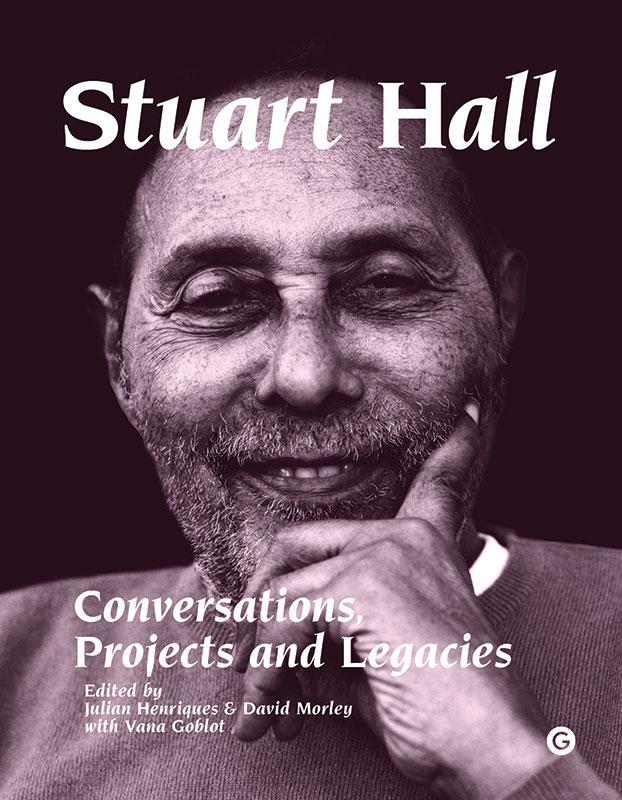

Stuart Hall: Conversations, Projects and Legacies, Edited by Julian Henriques and David Morley with Vana Goblot, Goldsmiths Press, University of London, 2017, IBSN 978-1-906897-47-5 (hbk)
Publisher’s webpage: https://www.gold.ac.uk/goldsmiths-press/publications/stuart-hall-conversations-projects-and-legacies/
Open Access version available: http://research.gold.ac.uk/19747/
Reviewed by Karen Wilkes
Perhaps as you would expect from admiring contemporaries, former students and colleagues writing about the life of Stuart Hall in Stuart Hall: Conversations, Projects and Legacies, there is a depth of affection for one of the key founders of British Cultural Studies, who passed away in 2014.
Written in an upbeat style, the book provides readers with insights into the conference that was hosted by Goldsmiths, University of London in November 2014, in honour of Stuart Hall. The event was a celebration of a lifetime of intellectual work and the resultant publication is a convincing testament to his legacy.
The volume is structured into seven parts, with 24 contributions from colleagues, contemporaries and former students, and closes with an afterword by Catherine Hall. Each part is effectively introduced with an overview of the section’s chapters. In addition to reflections on Stuart Hall’s theoretical contributions within the academy, the essays by Lola Young, John Akomfrah and Mark Sealy demonstrate the significance of Hall’s contribution and influence within the visual arts and the public sphere.
This volume is a collection of essays that convey the ongoing influence of Hall’s intellectual work and celebrates his commitment to long-term collegial projects. Reflecting on Hall’s collaborative approach, Doreen Massey considers Policing the Crisis as an example of such collective labour. It was a six year project, which the preface to the second edition of the text describes as being produced in the “participatory spirit”[1] of the Centre for Contemporary Cultural Studies. It was customary for staff and graduate students to work together at the Centre, and Hall was joined by postgraduate students John Clarke, Chas Critcher, Tony Jefferson and Brian Roberts, then located in the Sociology Department, to co-author Policing the Crisis. Hall’s eagerness and ability to engage in partnerships is a characteristic that is repeatedly praised throughout the collection, and the Soundings journal, a project conceived and realised towards the end of his life, is also an example of Hall’s collective intellectual work (Doreen Massey’s chapter 6).
Conversations, Projects and Legacies draws attention to the transformation of contemporary Higher Education into a highly competitive environment, that differs enormously from the academy in which Hall co-authored Policing the Crisis. The contributions acknowledge with some sadness that under the current conditions of the neoliberal university, it is increasingly difficult to undertake long-term academic work in the way that Hall did, because academics operate in an aggressive business-orientated system now, in which they are compelled to accumulate research projects in short time frames, which discourages dialogue and undermines long-term collaborative partnerships that require deep thinking. The emphasis in the current research landscape is to anticipate research outcomes, something that Hall et al. (2013) state that they would not have been able to do at the beginning of the “difficult process of collective research” for Policing the Crisis.
For Hall, teaching and research were not mutually exclusive. His brilliance as a teacher is reflected upon in the volume, in equal measure to his intellectual thinking. Yet, in the land of the neoliberal university in the UK, scholars are repeatedly expected to pin themselves to either one of those masts. Aspiring to be dynamic seems to be positively discouraged, as indicated in John Clarke’s observation of the “ugly pressures of contemporary academic life” (Clarke, 2017: 79), in which academics are governed by an audit culture and league tables. In these spaces, Lawrence Grossberg questions whether it is possible for contemporary scholars to continue the work that Stuart Hall practised and advocated for within university spaces. Is it possible for the university to be future-orientated and celebrate cultural studies rather than suppress it?
The reflections consider Hall’s influence in different spheres; intellectual, cultural and political. Of particular note, is Hall’s contribution to shaping the way in which academics and students think about and analyse the media and popular culture, indeed contributing to arguments that stress the need to continuously examine the media and its outputs (see Charlotte Brunsdon’s chapter 13), thus rebutting claims that studying the media is not a necessity or indeed a worthy activity. This holds true in 2019, when there continues to be critiques of university degrees that aim to place the media under scrutiny.[2]
Stuart Hall’s cultural studies project and his preoccupation with studying the media, as Lawrence Grossberg (chapter 9) suggests, is to “engage [not only] with the organization of domination and subjugation” (p.109). Of concern in many of the submissions, is Hall’s development of the concept of conjuncture, and what it means in terms of identifying the moment that Hall named Thatcherism, and how that approach to analysis remains important as it enables scholars to do the heavy-duty work to identify the realms that come together and signify a specific moment.
The ground–breaking analysis in Policing the Crisis achieves the engagement that Grossgberg speaks of, and is emblematic of Stuart Hall’s legacy for a number of reasons; it exemplifies the conjunctural analysis that Hall was committed to, his commitment to collaborative working – as John Clarke (chapter 5) makes clear in his contribution – and Hall’s articulation of what was at stake at each conjuncture.
Policing the Crisis is significant because of inspiring new areas of intellectual engagement, such as critical prison studies, as discussed by Angela Davis in her piece (chapter 23), and continues to provide a framework for analysis into the contemporary context of racialized policing in America and the UK.
Perhaps what is missing for me in this volume is reference to or a discussion about Hall’s significant work on representation, namely the text, Representation: Cultural Representations and Signifying Practices. Of course not all of Hall’s achievements, projects and collaborations could possibly be included in this volume. Henriques, Morley and Goblot needed to be discerning when they selected contributions for this collection.
You are left with a sense that the conversations that took place at Goldsmiths really have continued, leading me to wonder what Hall would have to say about the current political, social and economic context.
This book made me smile, nod my head and as I write this review, reflect and sigh deeply about the operations of the academy. It is not to say that Hall agreed with everyone, or indeed, that everyone agreed with him (see Michael Rustin, chapter 8). But what his legacy should remind us of is the need for dialogue and a commitment to working through disagreements and tensions.
On finishing reading Stuart Hall: Conversations, Projects and Legacies, it is clear that Stuart Hall is acutely missed.
Notes
[1] Hall, S. et al. (2013) Preface in Policing the Crisis: Mugging, the State and Law and Order, London: Palgrave Macmillan.
[2] See Stuart Price’s recent article on a BBC journalist’s views regarding media studies degrees. https://theconversation.com/what-exactly-do-journalists-like-john-humphrys-have-against-media-studies-122248

Karen Wilkes is an assistant editor of Media Theory.
Leave a Reply