

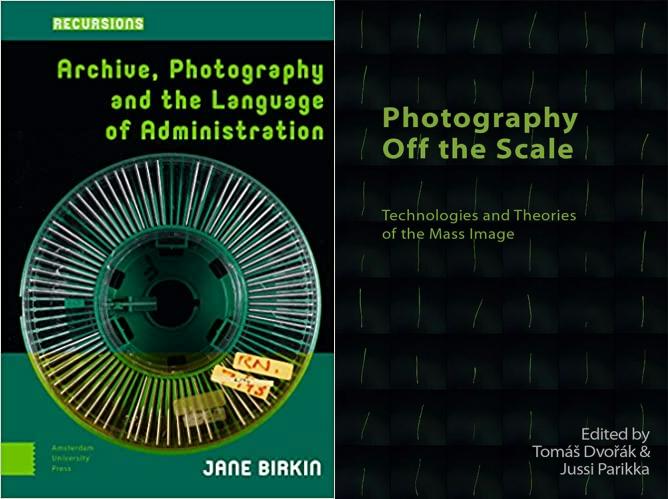

On Practices of Images and Measures of Practice: A Conversation around Two Books on Photography
JANE BIRKIN
Winchester School of Art, University of Southampton, UK
JUSSI PARIKKA
Aarhus University, Denmark
Abstract
This conversation between Jane Birkin and Jussi Parikka picks up on two recently published books, Birkin’s Archive, Photography and the Language of Administration (Amsterdam University Press 2021) and Parikka’s co-edited Photography off the Scale (Edinburgh University Press, 2021, with Tomáš Dvořák). The conversation focuses on some of the media theoretical undercurrents of their two books that feature the photographic image as a central part of both their interests, while also shifting to different aspects of institutional practices of images, including questions of logistics of order and enumeration.
Keywords
archive, logistics, mass, measurement, order, photography, scale
Jussi Parikka (JP): In many ways, this conversation started already years ago during joint projects at the Winchester School of Art. These included your PhD work, which is one reference point for this recent monograph too, even if a large part of your practice with images is part of your artistic work anyway. I was and continue to be fascinated by how you displace the photographic in your practice in ways that become productive of these broader scenes, sometimes even histories, of images as part of questions of ordering, organizing, searching and more. Your practice has artistic elements, it draws on your background in relation to design, but also your work in Special Collections at the Hartley Library in Southampton. In other words, practice, here, is not merely a word used for artistic work but encompasses a range of different situations and institutional roles. This is why I would propose that our conversation takes this route and these themes as its broad framework: multidisciplinary practice, media theory and photography, archives but also datasets of mass images, and many of the cultural techniques of standardisation, scale, measurement that we are both interested in beyond images as pictorial representations. Or in other words: we both are interested in images, but also in such ways that contextualise them into a longer legacy of media of bureaucracy. Would it make sense to start our exchange with this idea?
 Jane Birkin (JB): Yes, thinking about ‘practice’: as I mention in my introduction to the book, not only do I consider my own archive-related practice as research, but I also view my paid work as practice-based research. I am very lucky in this respect: many artists must draw a line between their paid work and their own art practice but, in my case, there is no such demarcation. My paid work influences my practice and my writing, and my personal research profoundly affects the way I understand archives. An important observation is the intense human labour involved in all aspects of keeping archives (something that is invisible to outsiders), although cataloguing itself is generally pared back to the minimum required these days, with the use of metadata schemas and outsourcing sometimes taking over from in-house object-level description. The labour that has been carried out to enable these schemas is of course hidden as well, and we might talk more about this. Ideas around archival labour and artistic labour (both can be bureaucratic) are specifically addressed through the inclusion of a section from Patrons–watch–an–activist–004.jpg, my own longform image description, which would be unthinkable to produce in the archive because of its size and its detail. It leads us to think about how artistic labour is expected to be time-intensive and is somehow seen as invalid if it is not. I include other references to my artworks, through a determination (fostered through the PhD) that this should be considered as equal to other types of research undertaken for the book.
JP: Archives and special collections, practice-based artistic work and research, and then media theory: these are the three core themes that your book revolves around. Media archaeology features there as a central part of the media theoretical aspect. We both are more than aware of the seeming gap between media theory (and philosophy) that speaks of the archive with a capital A, and the situated labour of practice in cultural techniques of management of information. Yet, we both also find such theoretical approaches as media archaeology interesting especially when it zooms in on the specific techniques of these institutions. What did media archaeology – and what kind – do in your work, what role does it serve as one hinge that helps to think through those aspects you are interested in? I am asking this also with my Recursions series co-editor hat on: your book is the penultimate in the series that we founded with Geoffrey Winthrop-Young and Anna Tuschling.
JB: The word ‘archive’ has become incorporated into our digital vocabulary, of course, and the structure of the archive has spoken to the organization of media of all kinds. As well as the word ‘archive’ itself, various words such as ‘file’ and ‘document’ have migrated in a very metaphorical way from the workings of the physical archive to that of the network, echoing media-archaeological thought and in turn being analysed by it — by you, by Cornelia Vismann (2008), by Giuliana Bruno (2016), by Wolfgang Ernst (2016) and by others. I read with interest your article (with Garnet Hertz) ‘Zombie Media: Circuit Bending Media Archaeology into an Art Method’ (2012), where you argue that archives, just like consumer electronics in this respect, present themselves as boxes waiting to be ‘cracked open, bent and modified’. Although my interest in media archaeology does not lie in the area of opening up and exploring of consumer electronics, the archive is just as complex and material an entity, and the idea of opening up, digging out and repurposing are embedded in archival research as well as in hands-on media-archaeological ‘tinkering’ methods. In What is Media Archaeology (2012), you position the archive as a storage space that gives rise to a media-archaeological examination. Importantly, you also argue that the storage and preservation of cultural heritage is an index to understand and to rethink time, which you put ‘at the core of the wider media-archaeological process’.
The notion of original order, the preservation of the order of material as it enters the archive, is fundamental to my thinking throughout this book. It is a developmental or diachronic order, often confusingly non-chronological and with no apparent narrative. Time and complex temporal anomalies are therefore part and parcel of the archive, and this chimes with Foucault’s ideas on the research model of archaeology. He argues in The Archaeology of Knowledge (2002) that archaeology maps time and the ‘vectors’ of time, mapping relations between things that are connected by time and things that are not. The archive catalogue effectively maps discrete yet interconnected units and relations in time, and this temporal mapping is especially critical to the photograph in the archive. Photographs are inherently time-specific and de-contextualized objects, short and discrete embodiments of time that rely on their physical position in the archive and their documentation in the archive list for their significance in the world.

JP: This move you describe shifts the attention from the photograph as a visual object to a logistical object, doesn’t it? You visit all sorts of curious archives – such as the amateur psychic detective Harry Price’s Collection in London – but this is not reduced to an archive fever of the sort that would just find curiosities for curiosities’ sake. There’s something else at play in terms of order, units, and catalogues that become media theoretical objects.
Also then: the photograph as a time-based, perhaps even a time-critical unit. Some of this is what part of the book Photography off the Scale is after too: to discuss scale, measure, quantity is to slip into the world of order, organization, and even logistics of sort – the kind that one finds also in archives as documentation and address systems. I also read this seeming paradox in your response: that photographs are both time-specific and de-contextualised, which prescribes a peculiar sort of flexibility to them when they are re-ordered in such situations as an archive – or then in databases for all kinds of commercial uses or for machine learning datasets. In the book, Sean Cubitt (2021) deals with this in terms of a ‘mass-image’ of contemporary technocapitalism and its relation to the Anthropocene, presenting also in the three-part coda how “Labour in the mass image is everywhere freely given and everywhere in chains” (2021: 38).
Images are not just images; we see them as proxies of ordering, which is why this interest in logistics pops into my head constantly.
JB: I agree that this is a paradox. In part, the complication can be rationalized by considering photographs’ inherent reproducibility (and you trace this back to the Calotype). The ‘same’ photo can exist at the same time in different places – in different archives. So, this identical shutter-measured moment takes on a different spatiotemporal aspect, a different context, in each place. An ‘archived’ photograph, along with its content-based description, captures a discrete moment that is unaffected by time outside; it is rendered time-critical by its specificity of place. I argue therefore that at one and the same time a photograph is temporal, atemporal, and supertemporal (eternal, existing outside of time). A further paradox is that it is through the stasis of the archive that time moves forward. A diachronic progression of time takes place, through an ordered juxtaposition of objects that are tightly bound to a numbering system. We see this very clearly in the image lists from the Harry Price Archive that are reproduced in my book. The archive as a system is totally dependent on enumeration, which, as you pick up on in your introduction, Sean Cubitt has previously termed as a ‘pledge against disorder’ (2014). Many of the arguments that are made regarding the problems of image recognition, training sets (and the unregulated labour behind them), are centred around loss of context and emphasis on crude interoperability. These are the same arguments as those that I make for the preservation of place and context that is secured in the archive by standardized and enumerated cataloguing and storage systems.
JP: So the archive becomes a way of understanding enumeration, becomes a way of understanding images, right? These sorts of loops are also interesting epistemological peepholes into the history of images. Perhaps this amounts to a sort of a non-representational way of placing images, such as photographs, into systematic relations that is both historical and speaks to contemporary techniques and infrastructures (such as images as training data). No wonder that a lot of recent years of discussions about images have referred to their disappearance, invisibility, or even an epistemological necessity to ‘forget photography’ (Dewdney, 2021).
JB: The idea of the invisible or hidden image is critical to both books of ours. For me, description is positioned as standing in for the image, even as equal to the image, both in its aesthetic qualities and its operation as evidence and information. Images are first met by description – and opinions/imaginings follow from this – because contrary to popular view, the majority of archive material remains undigitized, and is therefore hidden in storage until requested. It’s important to stress the role of the catalogue as a finding aid here: images that cannot be found remain unseen. And the difficulty of searching for images by keyword alone is creating a new kind of archival secrecy.
Perhaps the archival retrieval system, the fetching of images from their hidden spaces in boxes, in strongrooms, can be compared to the viewing of surveillance images, for example, which are unseen till needed for investigation; but analogue archive images that are digitized have always been seen, at the time of their making, their use, their cataloguing and their digitization. Images that are never seen by human eye, machine created and machine read, are of a different level of ‘hiddenness’. How, and to what extent should they be measured as images, rather than datasets? How do they become images?
JP: I like this riff on the invisible that emerges from an empirical observation: what’s invisible in actual practices, what is hidden behind search and accessibility (or lack of it), what is mediated by its description, and other mechanisms. The line by Trevor Paglen (2016), and even earlier by Paul Virilio – about images unseen, yet in abundance, only sorted and shifted from machine to machine – is useful in how it triggers this broader question of qualifying what sort of invisibility is at stake. One aspect we had in mind with Tomáš when writing and editing the Photography off the Scale book with our fellow contributors was that of measurement as both a result of and as a proxy, a stand-in, for images. The work of technical images (and beyond) as enabling measurement implies the existence of this non-representational sphere of information and data which in some cases takes the place of the visible. The countable, the calculable, the enumerable become a significant part of photographic and later imaging practices in such ways that bring into play the hidden aspect that is increasingly teased out in discourses of big data and data visualisation: to see patterns that are hidden, to amass data that creates such ‘images’ that reveal this other reality. The quantity, even abundance, of images is both then a feature that obscures and impedes seeing, as much as enables this (sometimes uncritical, and a bit hyperbolic) other regime of seeing as patterns. But as you imply, there are different layers and levels of how the invisible or hidden should be treated; much beyond any ontological definition of what is perceived, what is not, it actually becomes a feature of those management systems that mediate access or replace access in either numbers or descriptions. All that surrounds images than merely seeing them; to not see images, yet narrate and describe – or read descriptions of – or to calculate them and with them.
This does not mean we ignore images, and I know the same applies to you too; it’s more about looking at different scales of images. Unit of reference, as you early on coined it in the various discussions we had, and in your own work; the unit of reference is not a singular image but a set.
JB: Image sets are central to both books, even if on different scales. Both books take the emphasis away from the single image, and therefore away from representational aspects, and look at how images work together to build knowledge sets of different types. I frequently use the word ‘unit’, which comes directly out of cataloguing speak, where all levels of archival arrangement are identified in general terms as ‘units of description’, whether they are fonds, series, files, or single items. So, yes, a unit can represent any number of images. Both types of images – the ‘hidden’ and the ‘never seen’, involve ‘infrastructures, operations, apparatuses and the aesthetic questions of measures and scale’, as you point out in the introduction to your book. The images that both books cover are incorporated into logistical and administrative systems of one kind or another. An important notion in my book is that of seriality and relationships between images (and sometimes other objects) within the infrastructure of the archive. I argue strongly throughout that images must be seen in the context of others. Allan Sekula’s idea that one image is never enough would seem to run through both books, but this is more visible and more easily grasped in the archive (and the parallel catalogue) than in the somewhat nebulous quantities of images created today. How can we approach visualization and therefore afford the understanding of these vast images sets? Do we even need to?
JP: I was waiting for Sekula to make an appearance in our discussion! And yes, exactly – what’s at stake is not merely the list of how many billions of images are taken or some other eccentric measure that comes through, but their organisation into sets, series, and institutional units whether that institution is an archive or some social media corporate dataset or other. This is where we step from merely counting to organising, and to the sort of mechanisms of power that are central to this form of seeing in and through scales: how is measure regulated? I am reminded of Tomáš’s (Dvořák, 2021) wonderful chapter in Photography off the Scale on ‘eccentric measures’ of images: any assumed commensurability of and between images is part of a broader infrastructure of standardisation, but it is also shadowed by these sorts of comparisons that do not make sense (in a fundamental sense) concerning unimaginable quantities and alike. This concerns the contemporary moment of money and images, but also has historical precedents in technologies that push beyond the rationally visible.
JB: Yes, Tomáš talks about optical devices – telescope, microscope – that begin to measure the world in different ways. So, from the seventeenth century onwards, we begin to consider visibility and invisibility differently; as dependent on devices such as microscopes or telescopes. As Tomáš argues, the measurement of the world was before this limited to the confines of our own senses. In my chapter on the ‘archivization’ of the image, I take the example of Robert Hooke and his use of the microscope in his Microscopic Observations (1780). For Hooke, the use of optics enabled the imaging of elements not previously seen and also the text description of these elements. He acknowledges in his description of the louse that it would not be possible ‘did not my faithful Mercury, my Microscope, bring me other information of it’. Hooke’s framing of the microscopic image as ‘information’ is both perceptive and prescient. Of course, images do not always need to show the things our eyes can’t see in order to be classed as scientific evidence, there is plenty of science that went on – and is still going on – with the camera but without the use of particular optical devices. I mention how the photographic and other recording activities of Bertillon and Galton for the Paris Police Archives are important in the context of archival rigour and the ‘bibliographic’ (Sekula, 1986) and organizational aspects of photography; how images themselves archive and measure. We are always brought back, of course, to the idea of multiple images; as Tomáš argues, it is the way images are seen together, their relationship with each other, that matters as we move our research forward.
The problem of the management of mass images (described variously in your book in unmanageable terms such as ‘avalanche’, ‘explosion’, ‘deluge’ and so on) and the relationship between them, is very different to more controllable and manual methods of archiving, including acquisition and appraisal policies (which are never without compromise, as I emphasise). The results of collection management are seen in Annebella Pollen’s (2021) great chapter on deaccessioned slides and slide libraries in your book. The perception of information overload, which, as you say, goes back to antiquity, is always dependent on the technological and administrative means available to manage it, as well as the space that the information inhabits. Slide libraries are often considered obsolete in relation to the technologies needed to view them, which are actually still widely available, so they are not obsolete at all. Slides simply began to take up too much storage space in streamlined academic libraries.
JP: Storage space determines our media! Part of our new Lab Book (Wershler, Emerson, and Parikka, 2021) that we co-wrote with Lori Emerson and Darren Wershler includes attention to research and teaching collections, including those related to object collections of media archaeological value. This topic has emerged now in the context of, for example, media archaeology labs but is part of the broader issue of universities and how space is costed: from studio space to office space to space for such hybrid sites of practice as collections that might or might not sit as part of libraries and archives. Here, questions of non-linear histories of photography and its transformations are an interesting part of this discussion about university spaces vis a vis more specialist collections like in media museums.
As an anecdote, I remember when the astronomy colleagues at University of Southampton had to get rid of their own photograph collections and you rescued some of them. This operation is a good reminder how photography was never only part of the art and media schools at all and hence also archives of these other legacies of photography can be excavated in most interesting collections. (As a further sidenote on this sidenote, I am finishing now a book called Operational Images (Parikka, forthcoming 2023) that continues the work of Photography off the Scale and this new book starts with the case of astronomical photography at Harvard University around late 19th century and the wonderful curators (a hat tip to Lindsay Smith Zrull and Sarah Lavellee) at the Astronomical Photographic Plate Collection there have helped me find insights into this archival context of operational images beyond Farocki’s work).
JB: I am so much looking forward to seeing your new book! Those large format transparencies of the Northern sky that you mention are now stored in my own plan chest (taking up rather too much space). I recently took some of them out and made scans to use as a background to a film I’m working on. So, a second moment of capture that illustrates the photographic image’s infinite opportunities for reconfiguration, for its movement across time and space.
JP: I think that description – about photographic images’ infinite opportunities for reconfiguration – captures beautifully so much of what is at stake at this intersection of images, data, and also (art) practices, the theme we started. The archive and the studio go hand in hand, they feature as parallel spaces of interest. To close our conversation, could you share some thoughts on what you want to work on next – either in written scholarly work or in terms of artistic practice like that film you hinted about?
JB: The film is something I’m working on as part of my research within the Data Image Lab at Winchester School of Art. It’s a collaboration with the Institute for Life Sciences at Southampton and it deals with scientific imaging across different scales – from molecules to deep space. Hopefully, this work will provide a springboard to a fresh look at the uses of images across the University, and their ability to confound our established ideas about scale. Another side to this is that the film is mainly text-based, and the text (supplied by a scientist) is surprisingly poetic. This interests me as an example of a linguistic practice that manages to be imaginative and yet reflect deep thinking about a complex topic. We see this same thing in Hooke’s writing of course, where scientific and imaginative writing combine, but it seems that this persists and is perhaps more common across the disciplines than we believe it to be.
As I’m sure I’ve said to you before, I believe all archive images to be operational – and the image itself reveals so many things about the operation of the archive. So, as far as writing goes, I’m still thinking about photography and the way it exposes flaws in different systems of administration, perhaps moving out of the archive but always referring back to it. Categorization (I take the view that it’s almost universally damaging and discriminatory, by the way) is something that is especially intriguing because it’s widely assumed that it drives archival arrangement, yet it clearly does not – and this is something that I need to take on.
References
Bruno, G. (2016) Storage Space. e-flux Architecture. Available at: https://www.e-flux.com/architecture/superhumanity/68650/storage-space/
Cubitt, S. (2014) The Practice of Light: A Genealogy of Visual Technologies from Prints to Pixels. Cambridge, MA: The MIT Press.
Cubitt, S. (2021) ‘Mass Image, Anthropocene Image, Image Commons in “Beyond Human Measure: Eccentric Metrics in Visual Culture”’ in Photography off the Scale. Technologies and Theories of the Mass Image, edited by Tomáš Dvořák and Jussi Parikka. Edinburgh: Edinburgh University Press, 25-40
Dewdney, A. (2021) Forget Photography. London: Goldsmiths Press.
Dvořák, T. (2021) ‘Beyond Human Measure: Eccentric Metrics in Visual Culture’ in Photography off the Scale. Technologies and Theories of the Mass Image, edited by Tomáš Dvořák and Jussi Parikka. Edinburgh: Edinburgh University Press, 41-60.
Ernst, W. (2016) ‘Radically De-historicising the Archive. Decolonising Archival Memory from the Supremacy of Historical Discourse’. In Decolonising Archives (pp. 9-16). L’Internationale Online. Available at: https://www.internationaleonline.org/research/decolonising_practices/50_radically_de_historicising_the_archive_decolonising_archival_memory_from_the_supremacy_of_historical_discourse/
Foucault, M. (2002) The Archaeology of Knowledge. London: Routledge.
Hertz, G. & Jussi Parikka (2012) ‘Zombie Media: Circuit Bending Media Archaeology into an Art Method’, Leonardo, vol. 45, no. 5, 424-430.
Hooke, R. (1780) Microscopic Observations or Dr Hooke’s Wonderful Discoveries by the Microscope. London: Robert Wilkinson.
Paglen, T. (2016) ‘Invisible Images (Your Pictures Are Looking at You)’, The New Inquiry, December 8, 2016, https://thenewinquiry.com/invisible-images-your-pictures-are-looking-at-you/.
Parikka, J. (2012) What is Media Archaeology? Cambridge, UK: Polity Press.
Parikka, J. (Forthcoming, 2023) Operational Images. Minneapolis: University of Minnesota Press.
Pollen, A. (2021) ‘Photography’s Mise en Abyme: Metapictures of Scale in Repurposed Slide Libraries’ in Photography off the Scale. Technologies and Theories of the Mass Image, edited by Tomáš Dvořák and Jussi Parikka. Edinburgh: Edinburgh University Press, 113-139.
Sekula, A. (1986) ‘The Body and the Archive’, October, 39, 3-64.
Vismann, C. (2008) Files: Law, Media and Technology. Stanford, California: Stanford University Press.
Wershler, D., Lori Emerson and Jussi Parikka (2021) The Lab Book. Situated Practices in Media Studies. Minneapolis: University of Minnesota Press.
 Jane Birkin is an artist, designer and scholar. She is a Research Fellow at Winchester School of Art, University of Southampton and works on exhibitions in the Special Collections Division at the same University. https://unitsofdescription.wordpress.com
Email: j.a.birkin@soton.ac.uk
 Jussi Parikka is starting in 2022 as Professor of Digital Aesthetics and Culture at Aarhus University while continuing as visiting professor at the Academy of Performing Arts in Prague leading the project Operational Images and Visual Culture (Czech Science Foundation’s EXPRO grant 19-26865X). He is also affiliated with Winchester School of Art as Professor of Technological Culture & Aesthetics. http://jussiparikka.net.
Email: parikka@cc.au.dk
Leave a Reply