

Specters of Causality: Measuring Mediation and the Speed of Electricity in Eighteenth Century Physics
FLORIAN SPRENGER
Ruhr-Universität Bochum, GERMANY
Abstract
Electricity is invisible, only its effects can be perceived, but they should not be mistaken for electricity itself, because electricity designates a condition of matter. The article describes how in eighteenth century electricity research, the aesthetics of electricity – the forms in which it appears and its representations – are haunted by the anaesthetics of its object. It investigates one specific challenge in the early history of electricity research, in which questions of mediation, aesthetics, perceivability and causality are fundamentally connected: attempts to measure the speed of electric transmissions through wires. The article describes these phenomena as ‘specters of causality’, that means forces that become perceivable only in the form of aesthetic effects which cloak the physical events which happen in the realm of the invisible. Specters of causality made imperceptibility perceptible. These ghosts of mediation materialized the invisible transmission of electricity as an aesthetic experience. The causality that connects actions with effects at a distance through a wire challenges the perceptual status of immediacy and mediation.
Keywords
History of electricity, action at a distance, transmission, cable, instantaneity

For the official version of record, see here:
SPRENGER, Florian. Specters of Causality. Media Theory, [S.l.], v. 6, n. 1, p. 21-44, nov. 2022. ISSN 2557-826X. Available at: <https://journalcontent.mediatheoryjournal.org/index.php/mt/article/view/163>.
For Wolfgang Hagen (1950-2022)
Since the beginning of the eighteenth century, when electricity first came to be studied in a systematic manner, the aesthetics of electricity – the forms in which it appears and its representations – have been haunted by the anaesthetics of its object. Electricity does not occur to perception and its effects happen, according to eighteenth century physicist and philosopher Georg Christoph Lichtenberg, “in conjunction with so many invisible events” (Lichtenberg, 1956: 20). As a physical phenomenon, it remains below the sensory threshold. It is invisible, inaudible and intangible, though something can be seen and heard with a discharge, which can be felt on the skin, smelled or tasted. Electric discharges, sparks and light are not electricity itself, but the electrochemical effects of a disbalance of forces within a body or between bodies. They should not be mistaken for electricity itself, because electricity designates a condition of matter on the molecular level. Only in its effects or visual and textual representations does something become visible, something which, as Wolfgang Hagen has shown, in turn is taken to be electricity itself and quickly confused with it (see Hagen, 2012). In the words of Gaston Bachelard: “Where electrical phenomena are concerned, the book of the world is a picture book” (Bachelard, 2002: 39). A picture book, he continues, that has kept its secret.
The “objects” of electricity research – until today – are fleeting. They appear only briefly and disappear just as abruptly as they emerged from the invisible. Their reproducibility, which determines the scientific status of experiments, was always precarious, and many experimental difficulties throughout the nineteenth century derived from coincidental factors such as humidity, temperature, or the sweat of the person conducting the experiment. Electricity, especially in the early years of its exploration, therefore oscillates between various modes of representation – phenomena, spectacle-inducing experiments, visualizations, (Heilbron, 1997; Delbourgho, 2006). Before electricity could become a scientific object, an “epistemic thing” (see Rheinberger, 2006), that means an object of knowledge that has a certain permanence, these questions of visibility and invisibility had to be addressed. Following three episodes from this development between 1730 and 1760, this text offers a perspective on the early history of experimental research on electricity. It demonstrates that experiments on electricity, in one way or the other, encounter these questions and consequently challenge the assumption of the perceivability of physical phenomena (and the subjectivity of the researcher). As it turns out, this challenge entails questions of mediation in multiple ways. The episodes presented here thus add to the longstanding conceptual history of the term medium.
In the following, I will investigate specific constellations of mediation, (an-)aesthetics, perceivability and causality. Compared to the representational dimension of early electric showmanship (Hochadel, 2003), the imaginary of invisible forces in space, or the aesthetic representations of electricity in illustrations or artworks (Specht, 2010), my subject is rather inconspicuous. Nonetheless, it is fundamental for conceptualizing the causality of electricity and the question of how – and through which medium – cause and effect are bound to each other. All three episodes reiterate the question of how electricity can be transmitted through a wire, and how this allegedly instantaneous transmission can be observed. These challenges are central not only for electricity research, but also for the technical implementation of electric transmissions in telegraphy and other technologies since the nineteenth century. The temporality of ‘action at a distance’, that means the time it takes for distant events to cause each other, is part of the epistemological framework of modern electric media – and still relevant today with wireless transmissions, ubiquitous computing and the synchronization of global networks (see Peters et al., 2020). In today’s situation, videoconferencing tools have become a medium of global communication in what is supposed to be ‘real time’, but in fact is a constant adjustment of different layers of temporality, latency and jitter (see Hu, 2012). Co-presence turns out as an effect of synchronization.
In the context of early modern physics, causality is always a question of mediation and immediacy, of some substance that connects cause and effect either with a delay or immediately. “Forces are specters of causality [Kausalgespenster],” wrote Otto Liebmann in 1876 concerning the proximity of causality and miracles in a neo-Kantian treatise on the concept of force. “But,” he went on, “they are real, not imaginary. Take an iron key in your hand and bring it close to an inch away from a powerful electromagnet, and then you will sense and feel the phantom. It is there! And if a strong partition, something like an oak board or an inch-thick glass plate – is inserted between the key and the magnet – it doesn’t matter! – this puzzling tug, this mystical actio in distans continues to work just as before” (Liebmann, 1876: 269). What Liebmann regarded as a ‘specter of causality’ one and a half century after the research presented here was the causality of a force that was inaccessible to intuition, a force about which it was impossible to know anything beyond the fact that it was simply there. As regards intuition, every force acting at a distance seemed to be of spectral origins. Specters of causality are forces that become perceivable only in the form of aesthetic effects which cloak the physical events. These phenomena happen in the realm of the invisible. The specters of causality – the spirits, ether, and effluvia of early modern science – hovered about wherever one was confronted by these new phenomena and wherever things or events happened to be or occur where they ought not to, much like ghosts and the dead, which were evoked by spiritism and mediumism in Liebmann’s time. How could an observer not be amazed when, against all expectations, small particles would elevate into the air or tiny sparks would appear between glass plates? Because consistent explanations for such phenomena were scarce, the methods for producing the desired evidence became all the more aesthetic, prosaic, and moralistic (see Gamper, 2009). Specters of causality made imperceptibility perceptible. These ghosts of mediation materialized the invisible transmission of electricity as an aesthetic experience – in Liebmann’s example as the attraction felt by the hands, in the following examples as an action at a distance.
With regard to these specters of causality, the history of electricity research can be read as a history of a specific tension between aesthetics and anaesthetics that plays out in terms of mediation.[i] Making something visible that is invisible is of course a question that has been central for modern science ever since it employed optical instruments such as the microscope or the telescope, opening the realms of formerly invisible objects to the eyes. With electricity, however, the status of physical representation is transformed because electricity needs to be performed experimentally. The preconditions for electrical phenomena – aside from a few natural occurrences – had to be produced artificially and by hand, and therefore the early stages of electricity research suffered from severe experimental restrictions. Forced to traverse between visibility and invisibility, electricity research has long had to deal with the latency of electrical phenomena and their transition from invisible forces into visible or visualizable phenomena (see Hagen, 2000 and Sprenger, 2011). The history of experiments, diagrams, and metaphors used to study the physics of electricity reveals the development of the epistemological threshold of anaesthetics and visualization. At the core of this challenge lies the question of time: Are electric transmissions mediated (and therefore have a duration) or an immediate, timeless action at a distance?
In this regard, extensive research has already been conducted on the aesthetic techniques and practices with which the anaesthetic quality of electricity was transferred into the realm of the visible and how the body became a register of electricity’s occurrences (Parisi, 2018). Such studies have focused above all on the theatrical contexts of showmanship, the iconography of invisible forces, the narrative function of their visualizations, and the body’s role as a mediator of electricity. Inspired by this scholarship, my essay is concerned with a transition that has hardly received attention: the function of visualizations – not representations – of the speed of electricity within an experimental system, that is, within the specific context of research conducted on electrical transmissions and the materiality of wires, glass tubes and brass gold used in these experiments. The causality that connects actions with effects at a distance through a wire challenges the perceptual status of its specters. Concentrating on three episodes from eighteenth-century electrical physics, the following discussion of the media of physics will address not only the epistemological function of such visualizations in the history of science. It will also focus on the interrelations between instantaneity and intuition, between the imperceptible speed of transmission and the perceptible effects with which it was hoped to be measured. It will focus on how specters of causality were present in this research and how they informed the knowledge about electric transmissions. Given the interrelated nature of electricity’s perception-critical and time-critical aspects, it was impossible to unite the perception of electricity with its actual occurrence. Thus, the experiments in question, while indicative of a fundamental shift in physics away from intuition as a method, also demonstrate a transition in the dominant discursive frame of perception, of causality, and finally of mediation as opposed, but historically connected, to immediacy.
1. Stephen Gray’s Lines of Communication
On a warm summer day in 1729, a copper wire was suspended in Granville Wheler’s garden in the south of England (see Figure 1). When one end of the wire was touched with a rubbed tube of glass, small pieces of leaf brass simultaneously began to dance like butterflies on the other end and settle on the wire. From one end of the yard, without being able to see the outcome but rather relying on the sound of his friend’s voice at the other end, the dyer and physicist Stephen Gray (1666–1736) became convinced that he had generated an “Electrick Vertue” – attraction, electrical power (Gray, 1731: 27). It even sufficed to hold the glass tube near the wire without even touching it. Sometime later, Gray suspended a schoolboy perpendicular to the ground, charged him with electricity using the rubbed glass, and watched as minute sparks fell from his fingertips onto the audience below. The invisible force could not yet be harnessed as a decisive power over life and death, even if it had already been deployed to kill little birds. It was not yet possible to produce anything more than undifferentiated shocks. It was all still entirely meaningless and useless, a medium without a message, or rather: a medium whose message consisted in the fact that it existed, that there was an effect where there should not have been one. For there was a distance between cause and effect, a distance filled materially by 666 feet of wire. It was an instantaneous, simultaneous, and immediate transmission.

And it communicated. Gray referred to the wires as “lines of communication” (Gray, 1731: 27). A term such as “cable” was not yet available to him. At that time, nothing was known about isolation, states of charge, and electrons. Electricity had just begun to become a topic of scientific inquiry, and Gray was the first to explore the conditions of its transmission (see Ben-Chaim, 1990). In physical terms, communication is the connection of a cause with an effect by means of transmission: a causal connection is necessary. According to the physics of the time, every process in the universe must have a cause by which it can be explained. In this regard, three things are needed for electricity to be able to communicate: two entities attempting to communicate (one on each side) and whatever might be between them. The sender and the receiver have to be apart from one another, for otherwise there would neither be a channel nor a connection. There must be two in order for there to be one. Yet the two also need a third: the medium. Communication requires distance; it requires a chasm, and connection requires separation (see Peters, 2000 and Chang, 1996). The purpose of communication is to overcome this temporal or spatial chasm, to make it disappear. But the forces at play not only surmount such distance; they also seem to do away with it altogether. They transmit by making the difference of time imperceptible and by dispelling with space, by rendering both unmeasurable even though there is a piece of wire hanging through them. Cause and effect may be separated and distanced from one another, yet they seem, though connected by a long copper wire, to be simultaneous. At best, Gray and Wheler could yell back at each other whenever something happened. But by the time one would hear the other’s voice, the event would already have passed.
Gray was unable to say whether electricity had a certain speed. Seemingly requiring no mediation, it was rather simply there – simultaneously on both sides of the channel, which therefore ceased to be one any more despite its physical existence in space. Those communicating did not have to be in the same location, but their respective presence was brought together. That which took place at Gray’s and Wheler’s ends of the wire seemed to occur at the same time. An entire garden can lie in between and soon an entire world, strewn with copper wire but requiring not a single minute, second, moment, or blink of delay. The wire enabled a transmission whose characteristics turned transmittability itself into a topic of inquiry. It spanned across distance and was, as a medium, that which precedes every connection. In 1729, Stephen Gray transmitted transmittability; in this act of communication, communicability was communicated.
In Gray’s experiments, the spatial “co-presence” of the “sender” and the “receiver” at both ends of the line was no longer necessary. Rather, the wire extended across a space of transmission in which the sender and the receiver no longer had to face each other. Electricity was no longer tied to the presence of proximity because it was seemingly present at a distance. The place of electricity’s production was no longer necessarily identical with the place of its effect. Although the two events at the ends of the wire were not adjacent to one another, they were connected by a material medium that led to claims of immediacy and served to renegotiate the status of presence and absence.
For a good 150 years after 1730, the design of this experimental system was repeatedly varied and refined with the goal of detecting a delay. It is, in other words, an important early showcase of electric mediation. When electricity is sent from a source – in the beginning a manually rubbed glass bulb, then since the mid-eighteenth century a Leyden jar or a battery, and later a generator – through a copper wire, then the effect at the other end of the wire – attraction, sparks, or the movement of a needle – seems to take place at the same time as its cause. Even if the wire is lengthened, various materials are used or the wire is wound in a circle, it is nevertheless impossible to sensually perceive any delay. A direct measurement of the speed of electricity – something akin, for instance, to measuring the duration of a motion with a stopwatch because its locations are in plain sight – cannot be achieved with the means of perception. What remains invisible is what happens in (or on or around) the wire while electricity is transmitted – if something is transmitted at all.
Yet although powers of perception were incapable of discovering a delay, physics dictated that it must nevertheless exist. Because nothing can take place in two places simultaneously and because any distant effect requires a medium, this experiment was stalked by phantasms of instantaneity, immediate transmission, and actio in distans. In the case of measuring the physical speed of any other phenomenon, it sufficed to rely on visual measuring instruments such as the position of the sun, the rhythm of the heart, the swings of a pendulum, or the ticks of a clock. They can be perceived in parallel with the phenomenon being measured. The measurement of time depends upon methods of discretization that divide a given phenomenon into sections that can be measured by one instrument or another. Between two instantaneous or simultaneous events, however, there is nothing to observe. The phenomena of electricity, it seemed, are transmitted so quickly that they cannot be compared to anything. An instantaneous transmission, given that it does not involve any transition from the past to the present and future, cannot be measured because it cannot be subdivided and counted. The experimental challenge was thus to impart electricity with an aspect of difference or repetition that could make it countable and measurable. To do so, time had to be experimentally divided into comparable and repeatable units; it had, in other words, to be differentiated. The delay had to be made visible or at least detectable.
The framework of Newtonian physics provided an ideal-typical viewpoint that allowed both ends of the wire to be observed simultaneously. Gray did not have such a viewpoint. He was unable to compare the events; he could not, that is, turn his head as fast as the phenomena were appearing. For confirmation of the effect, Gray depended on Wheler’s voice. His perception and his non-absolute standpoint relativized the absolutism of the Newtonian universe. Yet the presumed instantaneity nevertheless obeyed the mechanical rules of Newtonian physics. In other words, Gray was the third; he observed the relation between the two ends of the wire from the outside and wished to impose a fixed point of view from which both events could be observed simultaneously. Yet his senses prevented him from doing so. Because he could not perceive any difference and was unable to make an accurate measurement, he concluded that no difference existed. Closely associated with this, however, was the assumption that both ends of the wire were simultaneously observable and simply separated by a timeless blink of the eye. And yet it was this blink that made visible specters of causality.
Instantaneity was an issue not only when the experimental setting was visibly present and comprehensible but also when the transmission was extended into a space – one as far away as a wire could reach – that could no longer be ascertained by the senses. For, even after a century of developments since the time of Gray’s first experiments, it was still the case that whenever transmission times were measured indirectly through a miles-long wire – with Charles Wheatstone’s rotating mirrors or André-Marie Ampère’s galvanometers in the 1830s, for instance, or even Samuel Morse’s electromagnetic telegraph in 1837 (see Sprenger, 2013) – the transmissions were still, against all better judgement, described as being instantaneous (even by those who were attempting to demonstrate their delay). Knowledge about the inevitability of lost time coexisted with claims of instantaneity. The situation was one of “coherence in contradiction,” which, according to Jacques Derrida, “expresses the force of a desire” (Derrida, 1967: 352). This desire for immediacy, which allowed such contradictory statements to stand side by side, is central to the historical fascination associated with electricity. Electricity could thus be evoked as the omnipresence of an instantaneously distributed force. This insistence on instantaneity, however, cannot alone be explained by the invisibility of electricity and its existence beneath the sensory threshold, for it continued to be conjured even after the senses were replaced by more precise instruments. For this reason, it is necessary to take the specters of electricity into account.[ii]
In this context, the wire functioned as a tape measure, stopwatch, and transmitter all in one. It was used not only for the sake of transmission but also (and above all in its historical beginnings) for measuring the transmission itself – its extent, its possible speed and distance – and for studying the space in which it was located. Although the action or effect of electricity obviously passed through a medium, this medium was negated by instantaneity. Gray was able to identify “no perceivable difference” in its effect, even though he had lengthened the line considerably (Gray, 1731: 28). By “difference,” he could have meant two things here: the repetition of attraction throughout multiple experiments, which remained the same, and the temporal delay that he was unable to detect. Nothing disrupted or impeded the immediate simultaneity of the transmission – and yet, as a spatial separation between the two ends, the difference remained between the two locations in the garden. It overcame and defined the materiality of the wire, which connected cause and effect as a spectral medium.
2. Johann Heinrich Winkler and the Limits of the World
Any pursuit of the excessive and perhaps phantasmatic aspects of electricity research will inevitably lead to the name of Johann Heinrich Winkler (1703-1770). Working in the middle of the eighteenth century, he formulated, with the utmost clarity, all that was aporetic and imaginative about the subject. He held three concomitant professorships at the University of Leipzig – in world wisdom (Weltweisheit), classical languages, and physics. Informed by early effluvial theories, Winkler believed that electricity consisted of small material particles that constituted a stable, omnipresent, yet invisible substance. The latter, he thought, was unified with solid bodies and distributed what he called a “sphaeram activitatis electricae” around them (Doppelmayr, 1744: 8). He explained the propagation of electricity in terms of the atmospheric reciprocity of multiple bodies, which flow into one another, unify with one another, and then can only be separated with force (attraction) and with frictions (charges). In its uncharged condition, as Winkler wrote in his Gedanken von den Eigenschaften, Wirkungen und Ursachen der Electricität [Thoughts on the Properties, Effects, and Causes of Electricity], this atmosphere is repelled, and this results in an undulating movement back-and-forth: “For as soon as the separations have occurred, the particles are agitated to reunited with one another” (Winkler, 1744: 121). An inner drive impelled them to unify into a common whole. Separation was an unnatural condition, and thus there was always an effect when bodies of any sort drew near to each other. If such bodies were not rubbed, however, electricity would remain imperceptible, and this was because the atmosphere had not been agitated.
Winkler hoped to substantiate these ideas about the unperceivable miracles of electricity by reproducing Gray’s experiments. The “discharge of electrical spheres” required, he thought with reference to Gray, “a proficient line of communication” and a framework made of the best materials (Winkler, 1744: 38). Through lines of this sort, electricity could be expanded piece-by-piece in “indescribable extensions” (Winkler, 1744: 37), though paradoxically in an instantaneous manner. This extension of electricity, he believed, was maintained by the continuity of the atmospheric unity of the wire’s physical body: proximity at a distance.
That which occurred on the smallest level could be extended to the largest. Electricity, according to Winkler, was faster than the fastest known motion, faster even than a “fired bullet, which can traverse the length of six hundred feet in a single second” (Winkler, 1744: 70). It could only be guessed – not measured – whether it was considerably faster or simply instantaneous. The emergence of this line of inquiry thus marked a decisive turn. It allowed scientists to speculate about the phantasms that might accompany electricity: “It was impossible to notice any time elapsing between the moment the cord was touched and the moment in which the gold flakes began to hop about” (Winkler, 1744: 72). Winkler discovered that electricity always took the shortest path when others were available (which is not entirely correct, for the material being used also played a role). A chain of electrical objects could thus be extended infinitely: “If, in the case of electricity, one were simply to witness the constant connection of the electrical particles, one could thus conclude that electricity could be extended to the limits of the world and would be visible, all the way out there, if a body were placed on lines of blue silk” (Winkler, 1744: 147). Whereas Gray’s estimate was 666 feet, Winkler believed that electricity could potentially be extended indefinitely and that its transmission – all the way to the limits of the world – could take place instantaneously. In 1750, Winkler made the following ironic observation: “For the time being, the speed of communicated electricity has been impossible to determine on account of the lack of necessary space” (Winkler, 1750: 6). Without spatialization, there can be no duration, and vice versa. If there is no space, there is no time because movement through space constitutes duration.
Because of their imaginary effects, Winkler underplayed the fact that these physical phenomena could not be adequately explained. On account of the friction losses that ought to occur when atmospheres come into contact, the atmospheric model should not allow for distant effects to be achieved without such losses. In order for electricity to be propagated by means of the merging of atmospheres, it should have to overcome a certain amount of resistance. One atmosphere had to “repel” the other, which is momentarily supported by the former’s body. Despite these assumptions, which contradict the notion of instantaneity, he assumed an instantaneous transmission because causality required continuity, though its time was occupied by simultaneity. For, regardless of the distances used in various experiments, this resistance remained unperceivable. Moreover, it was hardly conceivable that speed could have a limit: “Once set in motion, electricity will be propagated through any given electrical effect only to the extent that it will traverse three miles in one minute; over the course of an hour, it would thus traverse 180 miles” (Winkler, 1744: 150). In Winkler’s work, this line of inquiry found its home, for unlike his predecessors he believed that it was not only the effect that was transmitted. Communication between bodies could become communication between humans: “With the help of electricity, moreover, it is possible to produce an effect – one could fire a cannon or give a signal, for instance – at any given point in time across a distance as large as can be desired on the face of the earth” (Winkler, 1750: 15). There were not yet enough sources of electricity, however, to turn these ideas into practical applications.
3. William Watson’s Electrical Circuit
The Leyden jar, invented by both Pietrus van Musschenbroek and Ewald von Kleist in 1754, enabled electricity to be stored and strengthened, while electricity research continued to be haunted by the disappearance of its object and by the great difficulty of recreating its effects. With the help of the Leyden jar, however, a fundamental shift took place: By storing electricity, the Leyden jar provided an inexhaustible source, and its newly amplified effects could now be observed more easily and transmitted even farther.
Perhaps the most impressive demonstrations of the new storage capacity were performed by Abbé Nollet (1700-1770) in Paris. In presence of the King of France, he arranged 180 soldiers in a circle. When the first and the last soldier touched a Leyden jar, all the others in between experienced a shock and twitched simultaneously. Later, a 300-meter-long line of touching monks experienced this same shocking and consciousness-robbing treatment; Nollet blessed the line and the monks melted into a single twitching entity (see Nollet, 1746).
In London, this discovery was utilized by William Watson (1715-1787) in a number of experiments, focusing on the relation between conductive and non-conductive materials within the wire-based experimental system. A physician and naturalist, Watson gradually became one of the most prominent electricity researchers in the Kingdom; his experiments attracted the likes of the Prince of Wales, and his writings circulated in private printings and in pirated editions. For Watson, one of the essential advantages of the Leyden jar was its transportability: “The electrified Water will contain its Force many Hours, may be convey’d several Miles, and afterwards exert its Force upon touching the Wire” (Watson, 1746: 730). He made the most of this feature by setting up his experiments wherever there was a sufficient amount of space. In practice, however, a transportable “electrifying machine” was usually brought along because the storage capacity of the jar was, at best, good for just a few discharges. Nevertheless, he was thus able to circumvent the lightning-fast and barely perceivable aspect of electricity by repeating it. The reproducibility of the experiments was accompanied by the consistent production of the desired phenomena. It was no longer a problem to lengthen and explode (in Winkler’s sense) the electrical circuit, which was arranged around the jar to discharge it.
In his earlier experiments, Watson had established that there would be no discharge if a person touched a jar being held by another; this was, he thought, “because the Floor between them, tho’ the Distance is so short, will not conduct the Electricity sufficiently quick” (Watson, 1750: 61: 51). It was only by closing the circuit that electricity could be made to flow. The shock was caused by no more than closing a circle, by the sublation of distance into a closed circuit. It manifested itself as a phenomenon of perception. Watson presumed that the force of electricity was subject to a normal condition of balance. If this balance was disturbed – if, for instance, the amount of electricity was increased by means of a Leyden jar or decreased by means of a discharge – then this would lead to compensatory motions meant to restore the balance in question. He considered the discharge to be a lightning-fast closing of the circuit, an annulment of difference and discontinuity initiated by a spark. He assumed that, instead of using the interlocked hands and arms of monks, a similar experiment could be conducted with a wire. The extent of such expansion was precisely what Watson’s experiments were meant to test, for, much like Gray before him, he believed that a circuit could be enlarged by the addition of any conductive object – even the water of the Thames. Two elements, whose separation had to be overcome, could be united into a circuit by means of electricity’s instantaneous effects.
Inspired by Louis Guillaume Le Monnier, who had already conducted similar investigations in Paris, Watson began a two-month-long series of experiments on July 14, 1747 – exactly eighteen years after Gray’s first wire experiment – to study the speed of electricity under new conditions. His work was followed closely by an illustrious group of fellows from the Royal Society. Over the Westminster Bridge, he laid a 350-meter-long wire from one bank of the Thames to the other.
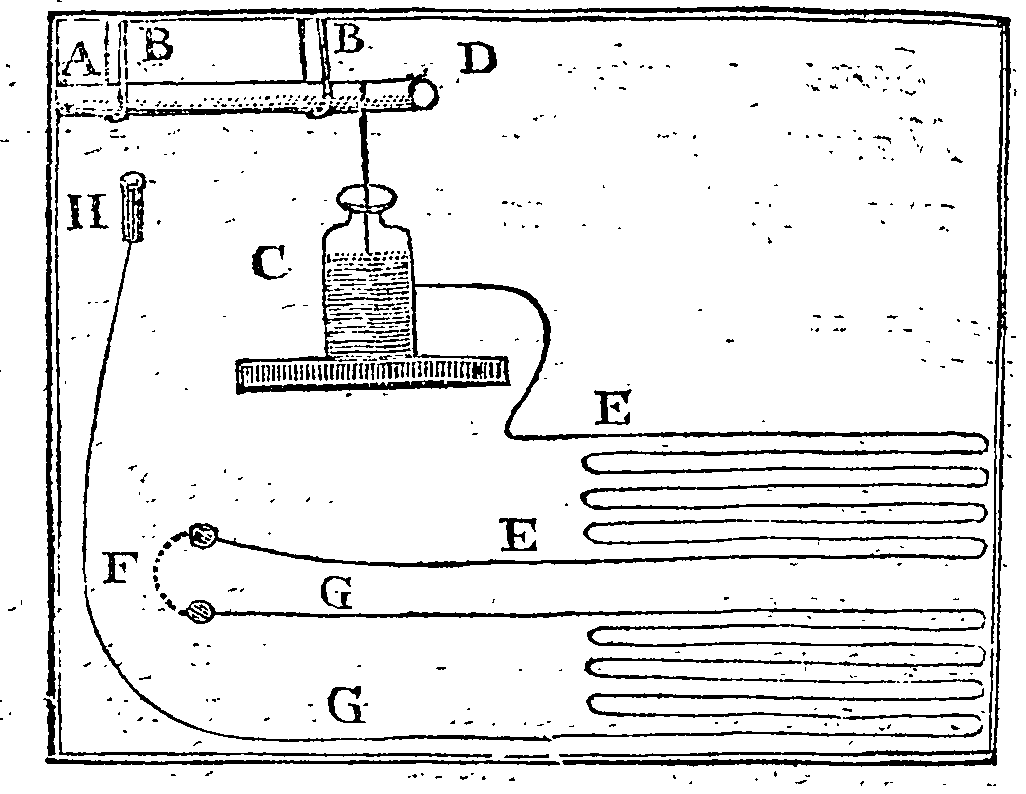
Le Monnier, having used the ponds in the Tuileries Gardens for a similar design in Paris, could not detect any difference in time from the moment that the current was triggered and the moment in which he felt a shock or saw the spark (see Le Monnier, 1746). In England, an electrifying machine was connected to the inner cell of a Leyden jar, and the outer cell of the latter was attached to a wire. The other end of the wire was held by a second experimenter on the opposite bank of the Thames. Watson discharged the Leyden jar by sticking an iron rod into the water. The circuit closed, and the result was thought to be instantaneous. There was no sign of a delay. A few days later, the electrical system, which consisted of an electrifying machine and a jar, was set up inside a house near the Thames in order to prevent any disturbances from curious onlookers. The wire was held by wooden poles. In this experiment, the experimenters included themselves in the circuit, both in the house and on the riverbank, and both sides experienced a shock. In contrast to Gray, the issue here was no longer to produce attraction at the end of the line but rather to shock human beings. As in Gray’s case, however, the speed of electricity remained imperceivable (see figure 2).

Watson repeated the experiment in a river bend near Stoke Newington, where the wire extended for eight hundred feet over land and returned for two thousand feet through the river. Having thus translated time into space, Watson constructed intermediate stations at which the effect could be tested. Yet even this distance was not long enough to cause the electricity to disappear or to allow any delay to be detected. Watson attributed the initial failure of the experiments to the “impertinent Curiosity of the Servants of the Gentlemen and other voluntary Observers, who, by touching the Wire […] felt the Shock in their Arms and Ankles, and formed subordinate Circuits […].” (Watson, 1750: 72). He believed that any interference or disruption of isolation led to a short circuit, which shortened the wire. The latter would only extend to the nearest place of discharge: “Neither should the Wire in this Space be subject to be disturbed by the Horses or Cattle, which were grazing; nor ought it to touch in this Passage the Trees or any other Vegetables, which at this Season of the Year were every-where luxuriant” (Watson, 1750: 76). This bucolic idyll is not something to be overlooked. Its space had to be bypassed and limited without being touched. Without isolation there could be no cable, which had to be separated from the earth – continuously discontinuous. It ran straight through this idyllic scene in order to render it into a surmountable distance, that is, to do away with its distance.
Watson’s final attempts to measure the speed of electricity involved lengthening the wire behind the threshold of the senses. A few days later in Islington, 5,379 feet were overcome. From then on, because the individual stations were no longer within sight of one another, it was necessary to fire a gun and the Leyden jar simultaneously. The starting shot and the final spark, however, were indistinguishable, aside from the lag caused by the transmission of sound, which was of course slower than the experimenters’ ability to see the results of the measurement. The subsequent experiments to overcome even greater distances likewise depended on the audible transmission of information. The source of the electricity – the house in which the electrifying machine and the jar were set up – was at least visible to the first relay station where the effect was tested, but the rest depended on a gunshot whose noise was slower than the electricity itself, whose effect would thus take place before the experimenter was in position to indicate it. In this case, perception or intuition is inseparable from the measurement of speed. Although the speed of sound had already been researched, and Watson acknowledged as much, the calculations ranged from 560 to 1,338 feet per minute. Watson’s estimation was a mere 4.5 seconds per mile. Given a wire of 7,000 feet, for instance, the measured effect of electricity would have to be adjusted for a 5.25-second delay caused by the speed of sound. Thus, the precise speed of electricity could only be calculated in an approximate manner. According to Watson, it required 837/1000 seconds to travel this distance, because the sound had needed six seconds to traverse it. From this figure, however, the transmission time from the jar to the wire would still have to be subtracted.
Despite its delay, such a speed was determined to be “nearly instantaneous” (Watson, 1750: 85). This “coherence in contradiction,” in which mutually exclusive ideas are allowed to coexist, would go on to characterize subsequent research into the nature of electricity. In order to look more closely into the matter one more time, Watson arranged a final experiment one year later. In this case, the experimenter stood in the middle of a two-mile-long wire and held its ends. “[I]n the same View,” wrote Watson, the other observers attempted “to see the Explosion of the charged Phial and the convulsive Motions of the Arms of the Observer in consequence thereof” (Watson, 1750: 86). There was no perceptible delay, and the difference between cause and effect remained undetectable.
Watson may have failed as the first to measure the speed of electricity, but at his time the measuring devices were hardly sufficient for the task. Unlike those of a century later, the early methods of electricity research did not produce results that could be reproduced. Above all, Watson’s measurements were the result of a methodological hodgepodge. For measuring signals, he relied on the bang of a gunshot; for measuring electricity, he relied on the attraction of elderberries. Ever since it first began to be studied, the speed of electricity has overwhelmed the senses of those investigating it, thus seeming immeasurable.
Decades would pass before the time of transmission, reconsidered in terms of transport or signal time, became an issue of its own. This occurred when methods were finally developed for making finer and finer measurements of speeds and when exact information about signal delays became indispensable to telegraphy. It was discovered that every wire influences that which it transmits. Its resistance ensures that the effect produced at the end is not identical with that at the beginning, for, even in the best cases of isolation, there will always be a loss. As the further study of electromagnetism would demonstrate, the speed of an electrical transmission is relative to the length of the wire. This disruption – and the temporal delay of electricity in general – cannot be perceived; its measurement is dependent on devices that, by subdividing time and space, make them countable. Sensory intuition, upon which Gray, Winkler, and Watson could alone base their judgement, defined the realm in which something could be deemed “present.” Thus, the design of their experiments, which were so large as to exceed the space of perception, undermined any attempts to render the speed of electricity ascertainable.
Conclusion: Perception and Instantaneity
When physical forces act at a distance – when gravitation, magnetism, or electricity overcome distances without evidencing a visible cause for doing so – then the question of the causalities, continuities, and materialities of this action gains considerable significance. Physics was therefore compelled to think about media. It had to develop criteria for determining which forces were subject to a medium and which actions were simply miraculous or inexplicable and thus immediate. The issue of causality had of course long been a topic in the natural sciences, but in the early modern era it became one of particular urgency. The Aristotelian principle was that everything that happened had a reason, which was its cause. Revived by modern science, this principle should ensure that equal experiments will produce equal results. This foundational idea had to be reconsidered in light of forces that could act at a distance, and this reconsideration was reflected in the experimental systems devised to bring instantaneity and intuition into relation with one another.
In a Newtonian universe, it is possible for spatially separated points to be connected in the present through communication. The simultaneity of absolute Newtonian time must exist in order for there to be immediate distant effects (Newton, [1687] 1934: 6). It required no time to produce a connection between the event at one end of the garden and that at the other end. Though this claim was to be fundamentally refuted in psychology by Hermann von Helmholtz and in physics by Hans Christian Oersted and Albert Einstein, telegraphy and all of the electrical and electronic media in its wake would nevertheless continue to invoke the idea of instantaneous transmission. But also in technical systems, simultaneity is a product of rhythm or pacing – that is, of synchronization or the coordination of differences – and, strictly speaking, this achievement is in fact not one of simultaneity (Gleichzeitigkeit) but rather one of good timing or punctuality (Rechtzeitlichkeit) (see Rohrhuber, 2009). Something can then be called synchronous if it does not exceed a given interval of time that is necessary for the operation of a technical process. In order to be processed, for instance, a sequence of telegraphic signals does not need to arrive at its goal simultaneously; rather, the signals simply have to arrive and be inscribed with enough distance between them to allow for them to be distinguished from one another. Every act of synchronization involves a remnant of time-bound transmission that cannot be simultaneous but is rather coordinated in such a way that the delay has no operational consequences. In this respect – and as Thomas Macho and Christian Kassung have demonstrated – synchronicity is the result of the cultural techniques of synchronization (see Kassung and Macho, 2012).
By relying on their senses, Gray, Winkler, and Watson ensured that their measurements of speed would fail. Like a line judge in a soccer match, who, to call someone offside, has to determine simultaneously when the ball has been passed and where the striking player was positioned at the time, Gray, Winkler, and Watson attempted to use their senses to compare the charge of a wire and the reaction at its end. If the one event happens after the other, there is be a temporal difference caused by speed and thus a delay (or an offside call). The objection to this form of observation, though never mentioned in the debates of the time, concerns the necessary belatedness of perceptual comparisons. It is impossible to keep both events in sight simultaneously because the gaze itself requires time to move from the charge to the discharge in what Jimena Canales has described as the “tenth of a second” (Canales, 2011). With the methods used at the time, it was impossible to measure any delay, either experimentally or with the senses, and yet the fundamentals of physics maintained that such a delay should occur. If the interval between the two events is shorter than the two events of perception, they can then be described – without contradiction – as being simultaneous because the difference is inaccessible. To recognize that the effect happened unsimultaneously entailed, on the one hand, the introduction of measurable time and, on the other, the ability to draw a causal connection between the different events. This, in turn, provided the possibility for phantasms of immediacy and specters of causality.
Instantaneity is not only a phantasm of physical timelessness, but an effect of sensual deferment. In the history of electricity research, the new forms constantly enacted new sensory stimuli to which the body had to respond in different ways (Parisi, 2018). The specters or causality, in this regard, are not only worldly apparitions of action at a distance – be it instantaneous or not – but live within the senses and what they perceive as the temporal order of the world in which one thing happens after the other. If they happen at the same time, there is a gap between perception and speed. These openings are haunted by specters of causality. What appears as the causality of electricity is thus bound to the conditions of perception.
To give a brief overview of later developments: In 1825, Georg Simon Ohm, working with the measuring instruments of his day, elevated the measurement of voltage, resistance, and electromagnetic force to a matter of central importance. Relative as it was to the capabilities of measuring instruments and to the reactions of human beings to the measurements in question, knowledge of the speed of electricity, as Ohm noted, was highly unreliable. In 1830, because it was fundamentally unable to grant any access to the relativity of phenomena, perception was ousted by the accuracy of mechanical measurements. Since then, the study of electricity hardly could have proceeded on the basis of perception. Thus, the measurement of speed was henceforth conducted under new auspices. Since Gray’s time, the formalization of experiments had been one of the main concerns of electricity researchers, who straddled the chasm between little time and no time at all, between high speeds and no speed at all – that is, between mediation and instantaneity. Their most important means of observation, their own senses, were ultimately discredited, because the phenomena they observed pleased the senses but didn’t reveal the knowledge that was sought. Associated with this was thus an epistemic configuration in which mathematical and experimental methods converged and pointed to new paths of knowledge production. The study of electricity was on its way to becoming a so-called exact science, while exactness – itself dependent on experimental possibilities – became the scientific ideal of the era (see Comte, [1844] 1994).
Even increasingly precise measurements, however, could not banish the specters haunting the transition from instantaneity to delay. By means of new methods, the units of measurement – time and space – were broken up into smaller and smaller parts. This act of fragmentation may have thwarted perception, but, the parts never being small enough, it could not go on infinitely. Even reflection-based methods, such as those described in Charles Wheatstone’s influential work An Account of Some Experiments to Measure the Velocity of Electricity and the Duration of Electric Light (see Wheatstone, 1834), required mediation between intermediate steps, which divided up the original motion, translated its time into space by reflecting it onto a surface, and thus made it accessible. The hope was that electricity would somehow account for itself and inscribe itself and thus generate differences that would allow it to be measured. The historical development of the accuracy of measuring mediated speeds is a story of experimental intuition and its supplantation.
During all these phases of electricity research, physicists knew that the options “no speed” and “no time” were logically and physically unacceptable. If there is speed, then there are measurable differences, in which case there can be no instantaneity. To measure speed is to search for and deal with differences, be they oscillations, which take place continually over time, or phases of attraction, which are visible at distinct points in time. The more precisely these differences could be measured, the less playroom remained for the physical idea of instantaneity. Developments in the accuracy of measurements allowed the smallest amounts of time to approximate no time at all, even if, to the human eye, this limit could not be reached. Ideas of immediacy tended to flare up where they ought to have been refuted. Knowledge about the speed of electricity and its measurement constituted knowledge about its transmission, and this understanding informed the construction of functional apparatuses. Although they contradicted this knowledge, the phantasms of instantaneity and the specters of electricity nevertheless assisted its development by remaining in the realm of the anaesthetic. Mediation and phantasms of immediacy are fundamentally connected.
References
Bachelard, G. (2002) The Formation of the Scientific Mind. Manchester: Clinamen.
Ben-Chaim, M. (1990) ‘Social Mobility and scientific change: Stephen Gray’s contribution to electrical research’, British Journal for the History of Science 22(22), pp. 3–24.
Castells, M. (1998) The Information Age: Economy, Society, and Culture: End of Millennium. Malden: Blackwell Publishers.
Canales, J. (2011) A Tenth of a Second. A History, Chicago: University of Chicago Press.
Chang, B. (1996) Deconstructing Communication. Minneapolis: University of Minnesota Press.
Comte, A. ([1844] 1994) Rede über den Geist des Positivismus. Hamburg: Meiner.
Delbourgo, J. (2006) A Most Amazing Scene of Wonders. Electricity and Enlightenment in Early America, Cambridge: Harvard University Press.
Derrida, J. (1967) ‘Structure, Sign, and Play in the Discourse of the Human Sciences’, in: J. Derrida, ed., Writing and Difference. London: Routledge, pp. 278–294.
Doppelmayr, J.G. (1744) Neu-entdeckte Phaemomena von bewundernswürdigen Würckungen der Natur. Nürnberg: Fleischmann.
Durham Peters, J., Sprenger, F. & C. Vagt (Eds.) (2020) Action at a Distance. Minneapolis: University of Minnesota Press.
Gamper, M. (2009) Elektropoetologie: Fiktionen der Elektrizität 1740-1870. Göttingen: Wallstein.
Gray, S. (1731) ‘A Letter to Cromwell Mortimer, M. D. Secr. R. S. containing several Experiments concerning Electricity’, Philosophical Transactions of the Royal Society of London 37(37), pp-18–44.
Hagen, W. (2000) ‘Zur medialen Genealogie der Elektrizität’, in: R. Maresch and N. Werber, eds., Kommunikation, Medien, Macht: Frankfurt a.M.: Suhrkamp, pp. 133–173.
Hagen, W. (2012) ‘Stürmische Plötzlichkeiten: Zur medialen Genealogie des elektrischen Funkens’, in: K. Müller-Helle and Sprenger, F., eds., Blitzlicht. Berlin: Diaphanes.
Heilbron, J. L. (1979) Electricity in the 17th and 18th Centuries. A Study in Early Modern Physics. Berkeley: University of California Press.
Hochadel, O. (2003) Öffentliche Wissenschaft: Elektrizität in der deutschen Aufklärung. Göttingen: Wallstein.
Hu, T-H. (2012) ‘Real Time/Zero Time’, Discourse 34(2-3), pp. 163–184.
Kassung, C. and T. Macho (eds.) (2012) Kulturtechniken der Synchronisation. München: Fink.
Le Monnier, L.G. (1746) ‘Recherches sur la communication de l’électricité’, Histoire de l’Académie royale des sciences (1): pp. 447–464.
Lichtenberg, G.C. (1956) Über eine neue Methode, die Natur und die Bewegung der elektrischen Materie zu erforschen. Leipzig: Geest & Portig.
Liebmann, O. (1876) Zur Analysis der Wirklichkeit. Straßburg: Trübner.
Newton, I. ([1687] 1934) Mathematical Principles of Natural Philosophy. Berkeley: University of California Press.
Nollet, A. (1746) Essai sur l’électricité des corps. Paris: Guerin.
Parisi, D. (2018) Archaeologies of Touch. Interfacing with Haptics from Electricity to Computing, Minneapolis: University of Minnesota Press.
Peters, J.D. (2000) Speaking into the Air: A History of the Idea of Communication. Chicago: University of Chicago Press.
Rheinberger, H-J. (2006) Experimentalsysteme und epistemische Dinge. Frankfurt a.M.: Suhrkamp.
Rohrhuber, J. (2009) ‘Das Rechtzeitige: Doppelte Extension und formales Experiment’, in: A. Volmar, ed, Zeitkritische Medien. Berlin: Kadmos, pp. 195–212.
Schaffer, S. (1992) ‘Self Evidence’, Critical Inquiry 18(2): pp. 327–62.
Specht, B. (2010) Physik als Kunst: Die Poetisierung der Elektrizität um 1800. Berlin: De Gruyter.
Sprenger, F. (2011) ‘Sternenstaub: Zur Anschaulichkeit elektrischer Phänomene um 1800‘, in: Kaufmann J., Kirves M., Reichel, K. and D. Uhlmann, Eds., Sichtbarkeit und Unsichtbarkeit um 1800. Tübingen: Niemeyer, pp. 39-64.
Sprenger, F. (2013) ‘Between the Ends of a Wire: Electricity, Instantaneity and the Globe of Telegraphy’, in: Hampf, M./Müller-Pohl, S., Eds., Global Communication Electric. Actors of a Globalizing World. Frankfurt: Campus, pp. 355-381.
Sprenger, F. (2015) ‘Insensible and Inexplicable: On the Two Meanings of Occult’, communication+1(4).
Watson, W. (1746) ‘A Sequel to the Experiments and Observations Tending to Illustrate the Nature and Properties of Electricity’, Philosophical Transactions of the Royal Society of London 44(44): pp. 704–749.
Watson, W. (1748) An Account of the Experiments made by some Gentlemen of the Royal Society, in order to discover whether the electrical power would be sensible at great Distances with an Experimental Inquiry concerning the respective Velocities of Electricity and Sound. London: C. Davis.
Watson, W. (1750) ‘A Collection of the Electrical Experiments communicated to the Royal Society’, Philosophical Transactions of the Royal Society of London 45(45): pp. 49–120.
Wheatstone, C. (1834) ‘An Account of some Experiments to measure the Velocity of Electricity and the Duration of Electric Light’, Philosophical Transactions of the Royal Society of London 124(124): pp. 583–591.
Winkler, J.H. (1744) Gedanken von den Eigenschaften, Wirkungen und Ursachen der Electricität. Leipzig: Breitkopf.
Winkler, J.H. (1750) Grundriss zu einer ausführlichen Abhandlung von der Electricität. Leipzig: Breitkopf.
Notes
[i] Electricity research thus perpetuated debates about the concept of the occult that had been taking place since the late Middle Ages. Its meaning shifted from the invisible to the inexplicable; see Sprenger, 2015.
[ii] Genealogically (though this is not the place to discuss such matters), its phantasms have persisted to the present day, as when the seemingly ever-current nature of digital cultures is described in terms of the “annihilation of space and time by electronic means” (Castells, 1998: 379).
 Florian Sprenger is professor for virtual humanities at Ruhr-Universität Bochum and principal investigator at the collaborative research group Virtual Lifeworlds. His research covers topics such as the history of artificial environments, media theories of transmission, and autonomous cars.
Email: florian.sprenger@rub.de
Leave a Reply