

Please Take it & Re-use It: Muybridge’s Motion Studies at Work in Present-day Visual Culture[i]
SARA CALLAHAN
Stockholm University, SWEDEN
Abstract
This essay examines three instances where Eadweard Muybridge’s motion studies have been referenced and reused in present-day visual culture—a scientific experiment that encoded a GIF of a galloping horse into bacterial DNA (2017); a project where multiple frames from the horse-in-motion series were tattooed onto eleven different people (2014); and an activist video that used images of animals from the series to argue for the urgency of species extinction and environmental catastrophe (2019). The author’s central argument is that, in addition to the more or less clearly stated intentions of this image-use, these transmediations of Muybridge’s historical photographic images also activate and extend questions and concerns from recent media theory: contributing to notions such as image ecology and image liveness, and proposing challenges to established distinctions between new/old media, still/moving images, and material/immaterial media qualities. A further suggestion is that their ability to carry out complex theoretical work relating to present-day media practices can help explain why these images have come to have such staying power in visual culture a century and a half after they were first made.
Keywords
media archaeology, image ecology, Eadweard Muybridge, transmediality, tattoos

For the official version of record, see here:
CALLAHAN, Sara. Please Take it & Re-use It. Media Theory, [S.l.], v. 6, n. 1, p. 45-72, nov. 2022. ISSN 2557-826X. Available at: <https://journalcontent.mediatheoryjournal.org/index.php/mt/article/view/164>.
In the summer of 2017, researchers at Harvard Medical School announced that they had succeeded in using the genomes of a population of living E. coli bacteria as a medium for archiving a short black and white digital film. To test their thesis the researchers used a low resolution, pixelated digital animation of a galloping horse. When outlining their work in the scientific journal Nature, the research team did not elaborate on their choice of test image, except to specify that the GIF used was “adapted from Eadweard Muybridge, Human and Animal Locomotion, plate 626, thoroughbred bay mare ‘Annie G.’ galloping”, and that it had been obtained from Wikimedia Commons (Shipman et al., 2017: 348).
Shot in the 1870s and 1880s, Muybridge’s motion studies have become part of the repertoire of present-day visual culture. They were inserted into Martin Scorsese’s Netflix series Pretend It’s a City to illustrate Fran Lebowitz’s loathing of gym culture (Scorsese, 2021); Irish rock band U2 performed in front of a Muybridge-like gridded background in the music video to their song Lemon (U2, 1993); singer Rihanna posed as quintessential characters from the series—horse, rider, a woman throwing a bucket of water—in a fashion shoot published in Italian Vogue (Panizza Cutler, 2009); Google temporarily replaced their standard logo with a doodle-version of a galloping horse to mark a seemingly random anniversary of Muybridge’s birth (Doodle: Eadweard J. Muybridge’s 182nd Birthday, 2012); and the mobile phone app “muybridgizer” enabled smart-phone users to create their own serial motion studies (Muybridgizer: Create Your Own Muybridgized Images!, 2010).[ii] Such examples are abundant: references to Muybridge’s motion studies have appeared in innumerable movies, artworks, advertising campaigns, on clothing, and much, much more.
In terms of the scientific credentials, results and methodology of the Harvard experiment in synthetic biology, the use of this particular set of images was of course neither necessary nor significant. Any short GIF could have been used as long as it was simple enough to be recognizable even in low resolution. One could speculate as to what prompted the scientists to select the Muybridge sequence: perhaps someone in the team had an interest in the history of photography or film, was an avid equestrian, had played with a motion-study flip-book as a child, or simply liked the look of these images. Maybe it was the Google algorithm that ensured that this GIF ended up high on the list of results when the team searched for a suitable test-image.
Whatever the reasons, it is what the images do, i.e. how they operate when they are used in different contexts that is the concern of this essay. By connecting the images’ historical conditions and mediation processes with their present-day reuse, different elements of both explicit and explicit references to Muybridge’s images will be analysed. This method pays attention to specific forms of transmedial movement and transformation that take place when the same set of historical images are reused in different present-day contexts. The term transmediality can be defined as “the appearance of a certain motif, aesthetic, or discourse across a variety of different media” (Rajewsky, 2005: 46), and in a transmedial analysis it is both the movement from one medium to another, and the transformations that result, that are of particular concern. In this essay, the focus is on how the movements and transformations of Muybridge’s motion studies become meaningful in three specific instances of reuse.[iii] Each of the three case studies can be interpreted in light of present-day media theory, but each instance of Muybridge re-use also sheds light on the complexities of transmedial operations. This set of images are activated for certain purposes by specific human actors but they also go beyond these by tapping into and reinforcing specific media theoretical questions and concerns.
In academic fields that study images and their mediation, some scholars have used metaphors of living entities, suggesting that images are like living beings, or that they are entangled in complex structures that resemble those of living entities. Terminology relating to evolution, virality, aliveness, embodiment, ecologies and families of images are indicative of this broad approach associated with writers such as Hans Belting (2011), Sunil Manghani (2013) and W.J.T. Mitchell (2005). Another set of concerns centres around how media practices and products can be understood via interventions in and inversions of traditional dichotomies and chronologies. Researchers within the academic field of Media Archaeology like Wolfgang Ernst (2011, 2015, 2018), Erkki Huhtamo and Jussi Parikka (Huhtamo & Parikka, 2011; Parikka, 2012) are associated with this approach, as are Jay David Bolter and Richard Grusin (2003), and Lisa Gitelmann (2006) among others. In contrast to the view that new media definitively replace old, these scholars highlight the way a new medium frequently mimics and reproduces technological and/or cultural features of the older media it is said to replace, and that, inversely, old media can be said to foreshadow yet-to-be-invented new media formats and features. Such views of media history have significant implications for our understanding of the material and immaterial qualities of still and moving-image formats.
This article is about the theoretical work that a specific set of present-day references to Muybridge’s motion studies carry out. In what follows, I discuss three examples where the reuse of existing images, all taken from Muybridge’s series of motion studies, activate and extend theoretical questions and concerns relating to media and medial processes. In addition to the already mentioned use of a Muybridge horse sequence as test-image for the Harvard Medical School experiment, I will also consider a tattoo project initiated by Evan Hawkins that involved tattooing a different frame from a Muybridge horse-in-motion sequence onto eleven people, photographing each tattoo and then animating the images into a looped GIF (Hawkins, 2014). Another example is a video that circulated online in the fall of 2019 featuring environmental activists George Monbiot and Greta Thunberg urging viewers to embrace a more sustainable lifestyle (Mustill, 2019): the video included a montage where a brief sequence of Muybridge’s motion studies of deer, camels, tigers, lions, elephants and birds flash by.
These three cases make use of a similar image-set, but they do so for entirely different reasons and within vastly different contexts. At times their role in producing media knowledge and theoretical reflection is recognisable by the producers and consumers of these images; at other times it is more indirect and in need of unpacking by sustained analysis by viewers with knowledge of media theory, media history and image-studies. Such differentiation between direct and indirect, explicit and implicit references, as well as the intersections between and across the different examples will be considered throughout this essay. In all three cases Muybridge’s images are shown to function—explicitly and implicitly—as interlocutors in decidedly current debates about media ecology and media archaeology, highlighting how present mediations shed light on historical media practices and how media practices of the past are embedded in the image culture of the present. All three cases exemplify the complex workings of transmedial movement and transformations, and when considered together, they suggest that some images may endure and retain value over time precisely because of their ability to carry out such media theoretical work.[iv]
Tattoos in motion
On the website Horseinmotion.eh84.com, Evan Hawkins describes himself as “creator, curator and photographer” of a tattoo project that involved Matt Hoyme from Liberty Tattoos inscribing a frame from Muybridge’s horse-in-motion series into the skin of 11 people, including Hawkins himself. The website presents each participant with their name, portrait and a close-up of their individual tattoos, but the most prominent part of the page, and the impetus for the project, is the short GIF-animation that transforms the still images into a looped moving image (Figure 1). Four different technical media are directly involved in the work: the analogue photography of Muybridge’s originals, tattooing, digital (still) photography and the GIF-animation made from these.[v] In addition to the four just mentioned, there are several other technical media implicitly involved here as well: the project website urges the viewer to “share this link everywhere!”, thus pointing to social media and other web-interfaces as integral to the work and its perceived success. Each tattooed image notably includes a thick dark frame that points to further transmedial potentialities. The frame highlights the status of the work as art, where each tattoo is like a discrete artwork “curated” by Hawkins into a single exhibition. This view lines up with terminology such as skin-as-canvas that is fairly common in writing about tattooing (Kosut, 2014), a vocabulary that indicates the transmedial elements embedded in the very conception of the tattoo as related to, and conceptualised via, another medium like painting or drawing. The tattoo-to-GIF transformation also implicitly challenges established views of what a tattoo is. By stressing the dynamic and communal aspects of tattooing, the project draws attention to paradoxes inherent in the medium and its conception. As Sinah Theres Kloss (2020: 3) has pointed out, contrary to common perceptions and descriptions, a tattoo is in fact neither still nor permanent. The dark frame can also be seen as a direct reference to the photographic arrangements made by Muybridge himself where a number of individual, and presumably sequential, photographs were put together into a grid to communicate movement over time: in these each image was frequently separated from the next by a heavy black line. Such a gridded sequence is not depicted in the tattoo project, however. Instead, each tattooed image is dramatically separated from the others, literally attached to a different body moving independently around the world. When they are combined into a moving image, movement takes place inside the same frame, not between them, and in that sense, the frame around each tattoo can also be seen to evoke the edge of a screen— movie, television or computer.

Hawkins’ tattoo project is part of a larger typology of Muybridge-reuses that take as their starting point the idea that these nineteenth-century photographs are inherently suitable for animation. In addition to numerous animated versions of Muybridge’s photographic images, many animations originate in craft-based processes and materials. Innumerable examples can be found online of animated drawings inspired by Muybridge’s sequences, but there are also textile-based works such as a knitted image of the horse galloping by Sam Meech (2014), and a “horse quiltimation” of a similar set of images by Nina Paley (2015).[vi] In each of these, the set of sewn or knitted singular frames were subsequently photographed and animated into looped GIFs, shown and circulated online. These works are inherently transmedial in the sense that neither the singular frames (whether tattoos, fabric patches or individual knitted images) nor the resulting GIFs are the main interest: it is the transition between them, and the way in which each medium structures and affects the other that is key to these projects. It is probably no coincidence that it is Muybridge’s images that are selected for such transformations. In fact, they appear to have been enlisted precisely because both producers and consumers of these images recognise their status in media history and theory and that because of this they can generate further reflection on the relationship between new and old media and different qualities associated with each.

The nineteenth century was replete with devices that could make still images appear to move: thaumatropes, zoetropes, phenakistoscopes, praxinoscopes, and later, kinetoscopes and mutoscopes. The popular zoetrope consisted of a circular drum with a sequence of images inside; when viewers spun the drum and peered through the eye-slits, they could see a short looped moving sequence. Muybridge’s own contribution to this field was the zoopraxiscope, a device that combined the function of the zoetrope with that of a magic lantern thus enabling the projection of the animation to a larger audience. It is not unusual to make a connection between today’s digital animations and such nineteenth-century technologies (Eppink, 2014). This connection is exemplified in an anonymous online meme showing a bearded Muybridge decked out with hipster-style glasses depicted against a dark background (Figure 2). On top of the still image a flickering all-caps text reads: “I made GIF before it was cool” where the word “GIF” is on fire, and the rest of the letters are patterned with a faint graph-paper grid. The overt message here is that Muybridge’s animations evoked and materialised qualities of digital GIF technology long before it was invented, but also that the newer technology somehow intervenes in our understanding of the nineteenth-century technologies used by Muybridge in his own time. Muybridge is, notably, confined to the still image-format in this meme, in contrast to the dynamic flickering of the text. He is peering out from behind his glasses, perhaps bemoaning that he never got to reap the fruits of his inventions—thus also illustrating the disconnect between the human and technological perspectives of media history.[vii]
The fact that the zoopraxiscope used circular discs as medial support for the projected images not only meant that Muybridge’s animations were always looped, it also necessitated a medial transformation that is of direct relevance for the analysis of Evan Hawkins’ tattoo project. In order for the images to appear correct to the viewer, Muybridge’s photographic motion studies had to be adjusted to a format that suited the technology that animated and projected them. Skilled draftsmen were enlisted to draw horses and other animals and human figures directly onto the glass discs, and therefore, what Muybridge actually projected during his zoopraxiscope lectures were in fact not animations of photographs of animals in motion, but animated drawings based on his original photographs (Hill and Herbert, 1998: 100, 105; Braun, 2010: 162–163). In that sense the hand-crafted tattoos, knits, sewn quilts and drawings created in order to be animated, can be seen as revivals of a complex medial transformation already at work in Muybridge’s own work, and they thereby make visible connections between the two time periods as well as the various media practices that characterise them.
When the online tattoo magazine Scene360 featured Hawkins’ project alongside other attempts to create “tattoos in motion”, they explicitly framed it in media-archaeological terms. Noting that humans have had the desire to create moving images for a long time, this historical lineage was exemplified by a prehistoric vase that the author described as a “primitive zoetrope” (Barnes, 2016). By spinning the vase, it too became a material support for a moving image, showing a painted goat leaping up to eat leaves from a tree.[viii] The author used this example to historically anchor present-day animated tattoo projects, and argues that despite being separated by 5200 years, the impetus behind these media practices, and the qualities of the media products, remain remarkably consistent over time. By using projects like Hawkins’ to theorise media relations and a long-term concern with the depiction of movement in still media, the article thus highlights that such reflection is not the exclusive domain of media theorists in academic settings, but has become part of vernacular image practices as well as popular narratives about these. [ix]
Appropriation as activism
The video NatureNow (Mustill, 2019) directed by Tom Mustill was published on The Guardian newspaper’s website and on social media in 2019. It featured environmental activists George Monbiot and Greta Thunberg stressing the urgency of climate change, biological extinction and what they believed needed to be done in order to counter the dangerous effects of our modern way of life. Just over 3 minutes and 40 seconds long, NatureNow actively promoted what the activists termed “natural climate solutions” to combat the current environmental crisis, and urged the viewer to get involved to “fix this”. “Everything counts,” Thunberg pronounced while looking straight into the camera, “what you do counts!” In contrast to the tattoo project’s playful approach to image reuse, the message here is dead serious: there is an imminent danger of ecological catastrophe if drastic action is not taken. In addition to Monbiot and Thunberg talking, the video is made up of a montage of a large number of different still and moving images of natural scenery, cities, oceans, mass-protests, money, circuit boards, oil drilling sites, etc.
Muybridge’s motion studies of deer, camels, tigers, lions, elephants and birds are enlisted in the video montage to represent animals that are in the process of disappearing. As these images are shown, Thunberg declares: “up to 200 species are going extinct every single day” (Figure 3). The same motion sequence is doubled or even tripled to fill up the entire screen, symbolically depicting a past era filled with animals that are now, or will soon be, history.


Ecological crisis and climate change represent long-term and complex phenomena that are notoriously difficult to depict visually (Brenthel, 2016; Demos, Scott and Banerjee, 2021). In that sense they are what Soviet filmmaker Sergei Eisenstein (1977: 30) in the 1920s called “undepictables”. Eisenstein argued that by joining different images together in a dialectical montage a perceptual and conceptual clash or shock enabled the communication of ideas and phenomena that otherwise defied visual depiction. By combining images of animals with images of industrial sites and urban sprawl in a fast-paced montage, the activist video attempts to communicate the complex causes, effects and urgency of countering ecological destruction in a way that echoes Eisenstein’s early experiments in film editing, as well as more recent arguments that challenge the dichotomy between the visible and the invisible in “what was once known as photography” (Dvořák, 2021: 57, 43).[x]
As noted, scholars have in various ways attempted to theorise how images relate to other images and how they are connected to broader signifying structures. Different metaphors have been enlisted to visualise images as such embedded objects: W.J.T. Mitchell (2005: 86ff) has famously described images as living entities whose survival and reproduction can be considered in terms of Darwinist processes of evolution and survival of the fittest. A related metaphor, ecology, has been picked up with increasing fervour in recent years by scholars like Matthew Fuller (2005), Franck Leibovici (2014), Sunil Manghani (2013), Andrew Ross (1994), and earlier Susan Sontag (1977: 180). Ecology combines ideas of individual agency with structural, automatic systems based on long-term processes and developments, and has therefore been useful to get at the sheer complexity of image-relations as a “massive and dynamic interrelation of processes and objects, beings and things, patterns and matter” (Fuller, 2005: 2).
NatureNow overtly connects image survival and reproduction (image ecology) to the survival and reproduction of actual plants and animals (natural ecology). As the environment is destroyed and real camels, deer, tigers and elephants disappear, the activists hope that the video should circulate and generate a change in behaviour that brings near extinct species back to sustainable life and avoids destruction of further species. One type of movement—images on the move—is thereby tied to another—activist movements—a connection made explicit in the invitation by Thunberg and Monbiot to join one of the “amazing movements fighting for nature”. It is worth bearing in mind that the kind of clash of images Sergei Eisenstein discussed a century prior to the activists’ use of montage to depict the environmental undepictable was similarly concerned with a call to action. Eisenstein believed in the political implications of the shock-effect of film montage; that the medium itself had a radical potential and power to elicit change. Similarly, the images in the activist video should not be passively consumed: their spread and circulation aim at provoking action.
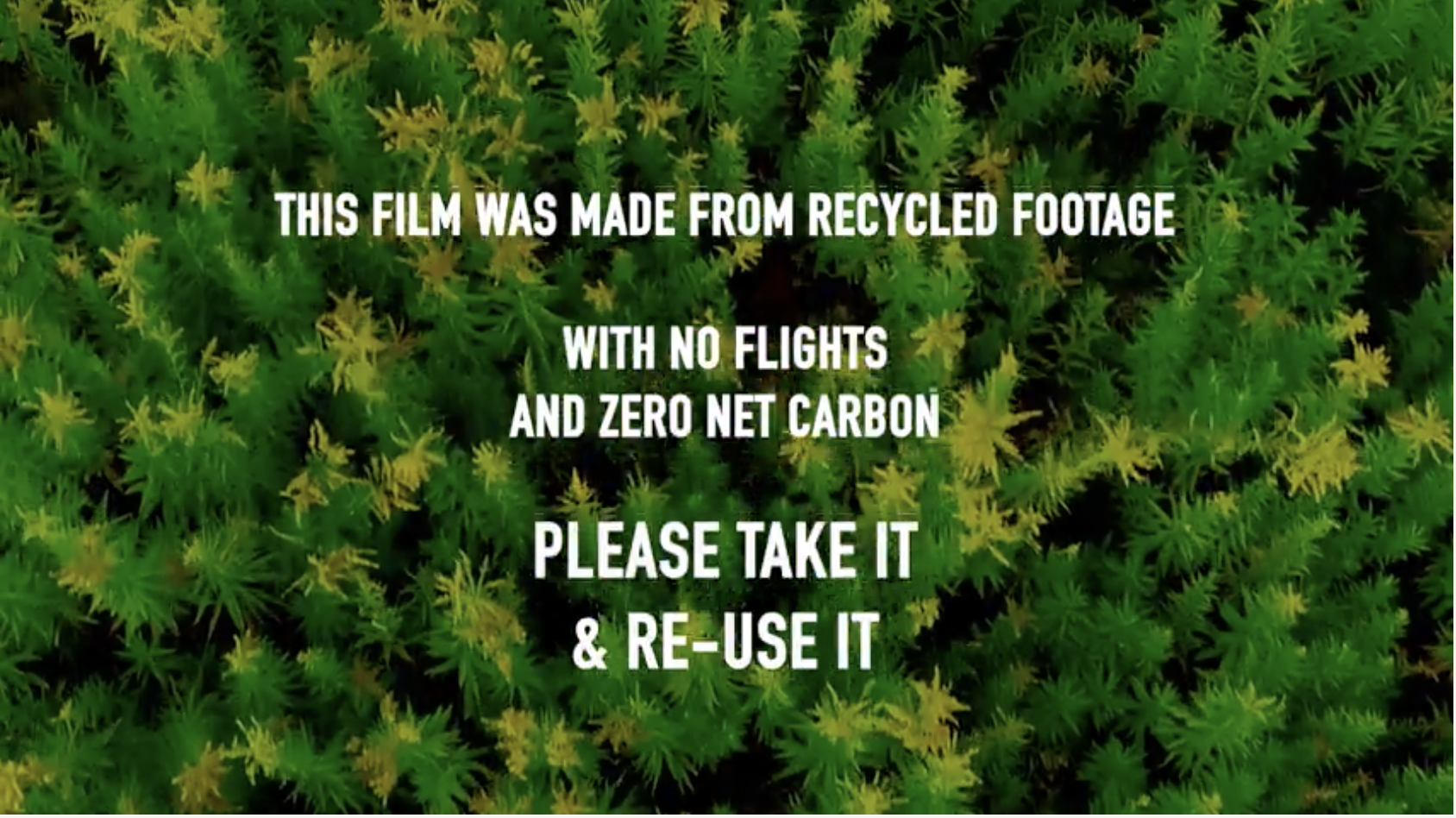
NatureNow ends with a statement directly addressing image-use and its perceived consequences. Over an aerial view of a green forest an all-caps text reads: “This film was made from recycled footage/with no flights/and zero net carbon”. After a brief delay two additional lines of text appear, urging the viewer to “please take it & re-use it” (Figure 4). The text betrays a particular view of material and immaterial media qualities. It suggests that although some image-production has a negative environmental cost, image recycling, re-use, appropriation and sampling does not. This is implicitly tapping into the false trope of digital media as “immaterial” and therefore without harmful consequences to the environment. The footage used in the film is presumably lifted—or recycled—from internet sources and it is thus directly dependent on material objects like servers and computers that use a great deal of energy.

When proposing evolutionary metaphors like a survival of the fittest for understanding the staying-power of certain images over time, Mitchell (2005: 85–86) suggested that “images” are akin to species, whereas “pictures” are like organisms whose kinds are given by the species. The picture is seen as an individual member of an image-species, distinct, material and anchored in a particular time and place. This distinction between an immaterial travelling visual idea, and the (relatively) fixed, materialised and specific object directly relates to the juxtaposition between the circulation of the activist video footage and its message of species extinction. When considering the use of the montage in conveying the overt message of the video, Muybridge’s Animal Locomotion series carries out a complex set of functions. They evoke nostalgia for what has become extinct while simultaneously pointing to the staying-power of the same. The presence of these historical images in present-day visual culture makes Muybridge’s images convenient stand-ins for endangered or extinct species—the images embody the hope that these species too will survive and multiply over time—but the black-and white format and the way these images are recognised as belonging to the history of photography and film also suggests that these are historical species belonging not to the present but to the past.
The transmediation of Muybridge’s images in NatureNow also highlights different ways in which images and ecology are connected. On the one hand, there is the issue of how ecology is represented and depicted; on the other, the idea that images are metaphorically embedded in systems that can be compared to ecologies. Importantly, however, these two types of image-ecology connections also implicate one another since the production, distribution and consumption of images often have concrete ecological implications. The montaged images in the video are clearly images of ecology, but the implicit link between environmental ecology and image culture—an ecology of images (Ross, 1994: 329) —is significantly more complex and not overtly acknowledged. The late nineteenth century, the era in which Muybridge’s photographs originated, was a significant period for both image-circulation and environmental destruction. It is during the last quarter of the nineteenth century that rampant industrialisation, urbanisation, and the drive towards faster modes of transport and increased efficiency laid the groundwork for the type of environmental destruction Monbiot and Thunberg hope to counteract. Printing technologies like halftone, offset printing, and new photographic methods developed and enabled images to spread more widely and rapidly. The study of animal and human locomotion was a hot topic during this period, in large part motivated by the drive to reduce energy-waste and increase efficiency among factory workers and athletes (Doane, 2002; Corwin, 2003). The view of the human or animal as a machine is part of a similar set of attitudes and ideologies that enabled large-scale exploitation of workers and the planet’s resources. The activists’ use of Muybridge’s motion studies to point to ecological abundance therefore comes with a number of complex and at times contradictory associations: these images overtly stand for what has been lost (a large number of animals), but they are also implicated in that loss because of the world view they promoted (an instrumental view of nature). By stressing the importance of image circulation and social networks, the transmedial movement of images (Muybridge’s included) is presented as a solution to a problem which such movement helped cause in the first place: advertising and the voracious production of goods and the instrumental views of both nature and workers that are tied to this production. The use of Muybridge’s motion studies in this context can thus be seen to highlight—by both undermining and underlining—the visual argument and the overt message of the video.
This paradoxical function is most probably something that most viewers of the video would not perceive—or particularly care about—but I suggest that this instance of transmedial movement and transformation is meaningful in ways that go far beyond the direct purpose of using Muybridge’s images to support a straight-forward message about environmental activism. In contrast to the tattooing project where the transmedial potential of Muybridge’s images and their technologies of display are important to understand the project’s underlying interests, the activists seem less concerned with such savvy references to media theory. Yet, the video nevertheless makes use of the images in ways that line up with and reinforce specific ideas that relate to the way film montage has been theorised historically; qualities and ideologies of late-nineteenth century image-culture; as well as present-day ideas about image circulation and connectivity.
It’s alive!
The tattooing project and the activist video evoke different versions of the notion of living images, but when a short GIF of Muybridge’s horse was used in an experiment in synthetic biology, this idea is taken far more literally. In the example I mentioned at the outset, scientists at Harvard Medical School used DNA to store and transmit image data of a Muybridge galloping horse in order to test a brand-new medium that is literally alive.
Just as in the other two instances of present-day uses of Muybridge’s motion studies, transformations and relations between different media are key here. The Harvard experiment made use of what had originated as glass plate photographs that eventually became digitised, animated and made available on Wikimedia commons. This digital animation was then transposed into another technical medium, bacterial DNA, a process that was then communicated through a number of visual objects.

The reader of a scientific text is expected to actively work with its images in ways that go beyond other types of viewing (Elkins, 2008: 6ff). The Nature article that explained the Harvard experiment included images that convey measurable data that can be used for calculations, and to understand, repeat or test the results of the experiment. To the initiated reader these image-elements provide a great deal of information. For example, the image referred to as “Figure 3” in the article, is made up of eight different image-components, numbered “a”-“h” (Figure 5).[xi] The black markings and the numbers on the left of each row in composite “e” communicate the sample depth and corresponding quality of the horse image after it has been transferred through the DNA of E. coli bacteria, showing the same five frames in each row, but in varying degrees of accuracy. The numbered squares placed on the larger image in composite “a” show the “pixet protospacer” of one such image: a sampling of a pixel-set of nine out of the entire grid of 26 x 36 pixels in a given frame. The protospacer sequence tells the scientists which position and colour (i.e. which shade of grey) should be assigned to each pixel within that set: information necessary to reconstruct the image after it has been extracted from the DNA.
Richard Dawkins (1989: 189–201) famously coined the term “meme” in 1976 to describe an idea, behaviour or style that spreads from person to person within a culture, thus directly linking the staying-power of cultural phenomena to biological genetic and viral processes. Since then, the terms “meme” and “viral” have become commonplace to describe images that spread rapidly online.[xii] The 2017 experiment in synthetic biology showed that the storage system used by bacterial cells to save information about invading viruses could also be used to store other things, such as a short digital image-sequence. This reuse of Muybridge’s images—whether incidental or not—highlights common metaphors of image virality as well as various interlocking elements of media practices over time. The persistent use of the genetic metaphor has affected how rapid spread and continued circulation of images are understood—particularly the way these processes are perceived as uncontrollable and potentially dangerous.[xiii] Linguists (Lakoff and Johnson, 2003; Kövecses, 2010) point out that persistent metaphors are rarely innocent or accidental; a successful metaphor taps into, brings to light, and reinforces an already existing set of correspondences between target and source terms. However, the typical metaphorical movement—the use of something known and concrete to help understand something abstract—is reversed in this case since the Harvard scientists created images that were literally viral. They thereby help adjust, reinforce and draw attention to the metaphor of viral image spread and the idea of images as somehow alive.
An illustration of the accuracy of this viral transmission can be found in various articles about the experiment in the daily press (Kolata, 2017; Sample, 2017). A split-screen GIF shows two versions of the short looped digital sequence of Annie G. galloping: on the left the “Original Image” and on the right “Image Reconstructed from Bacteria” (Figure 6). The side-by-side comparison makes clear that there is a certain amount of inaccurately placed pixels in the reconstructed image, but since both videos are highly pixelated, it also draws attention to the fact that both are digital mediations of the Muybridge sequence. The visibility of this pixel grid—the technical infrastructure of any digital medium—can also be compared to the gridded background in Muybridge’s motion study images. According to Marta Braun (1997: 170), Muybridge began using these after being asked to do so by artists who wished to use the photographs to replace life-studies. The gridded background also conjured the so-called “Lamprey grid” devised by contemporary anthropologist J.H. Lamprey, and carries implications for an instrumental and objectifying view of the depicted subjects (Brown, 2005; Braun, 2013; Smith, 2013). The grid—present in the scientists’ rendering both in the pixelated structure of the side-by-side images, and in the presentation of composite “e” in Figure 3 in the Nature article—is therefore itself a medium with historical and ideological significance.[xiv] The grid can be considered alongside the discussion in the previous section about obsessions with efficiency and objectifying views of humans and animals at the time of the production of the motion studies. Although far from an explicit reference, to those with specific cultural-historical knowledge the connection between the raster of regular lines and such historically anchored ideologies is clear.
A different gridded structure has been used by artists at least since the Renaissance as a tool to depict the world, or to copy and resize existing images. The most well-known depiction of this is Albrecht Dürer’s Draughtsman Making a Perspective Drawing of a Reclining Woman (ca 1600) (Figure 7). The wood-cut shows an artist meticulously at work capturing a nude model by using a gridded screen as a tool for translating the model onto the similarly gridded paper in front of him. My suggestion here is that transmedial elements of the Harvard experiment, and mediations of it, evoke connections to a much longer history of image-making and transmission. In the seventeenth century as well as in the twenty-first, the accuracy of copying, depiction, or transmission is tied to the presence of a gridded structure in, or behind, the image. In that sense, present-day uses of Muybridge’s images are embedded in, as well as conceptually reinforcing, connections between these various media conditions and associated ideas about how images are produced and reproduced.[xv]

https://www.shipmanlab.org/research. The GIF was also included in the online version of The Guardian science-section, 13 July, 2017:
https://www.theguardian.com/science/2017/jul/12/scientists-pioneer-a-new-revolution-in-biology-by-embeding-film-on-dna

In a much-quoted passage from his book An Anthropology of Images, art historian Hans Belting (2011: 10), described how images “colonize our bodies (our brains), so that even if it seems that we are in charge of generating them, and even though society attempts unceasingly to control them, it is in fact the images that are in control.” By transmitting a short digital film through genomes, the Harvard experiment provokes associations with the human body as a technological device, and thus Muybridge’s images activate questions about our understanding of image transmission, the notion of virality of images, and what a medium is and can be. One future application of this technology is to use DNA as recording devices to observe and record what cells are doing in the body in order to identify causes and cures when something goes wrong.[xvi] At the time of writing this, some four years after the Harvard experiment, wide-spread conspiracy theories about microchips in the Covid19-vaccine show how such ideas take on different form in response to new events, but that they feed on similar views of living bodies as battle grounds for surveillance, image spread and issues of control or lack thereof.
Conclusion
In this essay I have considered three different instances where historical photographic images have been used in recent visual culture. In each case there were more or less clearly stated intentions of the image-use: creating a set of attractive tattoos and linking them through a digital animation; convincing a large number of people of the urgency of environmental destruction in order to bring about a change in behaviour; and testing the accuracy of transmitting data through DNA, respectively.
My first example showed how the use of Muybridge’s images in a tattoo-to-GIF project activates media theory by way of various medial transformations, and that this reuse highlights what happens between these media, and how one technical medium is inferred and implicated by others. The next example highlighted how the insertion of Muybridge’s motion studies into a video montage in an environmentalist activist video enacts a complex negotiation between different theoretical positions relating to ecology of, and in, images. Here the use of Muybridge’s images points to the multifaceted relationship between the production and consumption of images and environmental damage, and to the way image cultures and the history of particular images are part of complex economic and conceptual structures. My final example showed Muybridge’s images hard at work addressing a number of present-day questions and concerns relating to technology, virality and the body as medium. Here the use of the motion studies activates associations connected to current and historical devices and technologies used for accurate depiction of the world and the bodies within it. These different present-day uses of the same historical image-set have been shown to carry out theoretical work related to image mediation both explicitly and implicitly. Explicit references can be likened to quotations, where an image points directly to a set of widely recognisable meanings and associations. Implicit references have dominated the discussion; these are references that are not obviously engaged in activating media theory, but are nevertheless shown to subtly function this way. In part these different activations of Muybridge’s historical images can be attributed to the complex understanding of media that is part of present-day visual culture. But these functions are also in part attributed to specific qualities associated with Muybridge’s motion study images: the fact that these specific images are highly mediated and theorised entities within visual culture, and the particular historical conditions of their production and mediation, means that they have come to have significant theoretical potential. In that sense, Muybridge’s motion studies are simultaneously specific historical markers and more general interlocutors and catalysts in present-day discussions and debates about virality, the political power of image spread, and how old and new media are understood to be embedded in one another.
It is worth acknowledging the perhaps obvious fact that I have considered media objects that can be designated “photographic” only in an extended sense of this term. Muybridge’s motion studies originated as photographic pictures, but their reuse in the second decade of the twenty-first century is anything but straight-forwardly photographic in a medial, technical or formal sense. Joana Zylinska (2016: 8) noted that “[t]he plethora of activities in which photographs are involved” tend to be approached in one of two ways: either as a distinct object, rooted in the methodology of art history where it is analysed in aesthetic and semiotic terms; or else from a more contextual perspective where photography as a social practice is the focus. In the latter, neither formal elements of the photographic object, nor how people take and make photographs are the main focus, but rather what people do with these. As a challenge to the dichotomy between the photograph as an aesthetic object and photography as a social activity, Zylinska (2016: 11) proposes the term “photomediation” by combining the terms photomedia and mediation, thus simultaneously stressing a variety of different technical-material aspects of photography as well as the process of mediation. In the three cases studied in this essay, processes of mediation are largely inseparable from the aesthetic or figurative content of the images that go through this mediation: discrete visual objects generate meaning that is intertwined with the social activity involved in their creation and spread. I have suggested that all three instances of Muybridge reuse draw attention to the workings of their own technical-material conditions and their processes of mediation: that they are images on-the-move, embedded in innumerable intricate relationships to other images, photographic and otherwise.
Rather than attempting to establish the precise reasons why individuals decided to use these particular images in these specific instances, my focus has been how the images function, how they activate and generate complex theoretical functions when they are reused. My suggestion is that their continued use—their retained value and potency in a present-day “iconomy” (Smith, 2006: 1–2)—may indeed be tied to their potential to carry out such operations. Muybridge’s images are well-known and have been around for a long time. It is tempting to conclude that such “iconic” (Hariman and Lucaites, 2011) images will continue to be referenced in the future. But we know that this is not necessarily the case; that images that are frequently circulated and referenced in one era are often forgotten in another. The reason to use Muybridge’s motion studies rather than another set of images in an environmental activist video, a science experiment or a tattooing project, may be a deliberate attempt to tap into their history and the associations that come with their many previous mediations. The fact that Muybridge’s motion studies are recognisable goes some way to explain why they continue to be transmediated, but what the analysis of the three examples discussed in this essay shows is also how these mediated images have the ability to draw attention to, and make sense of, questions and concerns of present-day media theory. Muybridge’s motion studies have been used in various academic and vernacular contexts to exemplify different things; they have been linked to film-history and longue-durée practices of animation and as containing the seeds of digital media practices. They represent the beginning of something as well as the end of something. They evoke nostalgia for what is gone, but they also point to their own status as ever-present and tokens of survival; they have decidedly analogue material medial associations but also evoke circulation and reproduction in digital environments. The three different examples analysed in this essay, use, abuse and diffuse established meanings of Muybridge’s images while also, at times gently and at times assertively, adding their own.
References
Ball, R. (2008) ‘Oldest Animation Discovered in Iran’, Animation Magazine, 12 March. Available at: https://www.animationmagazine.net/features/oldest-animation-discovered-in-iran/ (Accessed: 7 January 2022).
Barnes, S. (2016) ‘10 Artists Who Use Animation to Create Tattoos in Motion – Scene360’, 28 September. Available at: https://scene360.com/art/98629/motion-tattoos/ (Accessed: 13 December 2021).
Belting, H. (2011) An Anthropology of Images: Picture, Medium, Body. Translated by T. Dunlap. Princeton: Princeton University Press.
Bolter, J.D. and Grusin, R. (2003) Remediation: Understanding New Media. Cambridge, Mass.: MIT Press.
Braun, M. (1997) ‘The Expanded Present: Photographing Movement’, in Thomas, A. (ed.) Beauty of Another Order: Photography in Science. New Haven, CT: Yale University Press in association with the National Gallery of Canada, Ottawa.
Braun, M. (2010) Eadweard Muybridge. London: Reaktion Books (Critical lives).
Braun, M. (2013) ‘Muybridge, Authorship, Originality’, Early Popular Visual Culture, 11(1), pp. 41–51.
Brenthel, A. (2016) The Drowning World: The Visual Culture of Climate Change. Lund: Lund University (PhD Dissertation).
Brown, E.H. (2005) ‘Racialising the Virile Body: Eadweard Muybridge’s Locomotion Studies 1883-1887’, Gender & History, 17(3), pp. 627–656.
Bruhn, J. and Schirrmacher, B. (2021) ‘Chapter 1: Intermedial studies’, in Bruhn, J. and Schirrmacher, B. (eds) Intermedial Studies: An Introduction to Meaning Across Media. London: Routledge, pp. 3–27. Available at: https://doi-org.ezp.sub.su.se/10.4324/9781003174288.
Corwin, S. (2003) ‘Picturing Efficiency: Precisionism, Scientific Management, and the Effacement of Labor’, Representations, 84(1), pp. 139–156.
Danius, S. (2000) Prousts Motor. Stockholm: Bonnier (Bonnier Essä).
Danius, S. (2002) The Senses of Modernism: Technology, Perception, and Aesthetics. Ithaca (N.Y.): Cornell University Press.
Dawkins, R. (1989) The Selfish Gene. New ed. Oxford and New York: Oxford University Press.
Demos, T.J., Scott, E.E. and Banerjee, S. (eds.) (2021) The Routledge Companion to Contemporary Art, Visual Culture, and Climate Change. New York: Routledge.
Doane, M.A. (2002) The Emergence of Cinematic Time: Modernity, Contingency, the Archive. Cambridge, Mass: Harvard University Press.
Doodle: Eadweard J. Muybridge’s 182nd Birthday (2012). Available at: https://www.google.com/doodles/eadweard-j-muybridges-182nd-birthday (Accessed: 15 April 2018).
Dvořák, T. (2021) ‘Beyond Human Measure: Eccentric Metrics in Visual Culture’, in Photography off the Scale: Technologies and Theories of the Mass Image. Edinburgh: Edinburgh University Press, pp. 41–60. Available at: https://ebookcentral-proquest-com.ezp.sub.su.se/lib/sub/detail.action?docID=6562642.
Eisenstein, S. (1977) ‘The Cinematic Principle and the Ideogram [1929]’, in Leyda, J. (tran.) Film Form: Essays in Film Theory. New York: Harcourt, Brace & World (A Harvest book, 153), pp. 28–44.
Elkins, J. (2008) Six Stories from the End of Representation: Images in Painting, Photography, Astronomy, Microscopy, Particle Physics, and Quantum Mechanics, 1980-2000. Stanford, Calif: Stanford University Press.
Elleström, L. (2010) ‘The Modalities of Media: A Model for Understanding Intermedial Relations’, in Elleström, L. (ed.) Media Borders, Multimodality and Intermediality. Basingstoke: Palgrave Macmillan, pp. 11–48.
Eppink, J. (2014) ‘A Brief History of the GIF. So Far’, Journal of Visual Culture, 13(3), pp. 298–306. DOI 10.1177/1470412914553365.
Ernst, W. (2011) ‘Media Archaeology. Method and Machine versus History and Narrative of Media’, in Huhtamo, E. and Parikka, J. (eds.) Media Archaeology: Approaches, Applications, and Implications. Berkeley, Calif.: University of California Press, pp. 239–255. Available at: http://public.eblib.com/choice/publicfullrecord.aspx?p=769730 (Accessed: 9 November 2017).
Ernst, W. (2015) ‘Media Archaeology as such. Alliances and differences to archaeologies proper’, Journal of Contemporary Archaeology, 2(1), pp. 15–23.
Ernst, W. (2018) ‘Radical Media Archaeology (its epistemology, aesthetics and case studies)’, Artnotes. E-journal on Art, Science and Technology, 21(Thematic issue Media Archaeology), pp. 35–43.
Fuller, M. (2005) Media Ecologies: Materialist Energies in Art and Technoculture. Cambridge, Mass: MIT Press.
Gitelman, L. (2006) Always Already New: Media, History and the Data of Culture. Cambridge, Mass: MIT Press.
Green, D. and Lowry, J. (2006) Stillness and Time: Photography and the Moving Image. Brighton: Photoworks.
Green, D. (2006) ‘Marking Time: Photography, Film and Temporalities of the Image’, in Green, D. and Lowry, J. (eds.) Stillness and Time: Photography and the Moving Image. Brighton: Photoworks, pp. 9–21.
Hawkins, E. (2014) Horse in Motion -EH84-. Available at: http://horseinmotion.eh84.com/ (Accessed: 15 December 2021).
Herbert, S. (no date) Muy Blog « Muybridge News and Comment. Available at: https://ejmuybridge.wordpress.com/ (Accessed: 2 September 2018).
Higgins, H. (2009) The Grid Book. Cambridge, Mass: MIT Press.
Hill, P. and Herbert, S. (1998) ‘Eadweard Muybridge and the Kingston Museum Bequest’, Film History, 10(1), pp. 98–107.
Hornby, L. (2017) Still Modernism: Photography, Literature, Film. New York, NY: Oxford University Press.
Huhtamo, E. and Parikka, J. (eds.) (2011) Media Archaeology: Approaches, Applications, and Implications. Berkeley, Calif.: University of California Press. Available at: http://public.eblib.com/choice/publicfullrecord.aspx?p=769730 (Accessed: 9 November 2017).
Kloss, S.T. (2020) ‘Indelible Ink: An Introduction to the Histories, Narratives, and Practices of Tattooing’, in Kloss, S.T. (ed.) Tattoo Histories: Transcultural Perspectives on the Narratives, Practices, and Representations of Tattooing. New York: Routledge (Routledge studies in cultural history, vol 81), pp. 3–30.
Kolata, G. (2017) ‘Who Needs Hard Drives? Scientists Store Film Clip in DNA’, The New York Times, 12 July. Available at: https://www.nytimes.com/2017/07/12/science/film-clip-stored-in-dna.html (Accessed: 6 September 2018).
Kosut, M. (2014) ‘The Artification of Tattoo: Transformations within a Cultural Field’, Cultural Sociology, 8(2), pp. 142–158.
Kövecses, Z. (2010) ‘What is Metaphor?’, in Metaphor: A Practical Introduction. Oxford: Oxford University Press, pp. 3–15. Available at: https://ebookcentral-proquest-com.ezp.sub.su.se/lib/sub/detail.action?docID=535440. (Accessed: 17 May 2017).
Lakoff, G. and Johnson, M. (2003/1980) Metaphors We Live By. Chicago: University of Chicago Press.
Leibovici, F. (2014) ‘An Ecology of Artistic Practices’, in Calonje, T. (ed.) Live Forever: Collecting Live Art. London: Koenig Books, pp. 57–71.
Hariman, R. and Lucaites, J.L. (2011) No Caption Needed: Iconic Photographs, Public Culture, and Liberal Democracy. Chicago, Ill.: Univ. of Chicago Press.
Manghani, S. (2013) Image Studies: Theory and Practice. London and New York: Routledge.
Meech, S. (2014) Knitted Horse Firework | Knit Numerique. Available at: http://knitting.smeech.co.uk/knitted-horse-firework/ (Accessed: 17 January 2022).
Mitchell, W.J.T. (2005) What Do Pictures Want?: the Lives and Loves of Images. Chicago: University of Chicago Press.
Mustill, T. (2019) Greta Thunberg and George Monbiot film on the climate crisis. Guardian News: http://www.grippingfilms.com. Available at: https://www.youtube.com/watch?v=-Q0xUXo2zEY (Accessed: 16 February 2021).
Muybridgizer: Create Your Own Muybridgized Images! (2010). Available at: https://www.tate.org.uk/press/press-releases/tate-launches-muybridgizer-app-iphone (Accessed: 16 April 2018).
Nooney, L. and Portwood-Stacer, L. (eds.) (2014) ‘Special Issue on the Internet Meme’, Journal of Visual Culture, 13(3).
Paley, N. (2015) ‘Horse Quiltimation’, Nina Paley, 30 April. Available at: https://blog.ninapaley.com/2015/04/29/horse-quiltimation/ (Accessed: 17 January 2022).
Panizza Cutler, I. (2009) ‘RihannaxSK’, Vogue Italia, Supplemento (709).
Parikka, J. (2012) What is Media Archaeology? Cambridge, UK; Malden, MA: Polity Press.
Rajewsky, I.O. (2005) ‘Intermediality, Intertextuality, and Remediation: A Literary Perspective on Intermediality’, Intermédialités, 6, pp. 43–64.
Ross, A. (1994) ‘The Ecology of Images’, in Bryson, N., Holly, M.A., and Moxey, K. (eds) Visual Culture: Images and Interpretations. Hanover: University Press of New England [for] Wesleyan University Press, pp. 325–346.
Røssaak, E. (2010) The Still/Moving Image: Cinema and the Arts. Saarbrücken: LAP Lambert Academic Publishing.
Saatchi & Saatchi New Creators Showcase (2013) Just for Hits – Richard Dawkins. Available at: https://www.youtube.com/watch?v=GFn-ixX9edg&feature=youtu.be (Accessed: 18 February 2021).
Sample, I. (2017) Harvard scientists pioneer storage of video inside DNA | Science | The Guardian, theguardian.co.uk. Available at: https://www.theguardian.com/science/2017/jul/12/scientists-pioneer-a-new-revolution-in-biology-by-embeding-film-on-dna (Accessed: 22 September 2018).
Sampson, T.D. (2012) Virality: Contagion Theory in the Age of Networks. Minneapolis: University of Minnesota Press.
Scorsese, M. (2021) Pretend it’s a City: Episode 5, Department of Sports and Health [streaming]. Netflix. Available at: netflix.com.
Shipman, S.L. et al. (2017) ‘CRISPR–Cas encoding of a digital movie into the genomes of a population of living bacteria’, Nature, 547, pp. 345–349.
Siegert, B. (2015) Cultural Techniques: Grids, Filters, Doors, and Other Articulations of the Real. Translated by G. Winthrop-Young. New York: Fordham University Press.
Smith, S.M. (2013) ‘Chapter 3. The Space Between: Eadweard Muybridge’s Motion Studies’, in At the Edge of Sight: Photography and the Unseen. Durham: Duke University Press, pp. 75–98.
Smith, T. (2006) The Architecture of Aftermath. Chicago: University of Chicago Press.
Solnit, R. (2004) River of Shadows: Eadweard Muybridge and the Technological Wild West. New York: Penguin.
Solon, O. (2013) ‘Richard Dawkins on the internet’s hijacking of the word “meme”’, Wired UK, 20 June. Available at: https://www.wired.co.uk/article/richard-dawkins-memes (Accessed: 12 February 2021).
Sontag, S. (1977) On Photography. New York: Dell Pub. Co.
U2 (1993) U2 – Lemon (Official Music Video). Available at: https://www.youtube.com/watch?v=KEcx9F_FW2U (Accessed: 17 January 2022).
‘Wikimedia Commons: Category: Eadweard Muybridge Animations’ (no date). Available at: https://commons.wikimedia.org/wiki/Category:Eadweard_Muybridge_animations (Accessed: 17 January 2022).
Zylinska, J. (2016) ‘Photomediations: An Introduction’, in Kuc, K. and Zylinska, J. (eds.) Photomediations: A Reader. Open Humanities Press, pp. 7–17.
Notes
[i] This article is part of a larger study that examines how photographic motion studies from the late-nineteenth and early twentieth century have been used in different contexts over time. Work on this text was made possible by funds from the Swedish Research Council and Anna Ahlström och Ellen Terserus stiftelse. I want to thank Allegra Lord, PhD, Cellarity, Cambridge MA and Assistant Professor Sonya Petersson at the Department of Culture and Aesthetics at Stockholm University for valuable comments on this text.
[ii] For an overview of the range of Muybridge-related references in writing and visual culture, see Stephen Herbert’s “Muy Blog” (Herbert, no date): a blog entirely dedicated to Muybridge’s work and references to it. Homages and references to Muybridge’s motion studies appeared as soon as the images were shown to the public. In this text I focus on the 2010s, but in a forthcoming article I discuss artistic practices in the 1960s and 70s and their use of Muybridge’s and Étienne-Jules Marey’s work. Many connections can be drawn between post-war artistic references and the examples discussed in this essay, however there are also important differences. Pop- and conceptual artists used references to existing images by evoking and manipulating their perceived associations in ways that are characteristic of art practices of the era. Two out of the three examples in this essay have very different explicit reasons for their image appropriation. The tattooing project is more similar to art and film projects that use Muybridge as an explicit reference, but the project itself is not part of an art world context.
[iii] The term “motion studies” is used in this text to refer images from the different stages of Muybridge’s depictions of animals and humans in motion. He began his work under the auspices of Leland Stanford in California in 1872, in 1884 he continued this work at the University of Pennsylvania, publishing the subscription-based portfolio Animal Locomotion in 1887.
[iv] This raises the delicate question of agency, to which I cannot do justice within the limited space of this essay. It is worth acknowledging, however, that in an absolute and literal sense, images can of course not theorise anything, it is we—human actors—who create images and it is we who endow them with both meaning and power. When I suggest that these images have an ability to carry out media theoretical work, I mean simply that they have come to function—for us— in this way.
[v] My use of the term “technical media” lines up with what Jørgen Bruhn and Beate Schirrmacher (2021: 17) in a recent publication call “technical media of display”, defined as “the very material bases of mediation [that] provide access to […] media products.” Bruhn and Schirrmacher take their definition from Lars Elleström (2010: 30) who defined a technical medium as “any object, physical phenomenon or body that mediates in the sense that it ‘realizes’ and ‘displays’ basic and qualified media.”
[vi] For a collection of GIF animations based on Muybridge’s own images, see (‘Wikimedia Commons: Category: Eadweard Muybridge Animations’, no date). Sam Meech’s knitting project was, according to the artist’s website, done for the 2013 Crystallize show, and was made up of a knitted work 28 stitches x 4878 rows, resulting in an animation made from 272 frames, 11 seconds duration, 13 metres length.
[vii] The fire-effect on the word “GIF” can possibly be understood in light of the “burn all GIFs” movement of the late 1990s (Eppink: 300). If considered in that context, the meme refers to the long history of GIF technology in order to argue against copyright infringement of its use.
[viii] Scene360 refers to another online article (Ball, 2008) that describes the vase as an early example of an animation. This article includes an illustration of the effect of the jumping goat.
[ix] This taps into a broader discussion of still and moving media, and challenges to clear-cut distinctions between them. See for example (Danius, 2000, 2002; Doane, 2002; Green and Lowry, 2006; Røssaak, 2010; Hornby, 2017).
[x] Photography theorist David Green (2006: 12) has described another set of associations that come with the montage: “the restlessness of the city street finds its direct analogy in the relentless movement of the film, in the fluidity of the camera and the rapid spatial transitions of montage.” In other words, film and the fast-paced montage evoke and even repeat qualities of the urbanisation that, with hindsight, can be seen to contribute to the environmental destruction that is the topic of the activist video.
[xi] Three “Figures,” were included in the Nature article with eight additional images placed at the end of the text, designated “Extended Data Figures”. In the context of scientific articles, the standard term for an image-element is “figure”; terminology such as “image”, “illustration” or “picture” is generally not used.
[xii] Dawkins (Saatchi & Saatchi New Creators Showcase, 2013; Solon, 2013) has described how the internet “hijacked” his terminology and attached it to a partly different phenomenon. When he came up with the term it was to describe something analogous to genetic replication, but internet memes are caused by very deliberate manipulation by human creativity. I use these terms in a way that is aligned with this “hijacked” or broader sense. For more on memes, see The Journal of Visual Culture special issue on the topic: (Nooney and Portwood-Stacer, 2014).
[xiii] For an in-depth discussion of how virality and contagion are tied to threats of danger as well as to affective and desire-based processes of imitation, see Sampson, 2012.
[xiv] For more on the grid as medium, or cultural technique, see Siegert, 2015, and for a meditation of the grid by way of ten grids that changed the world, see Higgins, 2009.
[xv] For more on the grid in Muybridge’s images and their connection both to the grid of land-surveying and the type of grids used to copy drawings, see Solnit, 2004: 194–195.
[xvi] In the New York Times description of the Harvard experiment (Kolata, 2017), this method was described as “analogous to the black boxes carried by airplanes whose data is used in the event of a crash”.
Sara Callahan is an art historian specializing in Modern and Contemporary Art. She works at Stockholm University and she recently published Art + Archive: Understanding the Archival Turn in Contemporary Art with Manchester University Press in their series “Rethinking Art’s Histories”. Sara currently works on a book project that investigates how photographic motion studies from the late-19th and early 20th century have been used in different contexts over time.
Email: sara.callahan@arthistory.su.se
Leave a Reply