

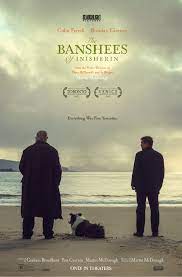

The Banshees of Inisherin and the fixation on Irishness
SEAN PHELAN
Massey University, Wellington, Aotearoa New Zealand
In the general, but far from universal, praise bestowed on The Banshees of Inisherin after its commercial release in October 2022, most reviewers felt compelled to mention the film’s own vague references to the Irish Civil War – as if interpreting the film as an oblique commentary on the conflict between the war’s pro- and anti-Treaty sides might give the otherwise absurd plotline, and the violent breakdown in the friendship between Pádraic (Colin Farrell) and Colm (Brendan Gleeson), a more profound meaning. The connection was often made tentatively. The Guardian’s Peter Bradshaw (2022) suggested the allegory is “offered to us on a take-it-or-leave-it basis”, with many reviewers seeming to take it, even when not quite sure why. The hesitancy did not, thankfully, foreclose an open-ended appreciation of the film, unlike one comically reductive assessment of the Civil War connection that critiqued it for not discussing “the Treaty terms” (Farrell, 2023). The same review in Socialist Voice (the official newspaper of The Communist Party of Ireland) lambasted writer-director Martin McDonagh for ignoring history and the working lives of people on the Aran Islands in 1923, wondering if a combination of the profit motive, and the desire for awards glory, might have inhibited him from offering a more partisan account of the Civil War that reflected “actual sensibilities during this time”.
The hollowness of the film’s billing as a Civil War metaphor was dissected, more authoritatively, in a widely circulated article in Slate magazine by Mark O’Connell (2023). The argument was made as part of a general critique of the film’s hammed up Irishness: its seeming delivery of a barrage of stock tropes, stereotypes, and visual motifs that, from its opening scenes, screams: “Hold on to your flat caps… Here comes Ireland”. O’Connell pegs his dislike of the film’s idioms to a wider reappraisal of McDonagh’s work as a playwright and filmmaker, especially its deployment of signifiers of “Irishness” that, “as McDonagh knows as well as anyone”, have always “had an uneasy relationship with the actual country and the people who live in it”. O’Connell is damning in his assessment of the efficacy of the Civil War metaphor, because “as a political allegory, it seems obviously retrofitted, tacked onto the narrative to add unearned resonance”. It prompts a withering dismissal of McDonagh’s oeuvre as “expertly crafted light entertainment passing itself off, sometimes almost convincingly, as provocative, serious art”.
O’Connell acknowledged that his Irishness mediates his assessment, no different from how my own Irishness (including twenty years of bona fide emigrant Irishness) mediates my own response to the film and the commentary around it. In fact, we might say the primary object of analysis in O’Connell’s essay was not so much the film The Banshees of Inisherin, but rather the enigmatic existential condition called “Irishness”, to the extent that the former becomes a vessel for ruminating on the abundant and debased meanings of the latter. Here, O’Connell’s piece takes an unfortunate step early on by informing the magazine’s primarily American readership (who “might be surprised to learn” this) that the collection of people who actually live in the country “do not include” McDonagh, who was born in London and raised by parents from the west of Ireland. Signposting the biographical detail has the effect of suggesting a boundary marker between authentic and inauthentic notions of Irishness, which the sub-editor then dramatizes in a headline titled “Blarney” and a sub-title reference to “the put-on Irishness of Martin McDonagh”. O’Connell is too thoughtful a writer to have any truck with some crass essentialist notion of national identity which might exclude the London Irishness of McDonagh. Nonetheless, his symptomatic commentary (which chimes with how other reviewers and audiences responded to the film in Ireland and elsewhere) invites the question: what if the fixation on Irishness, which predictably went into overdrive during the 2023 Hollywood awards season, obscures a richer reading of the film that might find more resonances in a European philosophical archive than any distinctly Irish source? And, in a world of commodified national identities and cultures, how might the aversive response to the stylized Hiberno-English idioms illuminate some of the neuroses of a sophisticated contemporary Irishness (let’s call it the Ireland of Normal People) that mainly sees a collection of antiquated, even offensive stereotypes?
O’Connell is not off track when, if we ignore the note of condescension, he describes the film as an “enjoyably perverse parable about self-determination [that] is closer to Kafka than, say, Synge or Seán O’Casey”. Yet, the thought goes nowhere – like it is already stifled by the assumption that the troll-like qualities of McDonagh’s work (The Financial Times famously dubbed him “the Quentin Tarantino of the Emerald Isle” in the 1990s (Feeney, 1998)) forgo the need for much philosophical reflection or elaboration. The abrupt breakdown in the friendship between Pádraic and Colm, which takes shape in the opening minutes of the film, initially seems to be contextualized by little more that Colm’s child-like observation that “he doesn’t like” Pádraic anymore. Yet, if we read the film on metaphysical terms which are displaced by the semiotic preoccupation with Irishness, maybe Colm’s break from Pádraic might be given a clear philosophical rationale. That may allow to us reframe the film as a critique of the hubristic and violent elements of a European intellectual tradition, a reading that both resonates with specific concerns about Irish sovereignty, but hardly signifies a uniquely Irish theme (as those in McDonagh’s birth country surely know better than anyone).
The ambivalent responses of Irish audiences to The Banshees of Inisherin was hardly surprising, given how it seems to restage a Hollywood representation of Ireland with a long oppressive history. Isobel Harbison (2023) suggests McDonagh released “into the world the most comprehensive collection of Irish stereotypes in contemporary cinema”. She concludes that the film’s nine Oscar nominations (albeit no awards) illustrates the Academy’s penchant for consecrating “the domestic Hollywood version of other cultures it has long created”. The headline of an Irish Times article by Hugh Linehan (2023) flags a similar story, juxtaposing the film’s international acclaim with the savvier assessment of a cultural insider: “Yes, The Banshees of Inisherin is up for 10 Baftas. But is it just more Martin McDonagh shtick”?
These criticisms show how the conflict between tradition and modernity continues to be a primary frame for assessing cultural artefacts billed as “Irish”. That conflict may, as Joe Cleary (2007) suggests in his 2007 book Outrageous Fortune: Capital and Culture in Modern Ireland, offer a drastically simplified frame for understanding how Irish society (not to mind Irish capitalism) has developed over time. Nonetheless, its thematic authority endures, and perhaps most tellingly among Irish audiences keen to exhibit the modernity of their own intellectual credo in the international market for culture. It is also discernible in the responses of international sophisticates who congratulate themselves for “seeing through the Blarney”. Even that bastion of post-colonial theory, The Telegraph, can signal its cultural literacy on all things Irish by priming its conservative readership with the headline “Why the Irish hate The Banshees of Inisherin”.
Ever since his spectacular emergence onto the international theatre scene in the 1990s, assessments of McDonagh’s work have been tied to the image of him as an exemplary post-modern writer who relishes the blurring of the modern and the traditional, the rural and the urban. In the Lennane trilogy of plays that established his reputation, his work was defined by its violent and comical subversion of some of the dour cliches of an Irish naturalist literary tradition, perhaps sometimes leaving the impression (even among admirers) that transgression might offer its own sufficient artistic justification. To those less enamoured by McDonagh, these hand-me-down perceptions offer the materials for a confident takedown of his work in 2023, now that enthusiasts for something called “the post-modern” are few and far between. The term has become, over time, a more straightforward pejorative for a hollowed out, opportunistic identity, bereft of meaningful political or ethical commitments, rather than an affirmative descriptor of how a particular cultural inheritance might be reworked or reimagined. It pairs with a stereotypical persona that McDonagh sometimes cultivates himself in promotional media appearances, as when he suggested – in a Variety magazine conversation with Taylor Swift (Setoodeh, 2022) – that the shocking self-mutilation scene in The Banshees of Inisherin was included because “I don’t know. I thought it was just funny”.
It is not hard to hear the echo of these unflattering post-modernist stereotypes in Linehan’s criticism that the film was rendered “facile” and “nihilistic” by the same “cartoonish act of self-mutilation”. However, if we think about how that moment might be interpretively squared with the rest of the film, maybe it might uncover a different reading, which restages the conflict between tradition and modernity, but from a horizon that would be better described as European or transnational rather than specifically Irish. Thus, much like the characters’ own seeming indifference to the events of the Irish Civil War, perhaps we might cultivate a stronger appreciation of the film’s allegorical power if we “leave” rather than “take” the Civil War metaphor: that is, see its underdevelopment as part of a deliberate artistic craft that is anticipating viewers’ need for a naturalistic meditation on Irishness and Irish history.
It would be a mistake to encase the meaning of the film in a rigid philosophical framework, let alone assume some heavy-handed causal link where everything will make sense once the film’s publicists belatedly unveil a densely scribbled copy of Being and Time. However, perhaps the trajectory of the conflict between Colm and Pádraic is best read as a lurid parable about the history of modern European philosophy. Colm’s initial decision to break from Pádraic seems made for interpretation through different philosophical sources. We might see it as the action of the prototypical Enlightenment subject: asserting his sovereign right to carve out an autonomous self-governing identity free from the tedium and inanity of their previous everyday rituals. Or we might see Colm’s quest for an authentic existence free from listening to the “bollocks” and “idle chatter” of Pádraic as enacting distinctly Heideggerian themes, steered by the assumption that the only possibility of a meaningful life – “before he staves off the inevitable” – must necessitate a radical break from a life of wasting time with his former friend.
The film’s attention to the domestic settings and arrangements of its two principal characters also invites interpretation through Heidegger’s notion of “dwelling” (Wheeler, 2020), a term signifying human beings’ struggle to find an existential grounding in the world while confronting the fact of their finitude and mortality. This theme is overtly expressed in the contrast between the cosmopolitanism of the gramophone, theatrical masks, and art objects on display in Colm’s home and the seeming primitivism of the domestic space Pádraic shares with his sister, Siobhán (Kerry Condon), who has to repeatedly berate him for letting the donkey into the house, as well as explain herself for reading a “sad” book. It is evoked more profoundly in the madness animating Colm’s striving for an authentic life defined on his own absolutist terms and in the fate of one of the dwellings near the end of the film,
For critics of the film, the self-mutilation scenes illustrate the dilettantish qualities of McDonagh’s work: an aesthetic that delights in its own shock value. However, perhaps Colm’s ludicrous acts of self-harm might be productively read as a macabre allegory for the violent telos of a European story of self-determination which, in its most monstrous colonial and fascistic forms, inscribed an image of human sovereignty with no effective limit. This perspective gives a rather different shade to the Heidegger allusions, who is more vividly remembered today for his affiliation to the Nazi party (and subsequent refusal to talk about that affiliation) than his critique of modernity. Colm’s quest for a more authentic life is ultimately undone by the inauthenticity of its foundational gesture, of demanding an absolute expunging of Pádraic from the web of interdependent relations that shape their communal interactions.
Conversely, maybe we might discern a more redemptive vision of planetary dwelling in the reconfiguration of the domestic space occupied by Pádraic at the end of the film, in images that – to a human-centric gaze – might initially seem rather abject. He is both profoundly alone, because of his beloved Siobhán’s migration to “the mainland”. Yet also not alone because all the surviving animals, who he cares for deeply, have moved into the house with him. Moments like this suggest a film that might have something much more profound to say about the relationship between humans and animals than it has about Irishness. The theme of inter-species solidarity is augmented, in turn, by a heightened alertness to the nature of human interdependency in the film’s denouement, symbolized by the hint of an affirmative exchange between Pádraic and Colm that is expressed through their shared love of animals (and we might add: in marked difference to the parish priest, who says God couldn’t care less about the violence done by humans to animals). The hand of friendship is offered once more by Colm, in contrast to his recoil at the same gesture by Pádraic earlier in the film; perhaps his earlier mockery of Pádraic’s homage to “niceness” as the supreme human virtue now registers differently. We end with an image of Colm taking in the vista of the ocean in front of him: alone and unmoored from his dwelling, but affirmative enough to compose a tune (and an Irish-inflected tune at that, for, even in his wish to break from the deadening weight of his traditional rituals with Pádraic, Colm’s aspirations for a modern way of being never excludes a parallel love of traditional Irish music, fiddle playing and balladeering).
This brief explication of the film’s philosophical resonances may seem like “cod philosophy” (Critchley, 2018), even if McDonagh’s identification of Terrence Malick as his “favorite film director” (O’Toole, 1998) suggests some fascinating genealogical connections: Malick travelled to Germany to meet Heidegger in the 1960s and produced a scholarly translation of Heidegger’s Vom Wesen des Grundes (The Essence of Reasons) in 1969 (Sinnerbrink, 2010). The point here has been to simply highlight how a metaphysical appreciation of the film is obscured by the fixation on Irishness, or at best expressed in vague commendations of the film’s universal themes. The critiques of O’Connell and Harbison are again illustrative, in how their understandable sensitivity to an exoticized representation of Ireland impedes other ways of perceiving the film. O’Connell begins his essay with a rich description of the images of landscape at the start of the film: like “a thousand ads for Irish tourism…once beautiful, unique, and irredeemably cliché”. What the impression of sensory overload misses, as I missed myself when I first saw the film, is the accompanying song and soundtrack: The Ensemble of the Bulgarian Republic’s beautiful rendition of Polegnala E Todora (Theodora Is Dozing). On reflection, it was as if I spent the first thirty minutes internalizing the assumption that I had to respond to a proposition about Irishness. I was so primed and ready to deliver a knowing critique of the “stage Irish” imagery that my capacity to perceive a different kind of theatrical staging was impaired. Likewise, Harbison’s critique of a gendered stereotype of “exhausted, subservient women rendered immobile by the weight of their shawls” is surely too one-dimensional, especially when we take in the strikingly modern (and presumably anachronistic) images of women singing and drinking in the local pub. It also does an injustice to the character of Siobhán, both in the assuredness of her own modern aspirations and literary interests, and the forceful authority of how she confronts the maddening reasons and reasoning of different male characters.
Ultimately, both the acclaim and controversaries generated by the film tell a straightforward story about the commodification of Irishness and Irish artistic culture, where the question of whether people appreciate the film or not can be hard to disentangle from conscious and unconscious perceptions of how well they think it represents or authenticates the desired national “brand”. McDonagh may be justifiably accused of trading in Irishness. But, if that’s the case, he’s hardly the only one, and he’s as entitled to do so as any of the rest of us. McDonagh has produced a serious work of art that is not without political resonances or commitments, or untouched by sincere love for the landscape of Ireland and the culturally distinct ways of being of its now many different peoples. How well it holds up as a work of art and work of cinema, beyond the Hollywood hype, will be better judged by others. But we should judge it on artistic merits that – yes – find one grounding in conversations about Irishness, but hardly the only one.
References
Bradshaw, P. (2022). “The Banshees of Inisherin review – a Guinness-black comedy of male pain,” The Guardian. Available at https://www.theguardian.com/film/2022/sep/05/the-banshees-of-inisherin-review-martin-mcdonagh (accessed 11 December 2023)
Cleary, J. (2007). Outrageous fortune: Capital and culture in modern Ireland. Dublin:
Field Day Publications.
Critchley, S. (2002). “Calm – On Terrence Malick’s The Thin Red Line,” Film Philosophy, 6(1), https://www.euppublishing.com/doi/epub/10.3366/film.2002.0023
Farrell, J. (2023). “The Banshees of Inisherin,” Socialist Voice. Available at https://socialistvoice.ie/2023/02/the-banshees-of-inisherin/ (accessed 11 December 2023)
Feeney, SJ (1998). “Martin McDonagh: Dramatist of the West,” Studies: An Irish Quarterly Review Vol 87, No. 345, pp. 24-32.
Harbison, I. (2023). “The Banshees and the Quiet Girl,” LRB blog. Available at https://www.lrb.co.uk/blog/2023/february/the-banshees-and-the-quiet-girl (accessed 11 December 2023)
Linehan, H. (2023). “Yes, The Banshees of Inisherin is up for 10 Baftas. But is it just more Martin McDonagh shtick?,” The Irish Times. Available at https://www.irishtimes.com/culture/2023/01/20/yes-the-banshees-of-inisherin-is-up-for-10-baftas-but-is-it-just-more-martin-mcdonagh-shtick/ (accessed 11 December 2023).
O’Connell, M. (2023). “Blarney: The Banshees of Inisherin and the put-on Irishness of Martin McDonagh,” Slate. Available at https://slate.com/culture/2023/01/martin-mcdonagh-irish-banshees-inisherin-blarney.html (accessed 11 December 2023).
O’Toole, F. (1998). “Martin McDonagh by Fintan O’Toole,” Bomb. Available at https://bombmagazine.org/articles/martin-mcdonagh/ (accessed 11 December 2023)
Power, Ed. (2023). “Why the Irish hate The Banshees of Inisherin”, The Telegraph. Available at https://www.telegraph.co.uk/films/0/banshees-inisherin-backlash-why-do-irish-hate-martin-mcdonaghs/ (accessed 11 December 2023).
Setoodeh, R. (2022). “Taylor Swift, Film Director, in Conversation With Martin McDonagh: How They Brought Heartbreak to Life,” Variety. Available at https://variety.com/2022/film/features/taylor-swift-director-all-too-well-hearbreak-martin-mcdonagh-1235456137/ (accessed 11 December 2023)
Sinnerbrink, R. (2006). “A Heideggerian Cinema? On Terrence Malick’s The Thin Red Line,” Film Philosophy, 10 (3), pp. 26-37.
Wheeler, Michael (2020). “Martin Heidegger”, The Stanford Encyclopedia of Philosophy. Fall 2020 Edition, Edward N. Zalta (ed.), Available at https://plato.stanford.edu/archives/fall2020/entries/heidegger. (accessed 11 December, 2023).
 Sean Phelan is an Associate Professor at the School of Communication, Journalism and Marketing, Massey University, Wellington, Aotearoa New Zealand
Leave a Reply