

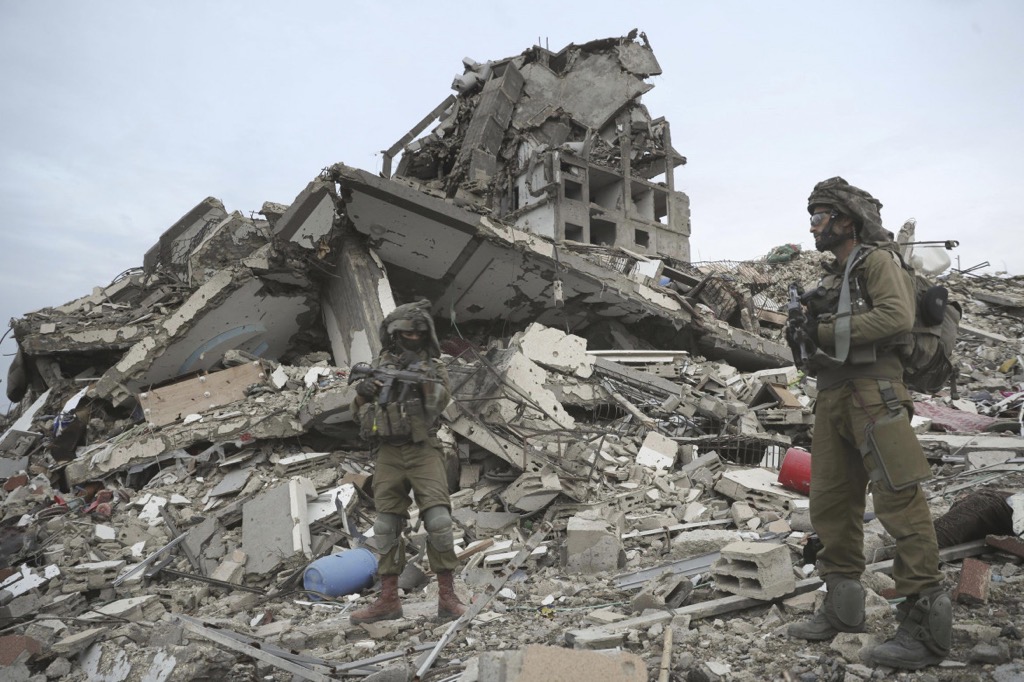
Gaza – the streets, the buildings, many of the people – no longer exists. Virtually all destroyed and wiped out by the Israeli occupation forces and one of the most powerful war machines in the world. Gaza has been occupied directly or indirectly by Israel for decades. Everyone entering and leaving the Strip is under the management of the colonial power, even building materials, medicines and medical supplies, food, water, electromagnetic waves for communications, and the banking and financial system (now frozen by the Israeli government). Everything, including land registers and birth and death records, is in the hands of the Israeli government in Jerusalem. In the last few weeks, it has gone from being the world’s largest open-air prison to the world’s largest desecrated cemetery.
This is the violence of colonialism. There is no other explanation. As of 7 October, nothing commenced. That was about a brutal escape from the Israeli prison, matured over more than 75 years of colonization and continuous oppression. So, there is a history of Palestine that is also the history of Europe and of the constant denial of our responsibility.
Centuries and centuries of European anti-Semitism have been dumped in the so-called Middle East (itself a European colonial invention), discharged in the Arab world, first offered as a space by the British empire to a group of European Jews, later sanctioned by the righteous guilt over the Shoah. And then sealed by the refusal of European countries, after the Second War, to take in Jewish refugees who had survived the extermination.
But in this way, Europe has solved nothing; it has merely shirked its responsibility by burdening the Palestinians, again in a colonial gesture, with carrying its burden and shame. From the centuries of anti-Semitism and the Shoah, it seems that Europe has learned nothing except to repeat the mantra of an emptied memory. Translated over the past 70 years into unconditional support for the State of Israel, in the end, it is Europe and the West that created Hamas and the tragedy that is unfolding in Gaza and maturing under military rule in the West Bank.
It is we who have produced and sustained the colonial system that has enabled our appropriation of the planet, with the present practices and policies of Israel representing the height of brutal, blatant, and shameless colonialism. It is now a rogue state out of control even by its American master. However, despite its anachronism, it is part of the same grammar of white European settlements that terrorized and massacred the indigenous in the Americas, Australia, and New Zealand with ethnic cleansing and massacres of natives.
This disturbing and embarrassing historical-political combination also explains why, with each passing week, despite the massacres that continue and Israel’s refusal to respond to the demands of the International Court of Justice, the news fades from the front page, rendered marginal, to avoid upsetting the status quo too much and perhaps address the violence that guarantees our sovereignty.
What remains everywhere is the structure of violence that characterizes all colonial relations, both for the colonizer and the colonized. The racialization of the world – whereby some lives are worth more than others – allowed Europe to export this violence elsewhere, to non-European spaces, at least until the third decade of the last century and the shock of the Shoah, where for the first time these practices were exercised on European soil in a massive and industrial manner in the extermination camps on a part of the white European population.
Now, these stories return; they come back with the bodies of migrants that we have made anonymous, illegal, and less than human, and with the Palestinians and Muslims that we have reduced to the denial of the West and its values to justify our fear of the other and allow us to continue without taking responsibility for the world we have created.
Meanwhile, while our politicians continue to blather on about two states for two peoples – clearly impossible given how Israel has dissected and colonized the land to block any real possibility of territorial continuity for a hypothetical Palestinian state – both in Gaza and the Occupied Territories, and especially in the Palestinian diaspora, the art of survival has been translated and transformed into the survival of the arts: in poetry and literature, film and music, critical thinking. This poetics challenges and resists the politics of denial and death. It maintains and extends what Israel and the institutional voices of the West want to remain anonymous and voiceless.
In laying bare the obscene violence of the First World, all the hypocrisy of the West’s so-called moral values is revealed, now put to the test by the history of others who have suffered its arrogance: from Gaza to South Africa. The question of Palestine has become the laboratory of the modern world, where the untold story of the West persists and returns to meet its ghosts.
When a so-called democracy depends structurally on the denial of rights and the denial of democracy to others, we are at the limit of our assumptions and claims, both with regard to Israel in its confrontation with the Palestinians and with regard to the West and its relationship with the rest of the planet. And that is why we have to talk about Palestine every day. Both Palestinian lives and our future depend on this conversation. As Angela Davis said recently, ‘We must deposit our dreams in Palestine.’
An Italian version of this text was previously published at Il Manifesto: https://ilmanifesto.it/il-colonialismo-e-i-fantasmi-della-palestina
Iain Chambers is a writer and independent scholar. He previously taught Cultural, Postcolonial and Mediterranean Studies at the Oriental University in Naples, where he was director of the doctoral programme in Cultural and Postcolonial Studies in the Anglophone world. His research work is in different fields, including migration, music and the phenomena of identity in the Mediterranean. He is a member of the editorial boards of the journals Cultural Studies, Media & Philosophy and Postcolonial Studies and he is author, inter alia, of the books Mediterranean Crossings: The Politics of an Interrupted Modernity (Duke University Press, 2008).
Leave a Reply