
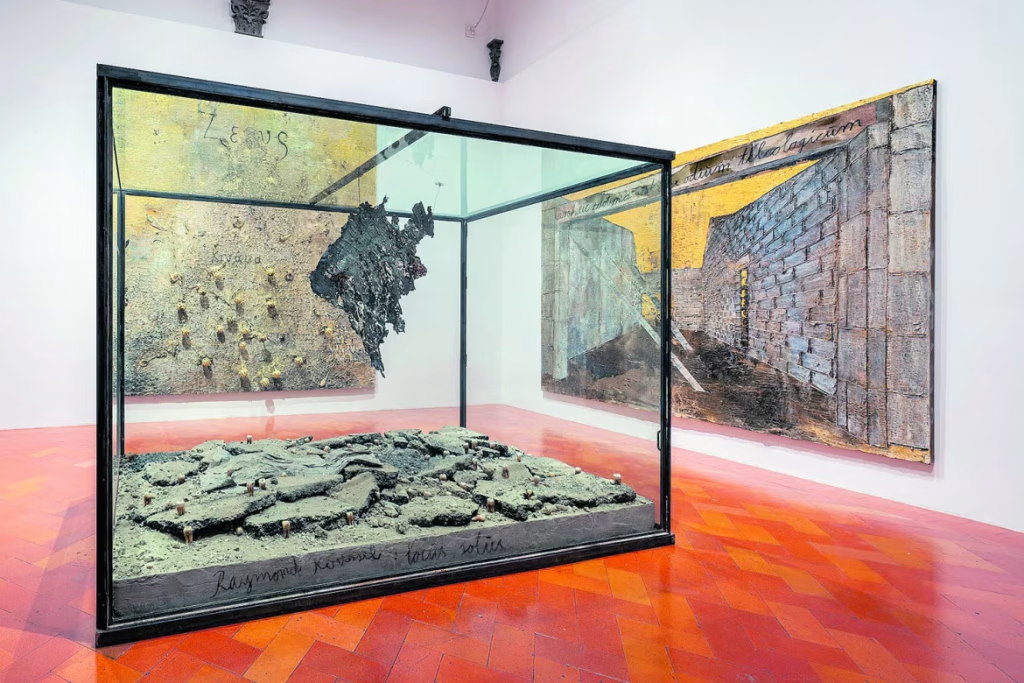
In a series of theatrical encounters, Gaza Ora. Messages From A Dear Friend, which is currently on tour in Italy, written by Hossam Madhoun, collected by Ruth Lass and Jonathan Chadwick and staged by London’s Az Theatre (a company with which Madhoun has collaborated for many years), the Palestinian author declared that ‘words have been disabled’. How can one write and speak about the world in a language full of stones, rubble and death? This is a question also posed by Paul Celan’s poetry of ashes that continues to haunt the works of contemporary German artist Anselm Kiefer as he confronts the atrocity of the Holocaust and the ruins of European history, which can be felt in the exhibition ‘Fallen Angels’, currently on show at Palazzo Strozzi in Florence. Kiefer’s art digs deep into the memory of the present, and not only that of Germany. It involves an artistic mourning that also connects us to the present-day immediacies of other genocides and denied rights.
The deadly landscapes of Europe and the Middle East, like the territories of the colonised world, together with today’s legal executions of migrants in the Mediterranean, are all, as the Lebanese artist Akram Zaatari once said, the ultimate archives. Against the obscene obscenity of extermination machinery and against European legislations seeking to punish or suppress migration from the Global South lies the Western and colonial framing of the world that decides who should live and who should die. Along the visual plane and through the musical elaboration of the world, we can arrive at another place. This, and involving the Palestinian oud player and singer Kamilya Jubran, who recently played in Naples, provokes another time-space that withdraws from and, at the same time, remedies the brutal political economy of the present. We are invited to look and listen again.
Touching the limits of language brings us to the edge of established reasoning pursuing the status quo. If we are dealing with crimes that ‘explode the limits of law’ and ‘surpass and break every legal system’ (Hannah Arendt), then numbed by Auschwitz and left speechless in Gaza we do not simply stare into the abyss; we also need to register our involvement. By rejecting the impositions of common sense and the media construction of reality, art can work to unearth lost connections and reopen the present to what has been buried, forgotten and abandoned. In an excess, even losing, of language that breaks the shackles of purely pragmatic communication, in Kiefer’s massive works that surpass our human pretensions, or in Kamilya Jubran’s sustained and suspended histories of experimental sounds, where an Arabic musical legacy is transposed in multiple paths from the past through the present into the future, we engage with unauthorised measures of time, space and life. Registering the ruined landscapes of the past (Kiefer) and translating and transforming the sounds of a poetic and musical tradition (Jubran), we can return with Akram Zaatari to what refuses to disappear.
Here, the confines of historical and sociological explanations are exceeded. The disciplinary protocols that reconfirm our subjectivity through presumptuous objectivity are undone and dispersed in a more worldly evaluation. Along this path, artists such as Kiefer, Zaatari, and Jubran come to the rescue of critical thinking. In their return to the past to repair the present, they uproot and redirect contemporary configurations to dismantle a suffocating consensus and propose other modernities, other Mediterraneans, others…
In this politically and climatically long hot summer, such art emerges from the ruined landscapes of colonial and fascist Europe, from the devastation of Palestine, and the deadly waves of the Mediterranean, requiring us to rethink ourselves as implicated subjects (Michael Rothberg, The Implicated Subject: Beyond Victims and Perpetrators, 2024). Art itself becomes an urgent exercise in historiography. Against the frozen figures of a past seemingly gone forever, we encounter images and sounds that are slippery, incomplete and always in formation, ready to unleash other histories, other geographies, other horizons of hope, to distort and queer the languages of self-affirmation.
Adding the recent films Bye Bye Tiberias (2023) by Lina Soualem, Where Olive Trees Weep (2024) by Maurizio Benazzo and Zaya Benazzo, and The Teacher by Farah Nabulsi (2023) allow us to open gaps in the narrative, to cross the fields and burnt books of history, the cremation of moral language and the scarred landscapes of memory to venture into sedimented histories that constitute the violent formation of the present. If, at this point, we arrive at the borders where everyday language fails and the angel of history falls from the ladder of reason, we can perhaps finally begin to take responsibility for the ruins and begin to build a renewed house in this understanding.
An Italian version of this text was previously published at Il Manifesto: https://ilmanifesto.it/se-le-parole-sono-disabilitate
Iain Chambers is a writer and independent scholar. He previously taught Cultural, Postcolonial and Mediterranean Studies at the Oriental University in Naples, where he was director of the doctoral programme in Cultural and Postcolonial Studies in the Anglophone world. His research work is in different fields, including migration, music and the phenomena of identity in the Mediterranean. He is a member of the editorial boards of the journals Cultural Studies, Media & Philosophy and Postcolonial Studies and he is author, inter alia, of the books Mediterranean Crossings. The Politics of an Interrupted Modernity (Duke University Press, 2008) and with Marta Cariello of the forthcoming The Mediterranean Question (Punctum Books 2025)
Leave a Reply